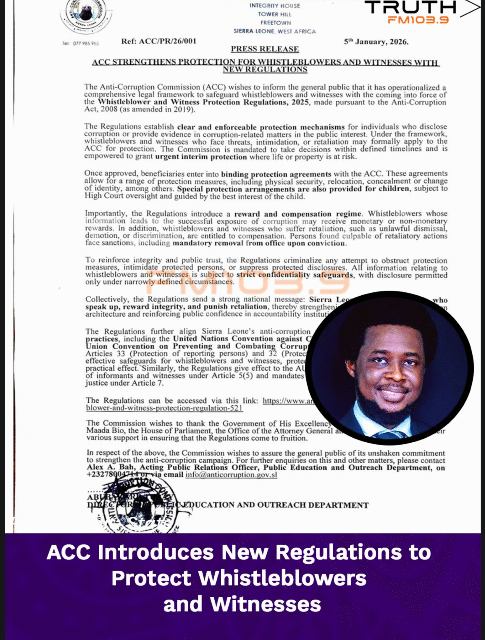
Freetown, 5th January 2026 — Sierra Leone’s Anti-Corruption Commission (ACC) has announced the enforcement of new Whistleblower and Witness Protection Regulations, 2025, designed to safeguard individuals who expose corruption or provide evidence in corruption-related cases.
The regulations, enacted under the Anti-Corruption Act of 2008 (amended in 2019), establish a comprehensive legal framework to shield whistleblowers and witnesses from threats, intimidation, or retaliation. According to the ACC, affected individuals can formally apply for protection, with the Commission mandated to act within defined timelines and empowered to grant urgent interim measures where life or property is at risk.
Key Provisions include:
Binding Protection Agreements: Beneficiaries will enter into agreements with the ACC, enabling measures such as physical security, relocation, or identity concealment. Special arrangements are available for children, subject to High Court oversight.
Compensation and Sanctions: Whistleblowers who suffer demotion or discrimination are entitled to compensation. Individuals found guilty of retaliatory actions face strict penalties, including mandatory removal from office upon conviction.
Reward System: The framework introduces incentives for those who report corruption, reinforcing accountability and integrity.
The ACC emphasized that the regulations send a strong message that Sierra Leone will protect those who speak up, reward integrity, and punish retaliation. The measures also align with international conventions, including: United Nations Convention Against Corruption (UNCAC): Articles 32 and 33 call for effective safeguards for witnesses and reporting persons and the African Union Convention on Preventing and Combating Corruption (AUCCC): Article 5(5) mandates protection for informants and witnesses, while Article 7 criminalizes acts that obstruct justice.
By operationalizing these protections, the ACC aims to strengthen Sierra Leone’s anti-corruption architecture and bolster public trust in accountability institutions. The regulations are publicly accessible via the Commission’s website at anticorruption.gov.sl (anticorruption.gov.sl in Bing).
The Commission expressed gratitude to stakeholders who supported the development of the framework and reaffirmed its commitment to safeguarding whistleblowers and witnesses as part of its broader fight against corruption.