Freetown, 6th November, 2026 – Sierra Leone has passed the Millennium Challenge Corporation’s (MCC) FY2027 scorecard, registering improvements across key governance, economic and social indicators in what the government has described as a significant step forward in the country’s development agenda.
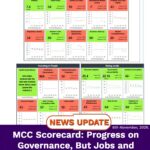
According to a statement issued by the Ministry of Information and Civic Education, Sierra Leone met 11 of the 22 indicators assessed under the MCC scorecard, up from nine indicators recorded the previous year.
The government said the country successfully met the mandatory requirements on Personal Freedom, Control of Corruption, and Government Accountability, benchmarks considered critical for assessing governance and institutional performance. The latest results come after the MCC expanded its scorecard framework from 20 to 22 indicators and introduced new measures covering economic freedom, governance and investment in people.
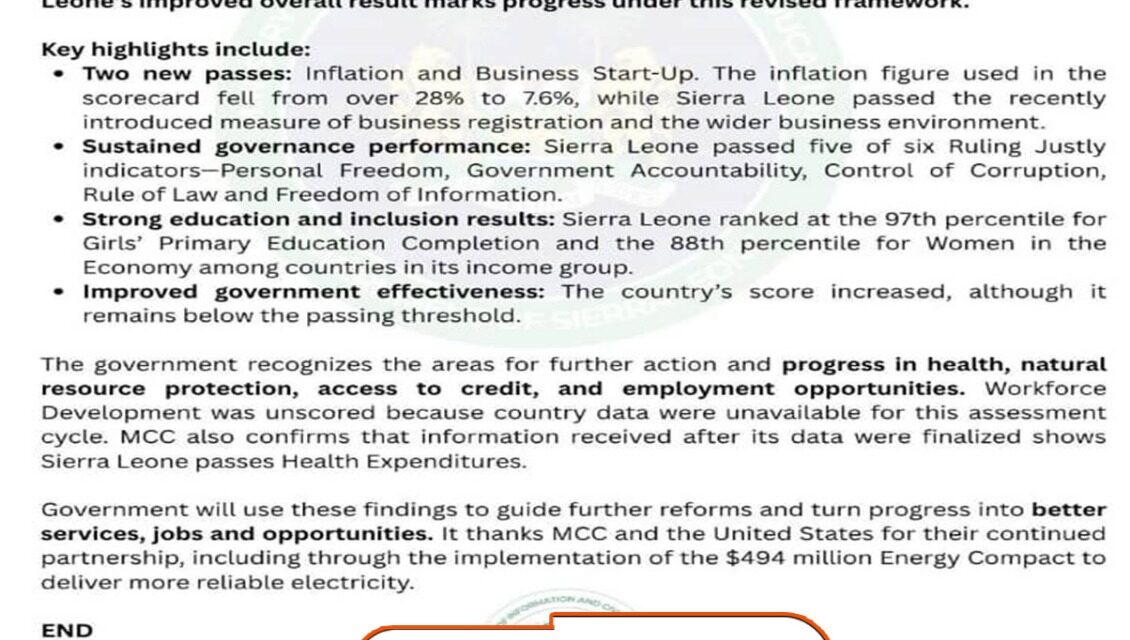
Among the most notable achievements was Sierra Leone’s performance in controlling inflation and improving the business environment. The inflation rate used in the assessment fell from more than 28 percent to 7.6 percent, while the country also passed the newly introduced Business Start-Up indicator, reflecting improvements in business registration processes and the wider investment climate.
The scorecard further highlighted strong performances in governance, with Sierra Leone passing five of the six indicators under the “Ruling Justly” category, including Personal Freedom, Government Accountability, Control of Corruption, Rule of Law and Freedom of Information.
In the social sector, the country posted strong results in education and gender inclusion. Sierra Leone ranked in the 97th percentile for Girls’ Primary Education Completion and the 88th percentile for Women in the Economy among countries within its income group. The government also reported progress in government effectiveness, although the indicator remains below the threshold required for a passing score.
The Ministry noted that challenges remain in areas including health, natural resource protection, access to credit and employment opportunities, adding that further reforms would be pursued to improve performance in those sectors.
According to the statement, workforce development was not scored during the assessment cycle because the required country data was unavailable at the time of evaluation. However, the government said information received after the assessment had been finalized shows that Sierra Leone now meets the benchmark for Health Expenditures.
The government attributed the improved performance to ongoing reforms under President Julius Maada Bio’s administration aimed at strengthening governance, stabilizing the economy and creating a more attractive environment for investment. Officials said the findings would guide future reforms geared toward translating policy gains into improved public services, jobs and economic opportunities for citizens.
The government also expressed appreciation to the MCC and the United States Government for their continued partnership, including support through the US$494 million Energy Compact, which is expected to improve electricity reliability across the country.