Freetown, 13th October 2026— The Independent Procurement Review Panel (IPRP) has dismissed a complaint filed by Tiwai Memory Masters Ltd challenging its technical evaluation score in the bidding process for the supply, installation, implementation and support of Government Wide Area Networks (GWAN) and Government Local Area Networks (GLANs) across Ministries, Departments and Agencies (MDAs).
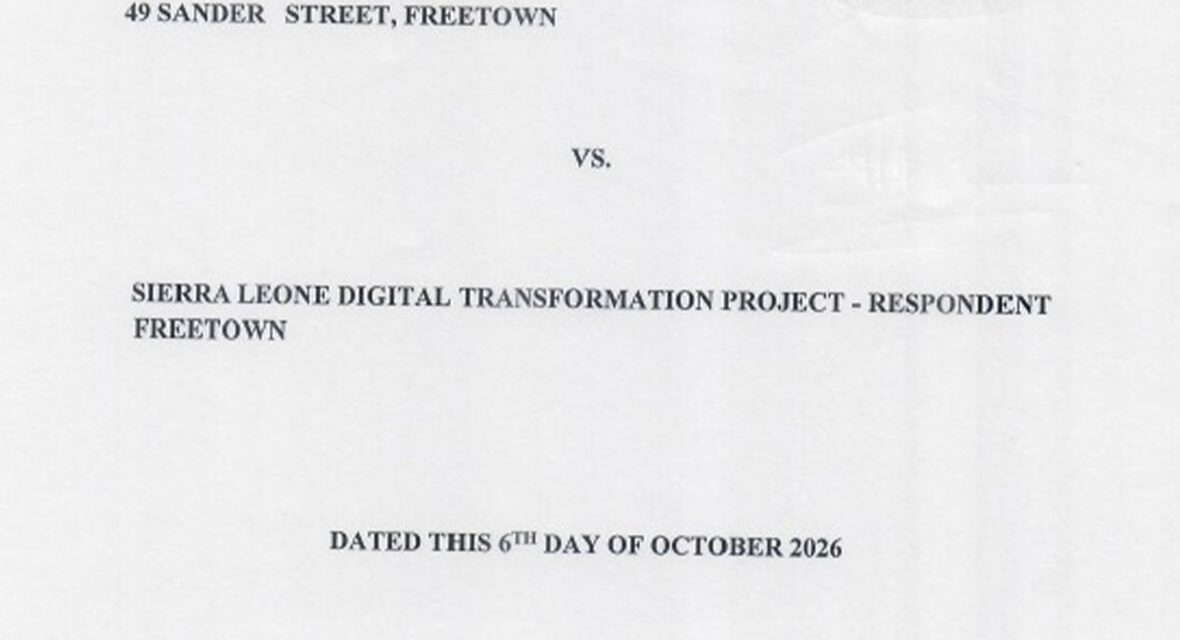
The ruling, dated 6 October 2026, arose from a request for redress submitted by the company under Section 65(1) of the Public Procurement Act, 2016, against the Sierra Leone Digital Transformation Project and the Ministry of Communication, Technology and Innovation. The company challenged the decision of the evaluation committee to award it a technical score of 88.86 percent during the procurement process.
According to the ruling, the procurement, funded through World Bank resources on behalf of the Government of Sierra Leone, relates to the nationwide deployment of government network infrastructure under Procurement Number SL-MOF 526879-NC-RFB. The Panel noted that it had jurisdiction to hear complaints from dissatisfied bidders under the Public Procurement Act.
The bid process began on 18 March 2026, with bids opened on 20 May 2026. Eight companies submitted bids, but only four advanced to the technical evaluation stage, including Tiwai Memory Masters.
The company argued that its own assessment of its submission indicated a score of 96 percent and complained that the procuring entity had failed to adequately explain how deductions were made to arrive at the final score of 88.86 percent. It further maintained that the evaluation team should have clearly identified specific deficiencies, applicable requirements, scoring bands and the exact marks deducted.
During hearings before the Panel, representatives of Tiwai Memory Masters alleged that their bid had been underscored on issues relating to technical factors, cybersecurity governance, qualifications and certifications, service arrangements, incident response planning, understanding of local implementation requirements and deployment methodologies for different categories of organisations.
The procuring entity rejected those claims and provided detailed explanations for the deductions. According to the ruling, the evaluation team cited inconsistencies in equipment references, contradictions within parts of the proposal, missing device information, gaps in network coverage plans and shortcomings in demonstrating how the proposed solutions would be implemented in Sierra Leone.
The respondent also pointed to what it described as generic security and high-availability plans, insufficient differentiation between deployment approaches for small, medium and large organisations, inadequate architecture details, and shortcomings in demonstrating regional network resilience. The evaluation team maintained that these issues justified deductions from full marks but did not amount to non-compliance with the bidding requirements.
Further concerns were raised over evidence provided for similar projects and the validity of professional certifications submitted for key personnel. The respondent argued that some certifications appeared expired or lacked proof of current validity, while aspects of project experience were not fully evidenced.
After reviewing written submissions and oral arguments from both parties, the Panel concluded that the technical evaluation had been conducted fairly and that the deductions applied by the evaluation committee were supported by deficiencies identified within the bidder’s own proposal.
The Panel also made observations regarding information contained in the curriculum vitae of one of the personnel presented by the complainant. According to the ruling, the Panel questioned a claim that an individual identified as Rashid Abu had been employed by the company for ten years, while also reportedly working for the Bank of Sierra Leone. The ruling stated that such a situation could not exist simultaneously in full-time capacities and described the matter as “tantamount to fraud” that should be stopped immediately.
In addition, the Panel criticised remarks allegedly made during the hearing by the complainant’s team lead, Mohamed A. Turay, stating that derogatory comments directed at both the respondent and the Panel were inappropriate and questioning the Panel’s integrity was unacceptable. The ruling noted, however, that its final decision was based solely on the evidence, oral submissions and applicable law.
In its final decision, the Panel confirmed the technical score of 88.86 out of 100 awarded to Tiwai Memory Masters and dismissed the complaint. It further lifted any suspension arising from the complaint, allowing the procurement process to proceed to the financial evaluation and contract award stages in accordance with the tender requirements and procurement regulations.
The Panel also ruled that Tiwai Memory Masters remains eligible to continue participating in the procurement process and directed the procuring entity to maintain a complete record of the complaint, review proceedings and final decision as part of the procurement file.