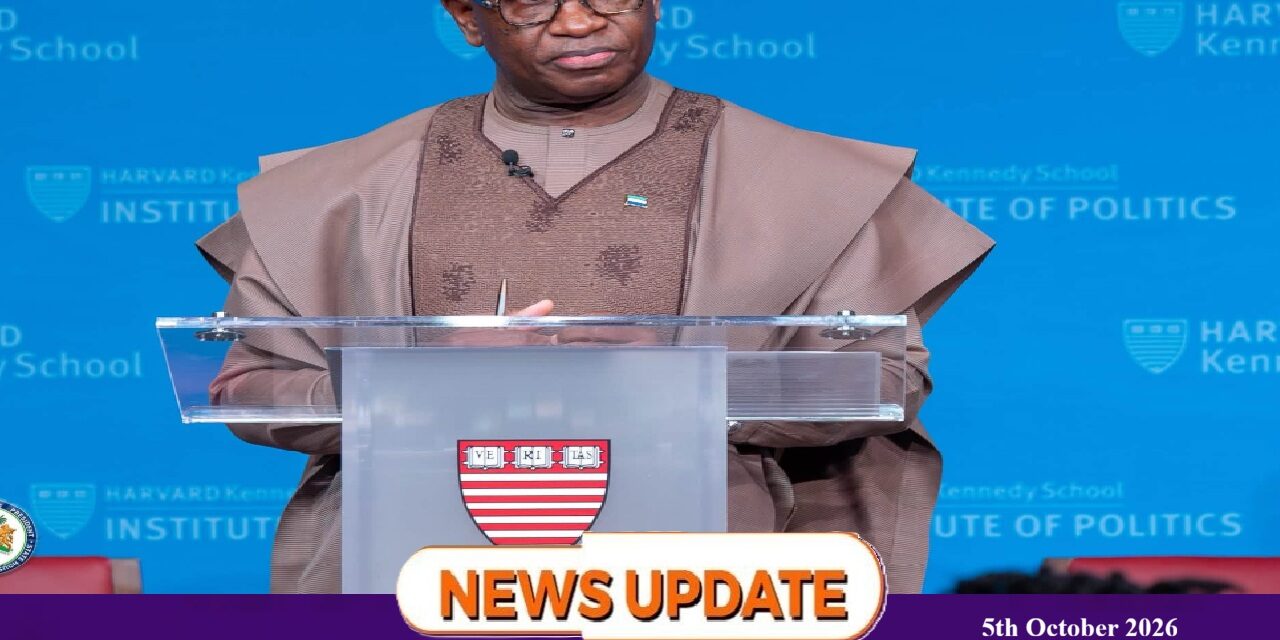
Freetown, 5th October 2026- President Julius Maada Bio has questioned efforts by developed countries to seek access to Africa’s critical minerals while simultaneously imposing barriers that limit educational opportunities for African students, arguing that the continent’s greatest resource is its people rather than its mineral wealth.
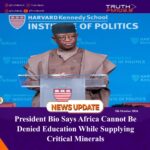
Speaking during an interview at the Harvard Kennedy School following a keynote address on “Africa in a Shifting Geopolitical Landscape: Leadership, Democratic Resilience and Strategic Choice,” Bio addressed ongoing discussions between Sierra Leone and the United States over critical minerals cooperation.
The President said that while minerals, artificial intelligence and other strategic resources dominate global discussions, human capital remains the continent’s most valuable asset.
“As I speak, we are engaged with the United States on critical minerals,” Bio told the audience. “For me, the most critical assets I have are people. We can talk about minerals, we can talk about AI and every other thing, but the most important asset given to us by God are people.”
Bio argued that Africa’s long-term development depends on expanding access to education and knowledge, warning that restrictions affecting opportunities for Africans to study abroad undermine the principles of mutual partnership often promoted by developed nations.
“I want education. I don’t want any limitation to where they get educated,” he said. “The continent wants to be able to get education everywhere else in the world so when you block us from having access to education and shared knowledge to make a better world, and yet you want access to our resources for free, that is difficult to reconcile.”
The remarks come against the backdrop of ongoing negotiations between Sierra Leone and the United States over a proposed Critical Minerals Agreement, an arrangement that has attracted growing public interest because of its potential implications for investment, trade and the country’s strategic mineral resources.
Bio’s comments appear to signal Sierra Leone’s intention to pursue a broader and more balanced approach to any future minerals partnership, one that extends beyond resource extraction to include opportunities for education, skills development and human capital growth.
The President’s position echoes his government’s long-standing emphasis on education as a development priority. Since taking office, Bio has consistently promoted investment in human capital through initiatives such as the Free Quality School Education programme, often describing education as the foundation for economic transformation.
His remarks also follow growing interest from Washington in Sierra Leone’s critical minerals sector.
In August, Ambassador-designate Daniel Travis told the U.S. Senate Foreign Relations Committee that Washington intended to use a range of engagement tools, including the Millennium Challenge Corporation (MCC), Development Finance Corporation (DFC) investments and broader bilateral relations to advance reforms that benefit American businesses.
The United States has increasingly identified Sierra Leone as an important strategic partner because of its mineral resources, which are considered critical for manufacturing and national security supply chains.
The Ministry of Information and Civic Education has previously confirmed that negotiations on a Critical Minerals Agreement are at an advanced stage, although no final agreement has yet been approved.