United Nations Headquarters, New York –22nd September, 2026
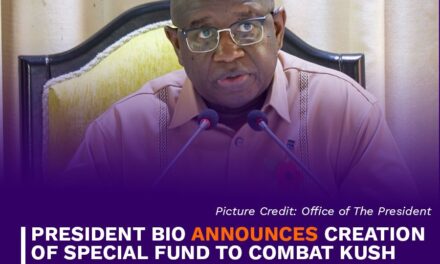
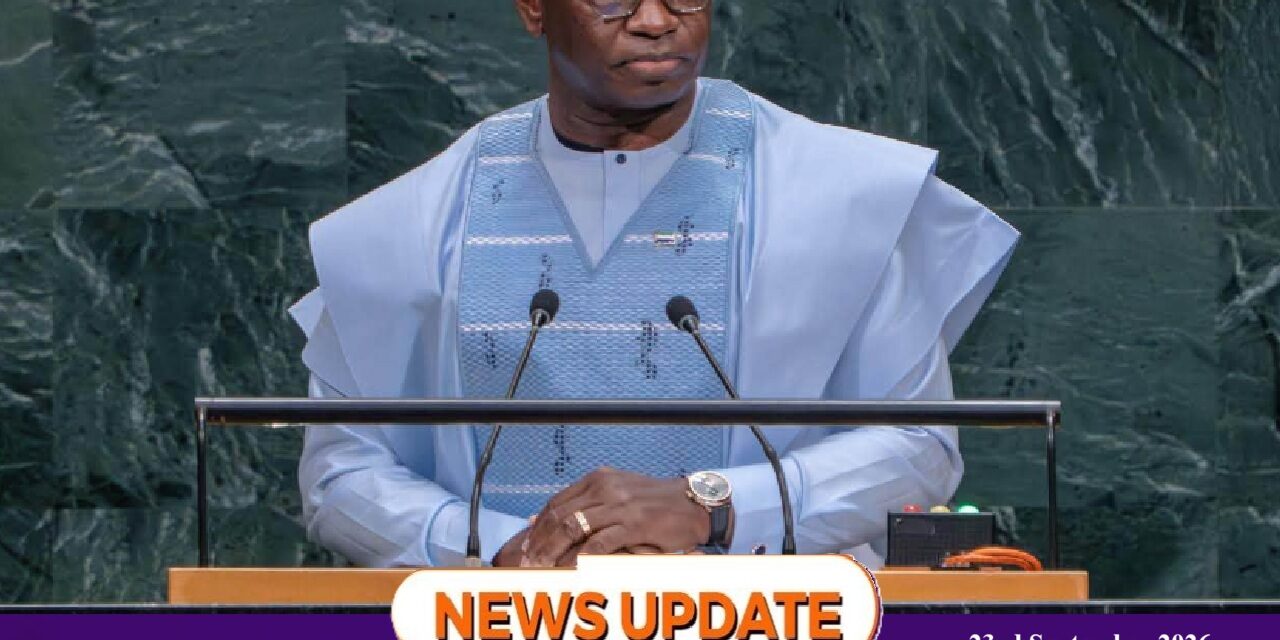
President Julius Maada Bio has delivered a powerful address at the 81st Session of the United Nations General Assembly, calling for a renewed commitment to trust, fairness, and global cooperation under the theme “Restoring Trust, Managing Transformation: A United Nations That Delivers for All.”
President Bio reminded the Assembly of Sierra Leone’s own journey from civil war to peace, underscoring that trust is not declared but earned. “Trust grows when promises are honoured, when the law protects everyone, when institutions serve their people, and when citizens can see a future for themselves,” he said.
Global Conflicts and Peacebuilding- Bio urged the UN to uphold international law consistently, stressing that civilians must be protected in conflicts from the Middle East to Sudan and the Democratic Republic of Congo. He warned that military action alone cannot secure lasting peace, noting that poverty, exclusion, and hunger fuel instability.
He highlighted the imbalance in global priorities, pointing out that military spending reached nearly $2.9 trillion in 2025, while investment in prevention and development lagged far behind.
Africa’s Place in Global Governance- The President pressed for urgent reform of the UN Security Council, insisting that Africa deserves permanent representation. “Africa, home to more than 1.6 billion people and the subject of much of the Council’s work, still has no Permanent Seat,” he declared, reaffirming Sierra Leone’s leadership in advancing the Ezulwini Consensus and Sirte Declaration.
He also called for fairer representation in international financial institutions and stronger participation of developing nations in shaping global tax rules.
Reparatory Justice and Fair Development- Bio’s speech carried historical weight as he addressed the legacy of slavery and colonial exploitation. From Bunce Island to Freetown, Sierra Leone’s history is deeply tied to the transatlantic slave trade. He joined Africa and the Caribbean in demanding reparatory justice through acknowledgement, apology, cultural restitution, and guarantees of non-repetition.
Turning to Africa’s critical minerals, he warned against repeating extractive patterns of the past. He urged processing at source, fair value chains, and technology transfer to ensure young Africans benefit from the green energy transition.
Domestic Achievements and Global Challenges: President Bio highlighted Sierra Leone’s progress at home, including the Feed Salone initiative to boost food security, the Free Quality School Education programme, and the landmark Prohibition of Child Marriage Act (2024). He reminded the Assembly that protecting girls’ education and freedom is central to development.
On global transformations, Bio stressed that artificial intelligence and climate change must be governed fairly. He painted a vivid picture of climate impacts in Shenge, where rising seas are swallowing ancestral graves and fishing grounds. “Those who contributed least to the climate crisis are bearing some of its greatest costs,” he said, urging accessible climate finance and effective loss-and-damage mechanisms.
A Call for Equality and Reform- Bio challenged the UN to entrust a woman with the role of Secretary-General for the first time in its 80-year history, noting that competence is not in question, only political will.
He concluded by reaffirming Sierra Leone’s commitment to peacekeeping, international law, and justice, announcing the country’s nomination of Professor Charles Chernor Jalloh for election to the International Court of Justice.
“The words ‘FOR ALL’ should not remain at the end of this year’s theme. They must become the measure of our work,” Bio declared, urging the Assembly to restore faith in multilateralism and deliver tangible results for people everywhere.