By Saidu Kargbo
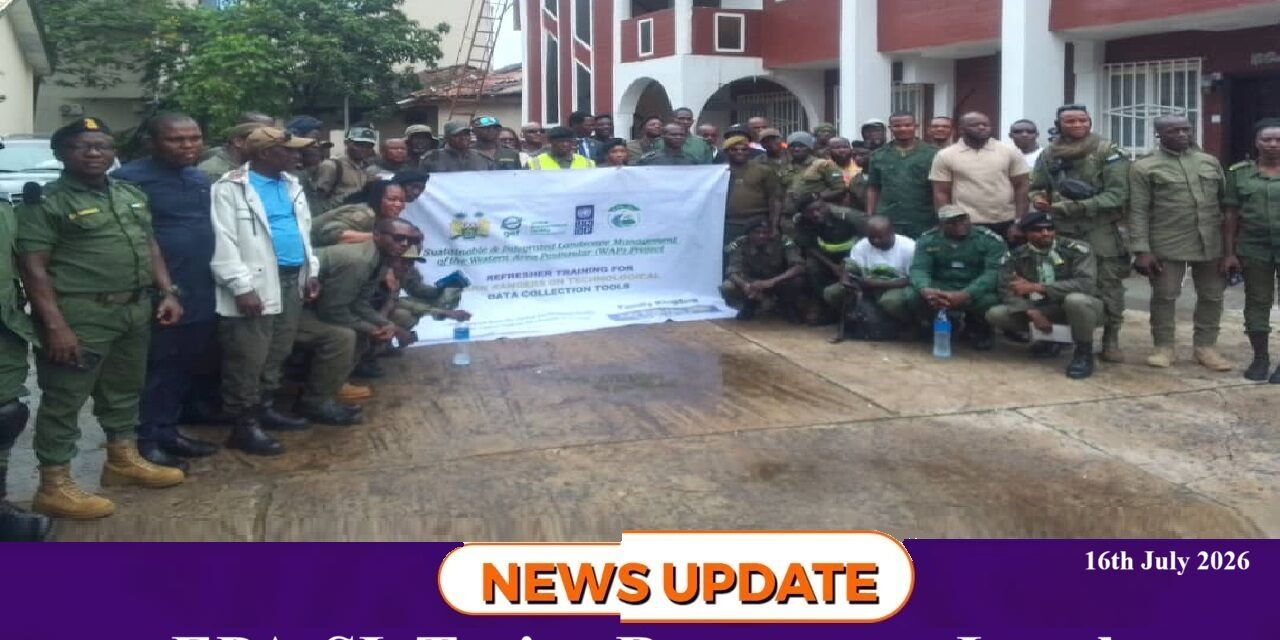
Freetown, 16th July, 2026 –The Environment Protection Agency-Sierra Leone (EPA-SL), in partnership with the National Protected Area Authority (NPAA), has conducted a refresher training for rangers, under the Western Area Peninsula Project, on the legal framework governing protected areas in Sierra Leone. The training took place at the Family Kingdom in Freetown on July 14, 2026.
In his presentation, the Head of Law Enforcement and Compliance at the National Protected Area Authority (NPAA), Laingay Bangura, outlined the legal frameworks governing the management and protection of Sierra Leone’s protected areas, emphasizing that the National Protected Area Authority and Conservation Trust Fund Act of 2022 is the cornerstone of the country’s conservation efforts.
Explaining the establishment of the NPPA’S Act, Bangura stated that their mandate is to manage, conserve and protect the protected areas across Sierra Leone.
“This law is important because it gives Government the power to create and establish an institution called the National Protected Area Authority,” Bangura said. “Any work the NPAA does is because of this law.”
He noted that the legislation also empowers the Government to designate protected areas and requires the Authority to work closely with local communities and other institutions involved in environmental management and governance.
Bangura further explained that the same Act established the Conservation Trust Fund (CTF), which is responsible for mobilizing financial resources from national and international partners to support conservation activities. “The Conservation Trust Fund is supposed to raise money for us from donors and partners to support the work we do because conservation is financially demanding,” he stated.
According to him, although the NPAA and the Conservation Trust Fund were established under the same law, they operate as separate institutions with different management structures while sharing the same office premises.
Turning to the Wildlife Conservation Act of 1972, as amended in 2022, Bangura described it as one of the most important legal instruments guiding the Authority’s daily operations.
He explained that while the NPAA Act provides the institutional mandate, it does not create specific offences relating to illegal activities in protected areas. “The NPAA Act does not create offences. The Wildlife Conservation Act is what we rely on because it outlines prohibited acts inside protected areas,” he said.
Bangura said Section 12 of the NPAA Act gives the Authority the power to manage protected areas in accordance with the Wildlife Conservation Act, making the two laws complementary.
Highlighting the importance of the Forestry Act of 1988, as amended in 2022, he noted that it primarily deals with plant species and forestry management.
According to Bangura, where there is any conflict between older legislation and the NPAA Act of 2022, the newer law takes precedence. “When two laws conflict, the most recent law prevails because it was enacted to address gaps in the previous legislation,” he explained.
He pointed out that the 2022 Act significantly expanded the Authority’s powers by granting prosecutorial authority, strengthening enforcement responsibilities and expressly listing protected areas under the law.
Before the enactment of the new legislation, Bangura said, the Authority lacked several of the powers it now exercises, disclosing that both institutions jointly implement conservation projects, with responsibilities shared depending on the nature.