Conrad Sackey urges performance-based school funding and lifelong learning as AI and automation reshape Africa’s job market
By Ophaniel Gooding
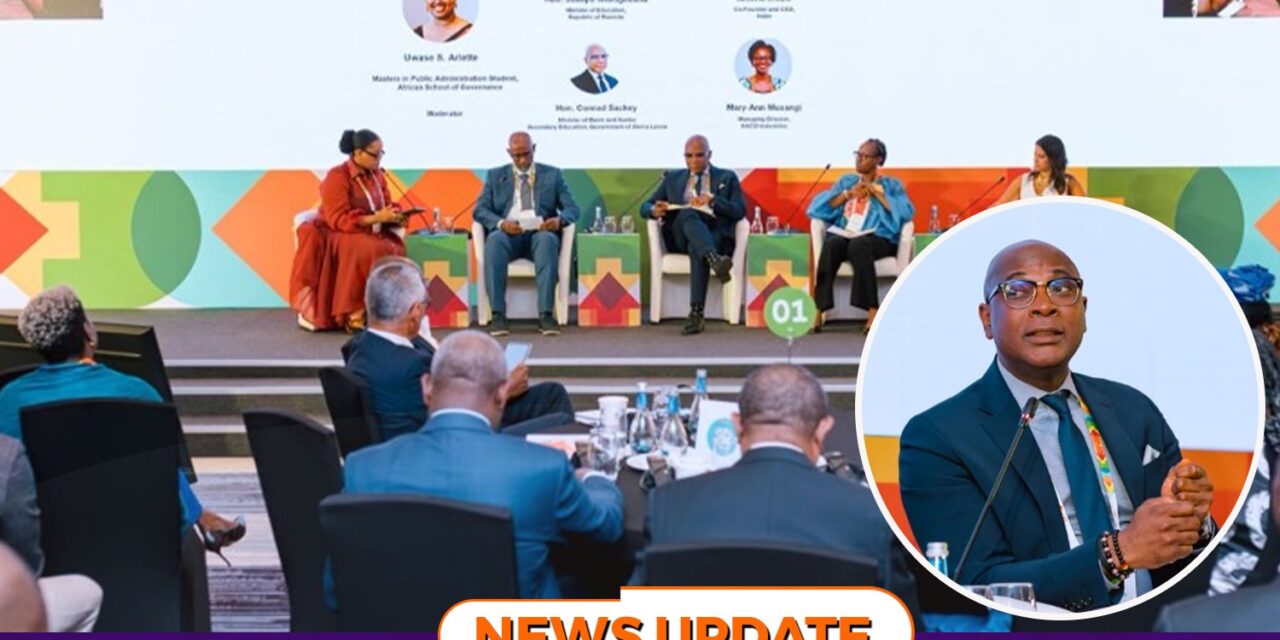
Freetown, 1st July 2026- There is a particular kind of silence that falls over a conference room when someone says something everyone privately believes but no one has been willing to say aloud. That silence settled over the Young Africa Works Summit here this week, hosted by the Mastercard Foundation, as Sierra Leone’s Minister of Basic and Senior Secondary Education, Hon. Conrad Sackey, told a room full of ministers, industry executives and young Africans that the continent’s schools are, in his words, producing graduates for a world that no longer exists.
It was not a comfortable thing to hear. It was, delegates in the room said afterwards, exactly the thing that needed to be said. Minister Sackey did not travel to Kigali simply to diagnose a problem that Africa’s policymakers have circled for years. He arrived with a plan, a timeline and a level of specificity that set him apart from many of his peers on the panel.
By 2027, he told the summit, Sierra Leone will have a new national education sector plan in place, one built not around fixed credentials but around lifelong competencies, and anchored by a bold proposal to tie government funding directly to whether graduates actually find work.
“In the old days, skills were something that you had for the rest of your life,” Minister Sackey said, addressing a hall that had grown noticeably quiet. “You acquire the skill, get into a career, and then you use that skill. Now, the skills acquired last only for eighteen months, then you are looking at something very different.”
It is a sentence that could have come from a Silicon Valley keynote. That it came instead from the education minister of one of West Africa’s smaller nations, a country still climbing out of the long shadow of civil conflict and the Ebola crisis, was precisely what gave it force.
At the centre of what Minister Sackey calls Sierra Leone’s Education Sector Plan are five competencies he refers to simply as the Five Cs: Comprehension, Critical Thinking, Creativity, Civic Mindedness and Computational Thinking. It is a framework that breaks decisively with the certification-obsessed model that has defined African schooling for generations, one where a diploma was treated as a lifetime guarantee rather than a starting point.
“Whatever changes come in the world’s environment, you will be able to handle them,” Minister Sackey told the summit. “Because these are lifelong skills.”
Officials familiar with the ministry’s thinking describe the Five Cs as more than a slogan. They are the scaffolding for a curriculum overhaul already under discussion in Freetown, one that places critical thinking and civic responsibility on equal footing with the technical fluencies that automation and artificial intelligence are making increasingly indispensable.
Perhaps the most consequential idea Minister Sackey brought to Kigali was his proposal for performance-based financing, a mechanism under which universities, colleges and technical and vocational training centres would receive government support based on whether their graduates find employment, not merely on how many students they enrol.
“My suggestion is to have some form of performance-based financing, for which employability skills is the performance element,” he said.
It is the kind of proposal that sounds simple until one considers how radically it would reorder incentives across an entire education system. Institutions that have long treated enrolment as their primary currency would suddenly answer to a different standard altogether, one measured in jobs, not headcounts. Minister Sackey argued the shift would force closer, more honest engagement between schools and the industries meant to absorb their graduates, replacing a system of assumptions with one of accountability.
The idea resonated. Rwanda’s Minister of Education, Hon. Joseph Nsengimana, who shared the panel with Mr Sackey, announced that his own government is moving toward tracking and publishing graduate employment data at three, six and nine months after completion of study, information that will be made public for parents and students weighing where to enrol.
“That’s going to provide information for parents and students as they select which institution to attend, or what to study,” Minister Nsengimana said, extending a framework that mirrored the accountability logic Mr Sackey had just laid out.
Minister Nsengimana also offered a warning that underscored the urgency of the moment Sierra Leone’s minister was trying to seize. “We’re aiming at today,” he said. “But it takes four or five years for someone to graduate, and that today is going to be looking very different from the time they graduate.” He spoke of a coming “learning highway,” a blurring of the line between classroom and workplace. It was a vision that, in the room, sounded very much like an echo of the path Minister Sackey had already begun to chart for Sierra Leone.
Woven through the session was a second, quieter argument, one that Mr Sackey has made a hallmark of his tenure: that the stigma long attached to technical and vocational education in Africa is not only unjust but economically self-defeating, at precisely the moment when the continent’s economies are starving for technical skill.
His performance-based financing proposal, delegates noted, does more than reward outcomes. It dismantles, structurally, the old hierarchy that has funnelled prestige and resources toward universities while technical and vocational institutions were left to compete for what remained. Under Minister Sackey’s model, a trade college that places its graduates in steady work stands on equal footing with any university, judged by the same measure and rewarded by the same formula.
For a summit convened to ask whether Africa’s schools are still fit for purpose, Sierra Leone’s minister did not simply answer the question. He arrived with a blueprint, and left Kigali with a continent’s education ministers taking notes.