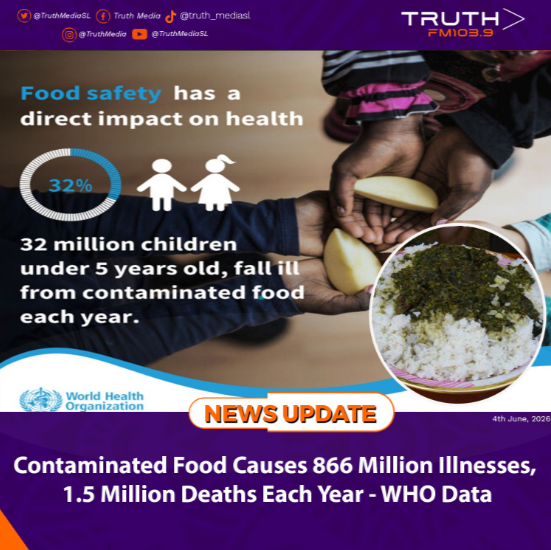
Freetown, 4th June, 2026 — New global estimates from the World Health Organization (WHO) reveal the staggering toll of unsafe food: 866 million illnesses and 1.5 million deaths annually, with children under five bearing the greatest burden.
Although they make up just 9% of the world’s population, children under five suffer nearly one‑third of all foodborne diseases. They face almost three times the risk of illness compared to older children and adults. Diarrhoeal diseases remain the leading killer, while exposure to chemical hazards such as methylmercury and lead threatens brain development, causing lifelong neurological and developmental problems.
Biological hazards- bacteria, viruses, parasites, caused 860 million illnesses in 2021.
Chemical hazards accounted for 73% of foodborne deaths, with inorganic arsenic (42%) and lead (31%) driving most fatalities through increased risks of heart disease and cancers.
The burden is not evenly spread. Africa and South‑East Asia together account for three‑quarters of all foodborne illnesses and 60% of deaths, underscoring deep inequities in food safety systems.
Beyond health, unsafe food cost the global economy US$310 billion in lost productivity in 2021. Adjusted for cost‑of‑living differences, the figure rises to US$647 billion, reflecting time lost to illness and reduced workforce capacity.
WHO Director‑General Dr. Tedros Adhanom Ghebreyesus said: “Unsafe food has always been a major public health concern, but until now we lacked the bigger picture of its staggering human and economic toll. These new estimates change that.”
The updated analysis covers 42 foodborne hazards across 194 countries (2000–2021), including metals, rotavirus, and parasites such as Trypanosoma cruzi. WHO urges governments to prevent contamination at the source through better agricultural practices, stricter industrial controls, and stronger environmental regulations.
WHO technical officer Yuki Minato, lead author of the study published in The Lancet Global Health, warned: “Foodborne diseases are being made worse by climate change and antimicrobial resistance. A One Health approach, integrating human, animal, plant, and environmental health, is essential. Delay costs lives.”
The report comes ahead of World Food Safety Day on June 7, 2026, themed “From burden to solutions – safe food everywhere.” WHO’s interactive dashboard and Global Health Observatory now provide country‑level data to help governments rank risks, prioritize interventions, and allocate resources more effectively.