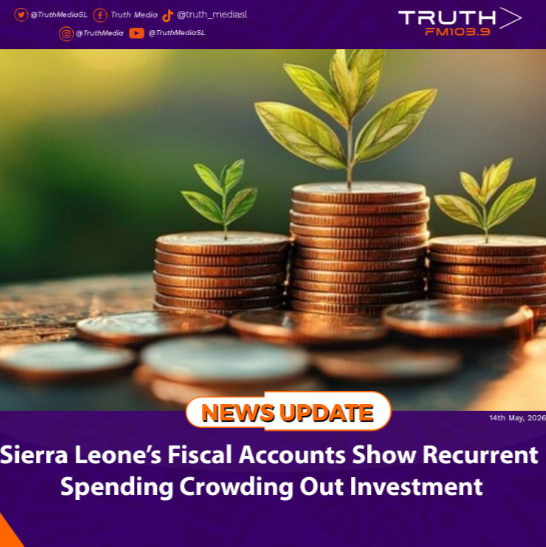
Freetown, 11th May 2026 — Sierra Leone’s 2025 fiscal accounts reveal a government still heavily constrained by recurrent expenditure, with wage costs and operational spending continuing to dominate the budget and crowd out development investment, despite an overall shortfall in execution.
According to official figures, total expenditure reached NLe25.3 billion in 2025, falling 19 percent below the approved NLe31.3 billion budget but slightly higher than 2024 levels. The gap underscores persistent weaknesses in fiscal execution amid tightening financing conditions and mounting debt‑service pressures.
Non‑interest recurrent expenditure remained the dominant component, absorbing NLe15.1 billion — about 60 percent of total spending and 8 percent of GDP. This reflects the structural burden of routine government operations on public finances.
The public‑sector wage bill alone consumed NLe7.17 billion, representing 28 percent of total spending. Although slightly below budget, wages and employee benefits still rose 19 percent year‑on‑year, highlighting continued payroll pressures even as the ratio remained broadly stable at around 4 percent of GDP.
Operational spending also remained elevated. Expenditure on goods and services reached NLe7.13 billion, exceeding budget allocations by nearly 50 percent, though declining 23 percent from the unusually high levels recorded in 2024.
By contrast, transfers and grants contracted sharply to NLe690 million, 63 percent below target and lower than the previous year, signaling tighter fiscal prioritisation and reduced discretionary spending.
Capital expenditure suffered the deepest retrenchment. Development spending fell 59 percent to NLe1.36 billion just 1 percent of GDP and 5 percent of total expenditure, despite a domestic capital budget allocation of NLe3.45 billion.
The figures underline a widening imbalance in Sierra Leone’s fiscal structure, where recurrent obligations continue to dominate while infrastructure and long‑term investment spending remain persistently underfunded. Economists warn that without a decisive shift toward capital investment, the country risks undermining growth prospects and delaying critical improvements in public services and infrastructure.