By Davida Spaine-Solomon
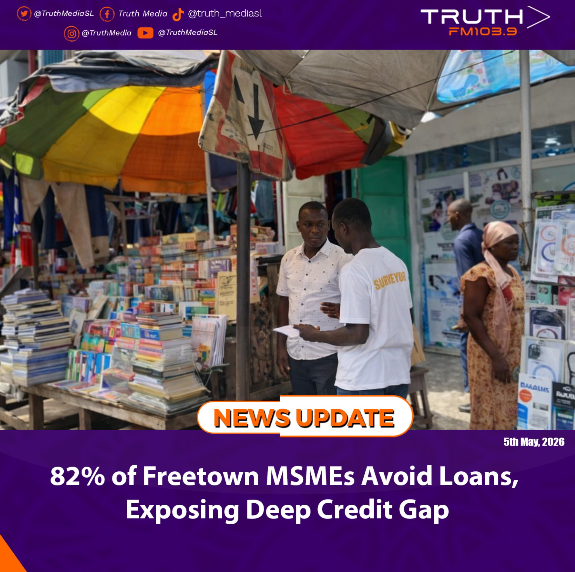
Freetown, 4th May 2026– A new financial inclusion survey has revealed that 82% of micro, small, and medium enterprises (MSMEs) in Freetown did not apply for loans in the past year, underscoring a suppressed demand for credit and exposing structural weaknesses in Sierra Leone’s financing ecosystem.
The Center for Africa Financial Inclusion and Advancement (CAFIA), in its State of MSME Financial Inclusion in Sierra Leone 2026 report, surveyed 495 businesses across key commercial corridors in the Western Area. The findings show that only 18% of MSMEs attempted to access credit, pointing to a financing challenge rooted not only in access but in reluctance, cost, and confidence.
High interest rates, uncertain sales, fear of default, and a general aversion to borrowing were cited as the main deterrents. The report stresses that banks do not simply exclude businesses; they are self-excluding, reflecting a fragile financial ecosystem where credit exists but trust in using it remains low.
The reliance on cash continues to define MSME operations: 74% purchase stock upfront with cash, only 12% access supplier credit, informal savings remain widespread
This heavy dependence on cash limits liquidity, reduces flexibility, and constrains growth potential.
Among the few businesses that do seek loans, microfinance institutions account for the largest share of applications. Yet overall participation remains weak, with trust concerns around affordability and repayment terms. Commercial banks, despite greater lending capacity, remain disengaged at the micro-enterprise level, a mismatch between available capital and the realities of small business operations.
Despite strong indicators of digital readiness, 90.7% of MSMEs own smartphones, 52.5% accept digital payments, and 94% are within five minutes of a mobile money agent- digital finance remains underutilized. Mobile money is primarily used to receive payments, with minimal adoption for supplier transactions, savings, or broader business management.
CAFIA’s Financial Inclusion Index places Freetown’s MSME ecosystem at 61.7 out of 100, classifying it as “integrated but not fully transformed.” The gap between access (81.3) and usage (52.1) highlights that infrastructure is in place, but behavioral and economic barriers persist.
Structural challenges extend beyond credit. Only 42% of MSMEs keep financial records, while 57.2% separate business and personal finances. Many see no benefit in record-keeping, undermining creditworthiness and making risk assessment difficult for lenders.
MSMEs drive employment and economic activity, yet without functional access to finance, many remain trapped in survival mode. The report calls for: More affordable and flexible credit products, reduced entry barriers such as lower minimum balances, stronger incentives for financial and digital usage, better alignment between financial products and real business conditions.
CAFIA concludes that Sierra Leone’s financial inclusion strategy must evolve from expanding access to driving active, productive use of financial services. With most MSMEs opting out of formal credit, the challenge is no longer building systems but ensuring those systems are trusted, relevant, and usable for the country’s smallest enterprises.