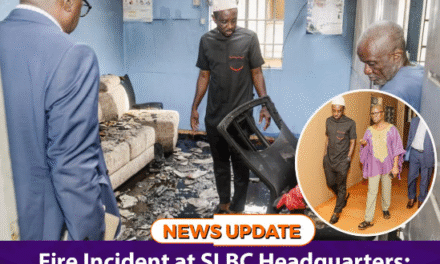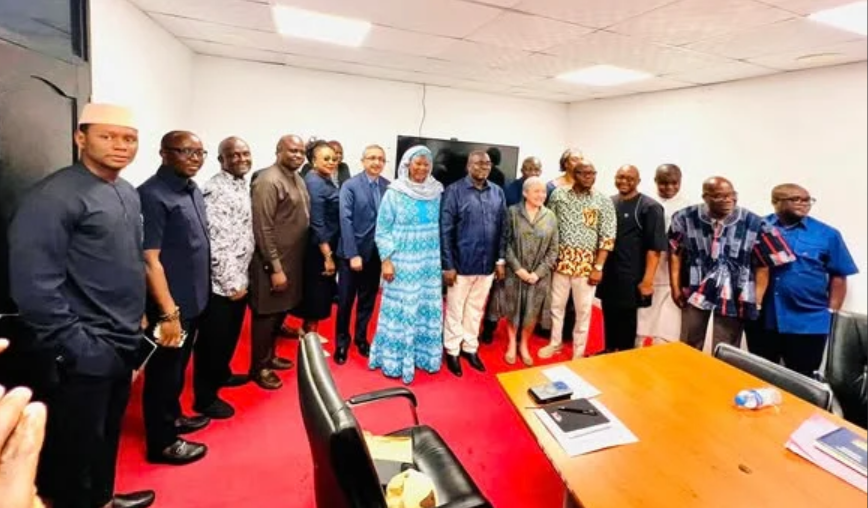
Freetown, 20th April 2026 – The International Moral Guarantors of the Tripartite Recommendations have urged opposition parliamentarians to end parliamentary boycott and praised the Speaker of Parliament, Rt. Hon. Sengepoh Solomon Thomas, for his mediation efforts and engagements with the Opposition Members of Parliament to put an end to the parliamentary boycott. The engagement formed part of the ongoing mediation to promote adherence to the Tripartite Recommendations.
The Leader of the International Moral Guarantors, Madam Fatoumata Jallow-Tambajang, former Vice President of The Gambia, said the visit was a follow-up to their previous engagements with the Parliament of Sierra Leone. She explained that the mission was focused on assessing progress on the implementation of the National Unity Agreement (NUA), and the parliamentary oversight regarding the National Peace Agreement (NPA). She added that the delegation was also sought to identify any barrier that was affecting the implementation of the said agreement.
The Speaker of Parliament, Rt. Hon. Segepoh Solomon Thomas, welcomed the delegation to Parliament and to the Republic of Sierra Leone. He acknowledged the National Peace Agreement between the Government and the Opposition and expressed his support for it. However, he made it clear that the Agreement had not been formally laid before Parliament; thereby limiting the House’s ability to act on it. As Speaker of the House, he said that he expected the Agreement to be tabled for consideration, while noting that “there is no clause in the Agreement that Members on either side should oppose.”
On the opposition’s Parliamentary boycott, the Speaker informed the delegation that he had held two meetings with the opposition members of parliament encouraging them to return. He stressed that Parliament is a separate branch from the Executive and should not be caught up in disputes between the Executive and the APC Party. He called on opposition MPs to use Parliament as a platform to freely express their views on the Executive. Whiles acknowledging that all MPs belong to political parties, he emphasized that their primary responsibility was to represent their constituents.
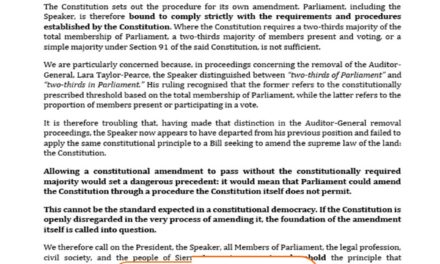
In his remarks, the Opposition Leader, Hon. Abdul Kargbo commended the Speaker for his efforts to finding a lasting solution to their boycott. He confirmed that the two meetings with the Speaker had been productive, noting the opposition’s main concern was the Amendment Bill to the 1991 Constitution. According to him, several points agreed upon by the two political parties were altered in the Bill that is now before Parliament. Hon. Kargbo called on the Government to adhere to the Tripartite Recommendations. He assured the delegation that the opposition had been supportive during the pre-legislative hearing and First Reading of the Constitutional Amendment Bill. He welcomed the fixed election date in the Bill and stated that the opposition was not opposed to constitutional reforms in principle.
The Majority Leader of Parliament and Leader of Government Business, Hon. Mathew Nyuma, said that Government had acted in the spirit of unity, citing the establishment of the Peace Commission for National Cohesion. He reminded the delegation that Parliament is the supreme law-making body.
Hon. Nyuma said that bills before Parliament, including the Constitutional Amendment Bill, are proposals that the House could modify as it sees fit. He said that elections should strengthen democracy, not divide the nation. He said that there is no dispute among MPs, noting that the interference by political parties affects their parliamentary operations. He welcomed the presence of the Moral Guarantors and joined the Speaker in calling on opposition MPs to resume their parliamentary duties.
In her closing remarks, the Leader of the Delegation, Madam Jallow-Tambajang commended the Speaker for his engagement with the opposition. She urged the opposition to recognize that representation requires compromise, and that boycotting Parliament would hinder their objectives. She said the best course was for the opposition to remain in Parliament and use it to hold the executive accountable. She noted that the National Peace Agreement had not been tabled, stating the delegation would do a follow up to ensure the necessary steps are taken.
The delegation also raised concerns about preparations for the electoral process ahead of the 2028 elections. The Speaker responded that progress was underway, with both the “Constitutional Bill” and the “Security Bill” [are] before Parliament. He said the opposition’s boycott had slowed the process because he wanted inclusive debates on these bills. He added that he had informed the president of his meetings with the opposition, and that the President had supported the dialogue process tin the interests of peace and national cohesion.
The formation of the Committee on the Electoral Management Bodies was also requested by Hon. Abdul Kargbo upon laying the Agreement on National Unity and the Tripartite Agreement. Hon. Abdul Kargbo reiterated the call for the Tripartite Agreement and its recommendations to be formally tabled in Parliament to give them full legal effect. He said that strict adherence to the Agreement was necessary to restore confidence in the electoral process.