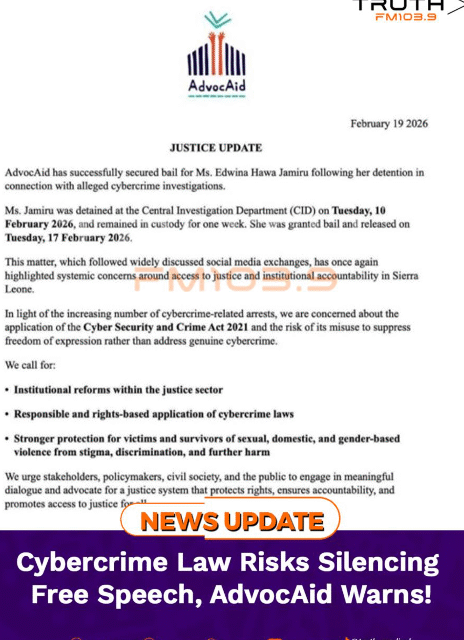
Freetown, 17th February 2026- The recent detention and release of Ms. Edwina Hawa Jamiru has reignited the debate over Sierra Leone’s cybercrime legislation, with rights groups warning that the Cyber Security and Crime Act 2021 risks being misused to stifle free expression.
Ms. Jamiru was arrested on 10th February and held at the Criminal Investigation Department (CID) for one week before being granted bail on 17th February. Her case, linked to widely discussed social media exchanges with the country’s first Lady Madam Fatima Bio, has become a flashpoint in the growing tension between digital freedoms and state enforcement.
Human rights organization AdvocAid, which secured her bail, expressed deep concern about the way cybercrime laws are being applied. “We are worried about the increasing number of arrests under this Act and the danger of it being used to silence voices rather than tackle genuine cybercrime,” the group said in a statement.
AdvocAid stressed that while cybercrime is a real and pressing issue, enforcement must be balanced with constitutional rights. They called for: Institutional reforms within the justice sector, rights-based application of cybercrime laws and stronger protections for victims of sexual, domestic, and gender-based violence against stigma and discrimination
The organization urged policymakers, civil society, and the public to engage in dialogue that ensures Sierra Leone’s justice system protects rights and promotes accountability.
For many observers, Ms. Jamiru’s ordeal is emblematic of a broader struggle: how Sierra Leone navigates the digital age without undermining freedoms. Her case has sparked questions about whether the country’s cybercrime law is being used as a shield against online abuse or a weapon against dissent.