By Andrew Chokpeleh
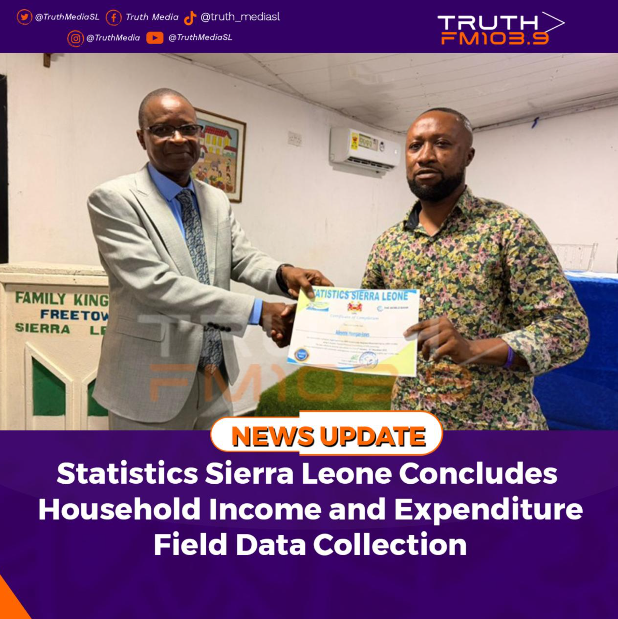
Freetown, 5th February 2026- Statistics Sierra Leone has officially concluded the field data collection phase of its latest national data-gathering exercise, marking a major milestone in the country’s statistical and development efforts. The data collection was to know the living conditions of Sierra Leoneans and to also know their economic standings. The data is to be used to make informed decisions that will further positively affect the lives of citizens.
The Statistician General Andrew Bob Johnny has confirmed the successful completion of a nationwide Integrated Household Survey, describing it as a rigorous and credible data collection exercise. Speaking during the certification ceremony, Johnny said the survey, which focused on education, household income, and expenditure, began 12 months ago and concluded one month ago. Certificates are now being issued to all innovators, supervisors, and field staff who participated in the exercise, in recognition of their contributions.
He emphasized that data accuracy and credibility were central to the entire process. “The survey went through several tests from the very beginning,” Johnny said. “All the enumerators underwent an intensive training exercise that lasted more than three weeks. Facilitators ensured that every module that was required to collect data on was properly understood and implemented.”
Addressing questions about when the public can expect the results, Johnny said preparations for poverty analysis are already underway. “With data collection now complete, we will need another two to three months to begin the poverty analysis,” he explained. “We expect to release findings within four to five months, potentially around June or July, depending on the progress of the work.”
He added that the analysis is expected to adopt a structural approach to poverty, providing deeper insights to inform policy and development planning. Johnny concluded by thanking all participants and reaffirming the organization’s commitment to producing reliable and high-quality statistical data.
The Consultant for this survey Mr Abdulai Jalloh, said the exercise followed an intensive 22-day training programme, designed to prepare field staff for rigorous data collection across the country. He praised the quality of the data collected, noting that adherence to procedures and strict compliance with instructions were central to the success of the exercise. “We are glad to say that we have obtained high-quality data,” Jalloh stated. “This is a direct result of the commitment of our field teams and the constant support provided from the back end, especially the data processing team.
Jalloh said, with fieldwork now complete, Statistics Sierra Leone will move into the next critical phase: data processing, tabulation, and analysis. The finalized results will be presented to the Government of Sierra Leone to inform policy decisions and support national development planning.
One of the Field Supervisors, Thomas Ezekiel Bindi, said that they faced serious challenges in accessing certain areas, especially those in rural communities. He explained that a snake even bit one of the field enumerators, forcing him, the supervisor, to step in to ensure the enumerator received medical care while the team continued with data collection. Bindi stated that the team also experienced difficulties accessing some households because residents had moved from the addresses provided by Statistics Sierra Leone. He added that some respondents were very hostile and refused to provide answers to the questions contained in the questionnaire.
He further noted that the team encountered significant cultural and language barriers, as many enumerators were deployed to areas they had never visited before and had to quickly adapt to unfamiliar environments. According to Bindi, the team often spent more than the transport allowance provided by Statistics Sierra Leone while carrying out fieldwork. He explained that this was partly due to perceptions within some communities that the data collectors had money.
Bindi confirmed that the data collected meets the standards set by Statistics Sierra Leone and expressed confidence that the information will support the government and its partners in developing policies and programmes aimed at improving the living conditions of the people.