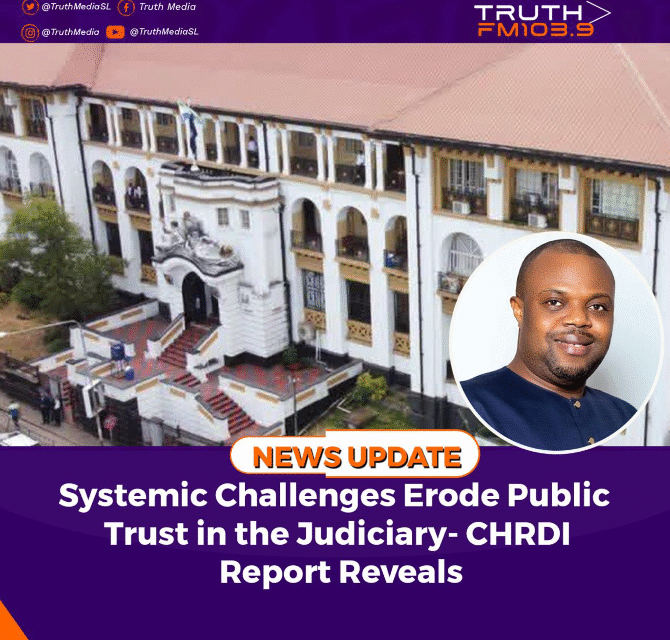
Freetown, 16th December 2025- A new report by the Campaign for Human Rights and Development International (CHRDI) has raised serious concerns about the state of Sierra Leone’s judiciary, citing widespread delays, poor infrastructure, and systemic barriers to justice.
The monitoring exercise, conducted between October and November 2025, observed 76 case sessions across Freetown. While judicial impartiality and professionalism were generally rated positively, the findings highlight critical deficiencies that undermine public confidence in the courts.
Court monitors documented persistent adjournments, often due to absent lawyers or inadequate case preparation. In one striking example, a judge adjourned ten cases within 10 minutes because neither counsel nor litigants were present.
CHRDI noted that training sessions for judges further compounded delays. On October 27-28, 2025, selected judges attended CPA training at Sierra Palms, while on October 3-4, 2025, online judicial training was facilitated by a Supreme Court judge. “Litigants appear in court on adjourned dates only to be told the magistrate or judge is unavailable due to training,” the report stated.
The report paints a stark picture of resource constraints. Several judges were unable to print rulings for over three months due to a lack of printer ink. Courts were also found without paper, and air conditioners had not been serviced, leaving judges “sweating owing to excessive heat in the courtrooms.”
At Pademba Road Magistrates’ Court, files were stored in rice and plastic bags, underscoring the absence of a digital filing system. CHRDI observed inequitable allocation of cases, with some judges overwhelmed while others had little to do. Appeal Court judges were found presiding over High Court matters, leaving the fast‑track Commercial Court “redundant.”
Adoption cases were also centralized in Freetown by order of the Chief Justice, forcing litigants from the provinces to travel to the capital. “We found it ironic that the Judiciary is taking the Court of Appeal to sit in the provinces whilst bringing all adoption matters to Freetown,” the monitors remarked.
The report highlights serious accessibility barriers. Persons with disabilities faced inadequate wheelchair access and poorly maintained facilities. There were no sign language interpreters in courtrooms, and language interpretation was often left to clerks or registrars, raising risks of miscommunication and miscarriages of justice.
At Magistrate’s Court No. 1, proceedings were held behind closed doors in chambers rather than open court, compromising transparency. Public toilet facilities at both magistrates’ and High Courts were described as “notably poor.”
CHRDI expressed concern over the practice of “forum shopping,” where the Chief Justice reassigns cases without consultation. Monitors witnessed at least five occasions where litigants arrived in court only to be told their case file had been removed from the judge and reassigned, forcing proceedings to restart.
In terms of recommendations, the report calls for stricter case management timelines to reduce adjournments, improved accessibility for persons with disabilities and modernization of court facilities and technology.
It also encouraged authorities to provide professional interpreters for non‑English speakers and sign language services whilst ensuring stronger oversight to address lawyer misconduct. The report also recommends an end to forum shopping and wasteful spending on judicial travel.
CHRDI, which holds Special Consultative Status with the UN Economic and Social Council, says it seeks to ‘promote transparency, accountability, and fairness within the justice system,’ primarily because, systemic challenges have eroded public trust in the judiciary, overshadowing its achievements.