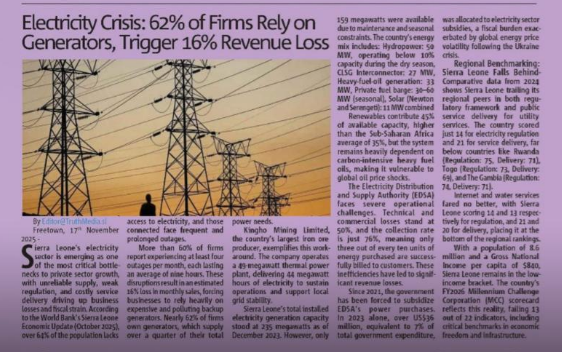
Freetown, 17th November 2025 – Sierra Leone’s electricity sector is emerging as one of the most critical bottlenecks to private sector growth, with unreliable supply, weak regulation, and costly service delivery driving up business losses and fiscal strain. According to the World Bank’s Sierra Leone Economic Update (October 2025), over 64% of the population lacks access to electricity, and those connected face frequent and prolonged outages.
More than 60% of firms report experiencing at least four outages per month, each lasting an average of nine hours. These disruptions result in an estimated 16% loss in monthly sales, forcing businesses to rely heavily on expensive and polluting backup generators. Nearly 62% of firms own generators, which supply over a quarter of their total power needs.
Kingho Mining Limited, the country’s largest iron ore producer, exemplifies this workaround. The company operates a 49-megawatt thermal power plant, delivering 44 megawatt hours of electricity to sustain operations and support local grid stability.
Sierra Leone’s total installed electricity generation capacity stood at 235 megawatts as of December 2023. However, only 159 megawatts were available due to maintenance and seasonal constraints. The country’s energy mix includes: Hydropower: 50 MW, operating below 10% capacity during the dry season, CLSG Interconnector: 27 MW, Heavy-fuel-oil generation: 33 MW, Private fuel barge: 30–60 MW (seasonal), Solar (Newton and Serengeti): 11 MW combined
Renewables contribute 45% of available capacity, higher than the Sub-Saharan Africa average of 35%, but the system remains heavily dependent on carbon-intensive heavy fuel oils, making it vulnerable to global oil price shocks.
The Electricity Distribution and Supply Authority (EDSA) faces severe operational challenges. Technical and commercial losses stand at 50%, and the collection rate is just 76%, meaning only three out of every ten units of energy purchased are successfully billed to customers. These inefficiencies have led to significant revenue losses.
Since 2021, the government has been forced to subsidize EDSA’s power purchases. In 2023 alone, over US$36 million, equivalent to 7% of total government expenditure, was allocated to electricity sector subsidies, a fiscal burden exacerbated by global energy price volatility following the Ukraine crisis.
Regional Benchmarking: Sierra Leone Falls Behind- Comparative data from 2024 shows Sierra Leone trailing its regional peers in both regulatory framework and public service delivery for utility services. The country scored just 14 for electricity regulation and 21 for service delivery, far below countries like Rwanda (Regulation: 75, Delivery: 71), Togo (Regulation: 73, Delivery: 69), and The Gambia (Regulation: 74, Delivery: 71).
Internet and water services fared no better, with Sierra Leone scoring 14 and 13 respectively for regulation, and 21 and 20 for delivery, placing it at the bottom of the regional rankings.
With a population of 8.6 million and a Gross National Income per capita of $840, Sierra Leone remains in the low-income bracket. The country’s FY2026 Millennium Challenge Corporation (MCC) scorecard reflects this reality, failing 13 out of 22 indicators, including critical benchmarks in economic freedom and infrastructure.