By Davida Spaine -Solomon
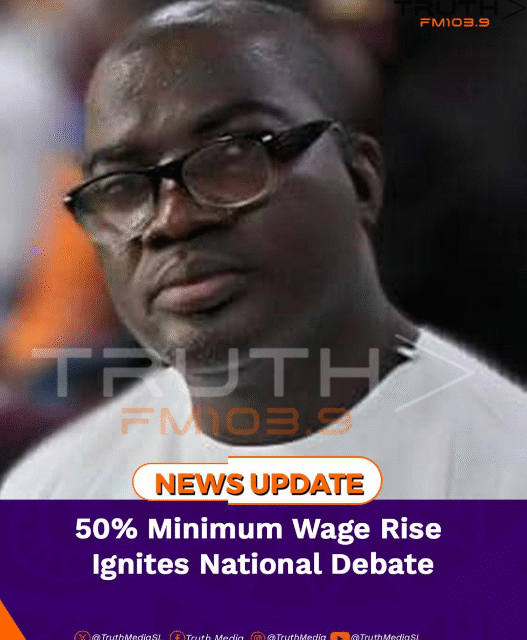
Freetown, 22nd December 2025- The Government of Sierra Leone’s decision to raise the national minimum wage from Le 800 to Le 1,200, effective April 2026, has ignited a national conversation about survival, fairness, and the future of work.
Announced as part of efforts to cushion the rising cost of living, the increase comes at a time when many workers say their wages barely stretch beyond food. With a bag of rice now costing around Le 650, the previous minimum wage left workers with little room to cover transport, rent, healthcare, or education an arrangement widely viewed as unsustainable.
Speaking at the Salone Civic Festival, Minister of Employment, Labour and Social Security, Hon. Mohamed Rahman Swaray, said the adjustment reflects the reality that living costs have soared, not only in Sierra Leone but globally.
“Salaries must at least be able to cover basic household bills,” the Minister said, while acknowledging concerns that some employers still pay below the legally approved minimum. He assured the public that enforcement would be strengthened to ensure the new wage is reflected on workers’ payslips.
Chief Minister Dr. David Monina Sengeh placed the wage increase within the government’s broader economic vision, revealing that US$24 million has been allocated to the private sector to boost agriculture a sector he described as central to economic growth. He noted that 40 percent of newly trained tractor operators are women, underscoring efforts to build an inclusive economy as Sierra Leone works toward becoming a green and economically independent nation by 2039.
“Improving livelihoods goes hand in hand with building a thriving economy,” Dr. Sengeh said.
Labour Congress: “A Significant Step, Not the Final Answer”- For the Sierra Leone Labour Congress (SLLC), the wage increase is both meaningful and symbolic.
In an interview, Edward Yarrimeh Kamara, Deputy Secretary General of the SLLC, described the decision as “significant,” particularly for low-paid and non-unionized workers.
“For workers earning the minimum wage, especially domestic workers, security guards, and other vulnerable groups, this is a 50 percent increase. That is not small,” Kamara said.
He explained that the minimum wage is determined through a legally mandated process involving the Joint National Negotiating Board (JNNB), made up of equal representatives from employers and workers, with government acting as a referee. By law, the board reviews wages every two years based on the cost of living.
Kamara revealed that during the 2024 May Day celebrations, President Julius Maada Bio, after engaging the Labour Congress, acknowledged that Le 800 was no longer realistic and directed an immediate review. Following months of negotiations, the new figure of Le 1,200 was agreed upon and approved.
While welcoming the increase, Kamara was candid about its limitations.
“Even my own salary does not meet all my needs,” he admitted. “This increase helps workers survive, but it is not yet a living wage.”
According to him, the next round of negotiations expected in April 2027 will shift focus from a minimum wage to a living wage, one that allows workers not just to eat, but to save, plan, and live with dignity.
Beyond the basic pay, Kamara emphasized that under Sierra Leonean law, the minimum wage is only the base salary and does not include allowances such as transport, medical, rent, or leave allowances benefits employers are legally required to provide.
“Many workers don’t know their rights,” he said. “If you are unsure, you can come to the Labour Congress. We will guide you.”
He also warned employers that enforcement will be stricter this time. The Labour Congress says it will work closely with the Ministry of Labour to inspect workplaces and ensure compliance. Employers who fail to pay the minimum wage risk fines or closure, as provided for under the Employment Act.
Private Sector Concerns- Some private sector employers, particularly small and medium-sized enterprises, have expressed fears that the wage increase could strain their businesses.
Kamara acknowledged these concerns as “legitimate,” noting that employers raised issues such as high energy costs, poor electricity supply, water shortages, and taxation during negotiations.
“This is why dialogue is important,” he said. “If electricity and basic infrastructure improve, businesses can redirect savings and still pay workers fairly.”
He added that the Labour Congress has already written to the President and the Minister of Finance, pushing for measures such as making the minimum wage tax-free, so low-income earners are not further burdened.
Sectors to Watch- Kamara identified the security sector and parts of the media industry as areas where non-compliance has historically been high, calling on employers in these sectors to respect the law when the new wage takes effect.
A Message to Workers and Employers- To workers feeling exhausted and uncertain, Kamara offered reassurance:
“The law guarantees a review of wages every two years. This move from Le 800 to Le 1,200 is progress, and the next fight is for a living wage.”
To employers, his message was one of cooperation rather than resistance:
“Workers are the engine of every business. A happy worker is a productive worker. Let us talk, engage government on the real challenges, and find solutions together.”
As April 2026 approaches, the minimum wage increase stands as a source of hope for workers, a test of compliance for employers, and a measure of the government’s commitment to ensuring that economic growth translates into better lives for ordinary Sierra Leoneans.