By Nafisatu Olayinka Deen
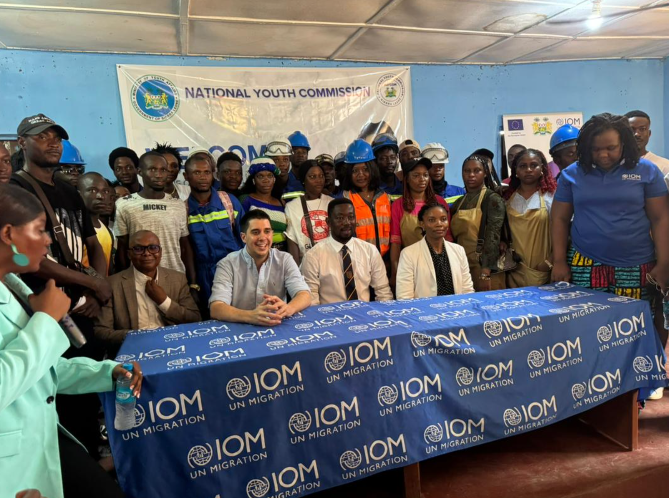
Freetown, 7th April 2026 – The United Nations Assistant Secretary General (ASG) for Youth Affairs, Dr. Felipe Paullier, has paid a courtesy visit to the Obasanjo Skills Acquisition and Youth Transformation College in Newton, Western Area Rural.
His visit was aimed at engaging directly with returned migrants undergoing vocational training under the European Union-funded Migrant Protection and Reintegration Program for Sub-Saharan Africa, implemented by the International Organization for Migration (IOM) in partnership with the Government of Sierra Leone.
The program seeks to tackle Sierra Leone’s high unemployment rate by equipping young people with practical, industry-aligned skills. Through collaboration with the National Youth Commission (NAYCOM), the Obasanjo Centre offers structured training in diverse fields including cosmetology, baking, catering, tailoring, solar and electrical engineering, civil construction, ICT, photography, driving, and automobile engineering.
Dr. Paullier toured the facility and interacted with trainees, expressing satisfaction with the centre’s operations. “Since I started working at the United Nations, Sierra Leone has always been ready to support and push for a UN that puts young people at the centre. This centre is one of the positive things. I came to Sierra Leone to learn and hear from you—about the challenges and the amazing things happening here. This centre is a testament to that progress,” he said.
He commended the trainees for their determination to acquire skills for a sustainable future and pledged to continue advocating for youth at the UN. “At the United Nations, we believe we must put youth at the centre of our institutions, especially those who have been left behind,” he added.
Dr. Pauline Macharia, Officer-in-Charge at IOM Sierra Leone, described the visit as an opportunity to strengthen dialogue on youth empowerment. “It is an honor to engage the Assistant Secretary General on how we can continue to support and empower young Sierra Leoneans to contribute to national development,” she said, noting IOM’s longstanding partnership with the Ministry of Youth Affairs.
Beneficiaries of the program expressed gratitude, highlighting how the training has transformed their lives. One female trainee learning to drive said the process was smooth and had equipped her with lifetime skills.
National Youth Commissioner Joseph Maada Lahai praised the centre as a symbol of resilience and innovation. “This centre is not just a building; it is a testament to the collective determination of our youth to transform challenges into opportunities,” he remarked.