By Kelfala Kargbo
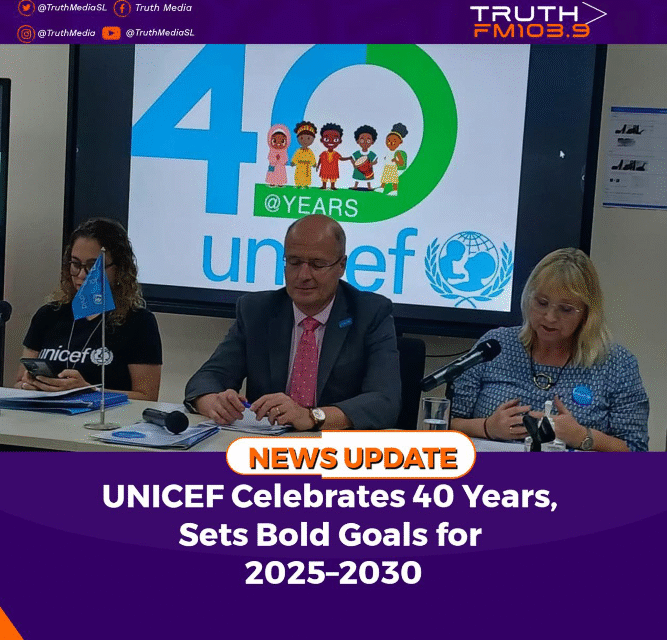
Freetown, 15th December 2025- UNICEF has celebrated its 40th anniversary in Sierra Leone, unveiling its five-year strategic goal areas under the theme: “For Every Child, A Promise Renewed.”
UNICEF, the United Nations agency dedicated to protecting children’s rights globally, established its presence in Sierra Leone in 1985 amid rising cases of child abuse. Over the past four decades, the agency has undertaken a wide range of initiatives, including the establishment of schools, provision of health facilities, and psychosocial support for both children and their parents.
This year’s celebration aims to deepen collaboration with the Government of Sierra Leone and development partners to achieve five strategic goals that will strengthen child protection systems.
The 2025–2030 Country Programme focuses on: Ensuring every child survives and thrives, enabling every child to learn and acquire future-ready skills, protecting every child from violence, exploitation, abuse, neglect, and harmful practices.
Providing safe and equitable WASH services and promoting a sustainable climate and environment and guaranteeing inclusive social protection for every child, including adolescents, to live free of poverty.
UNICEF’s Achievements Since 1985- According to Deputy Representative Liv Elin Indreiten, UNICEF’s journey in Sierra Leone has been built on strong partnerships. “It’s an honour to reflect on UNICEF’s journey in Sierra Leone, a journey defined by partnership, resilience, and a shared commitment to the rights and well-being of every child,” she said.
In the health sector, Indreiten noted that UNICEF has supported improved access to essential services for parents, newborns, and children, including early vaccination campaigns and the expansion of primary healthcare systems. She added that the agency has remained active during emergencies such as Ebola, COVID-19, and the current Mpox outbreak.
On education, she highlighted UNICEF’s role in building schools after the civil conflict, expanding access to learning especially for girls, children with disabilities, and those in hard-to-reach communities. “Even during crises, schools were reopened and teachers supported to ensure effective learning,” she said.
Child safety remains central to UNICEF’s mission. A 2017 study revealed that violence against children stood at 87%. When asked for updated data, UNICEF Representative Rudolf Schwenk confirmed that new figures would be included in the ongoing Multiple Indicator Cluster Survey.
“UNICEF helped support the demobilisation and reintegration of children affected by conflict, strengthened child protection systems, and provided psychosocial support to children who experienced violence, separation, or loss,” Indreiten explained.
She also noted UNICEF’s support for legal reforms, including the Child Rights Act of 2007 and its recent ratification as the Child Rights Act of 2025. While celebrating decades of progress, Schwenk acknowledged persistent challenges, particularly for vulnerable children and those in remote communities.
Looking ahead, Indreiten reaffirmed UNICEF’s commitment to long-standing partnerships with the government, advancing innovation, strengthening national systems, and creating sustainable opportunities for children.