By Abdulai Fofanah
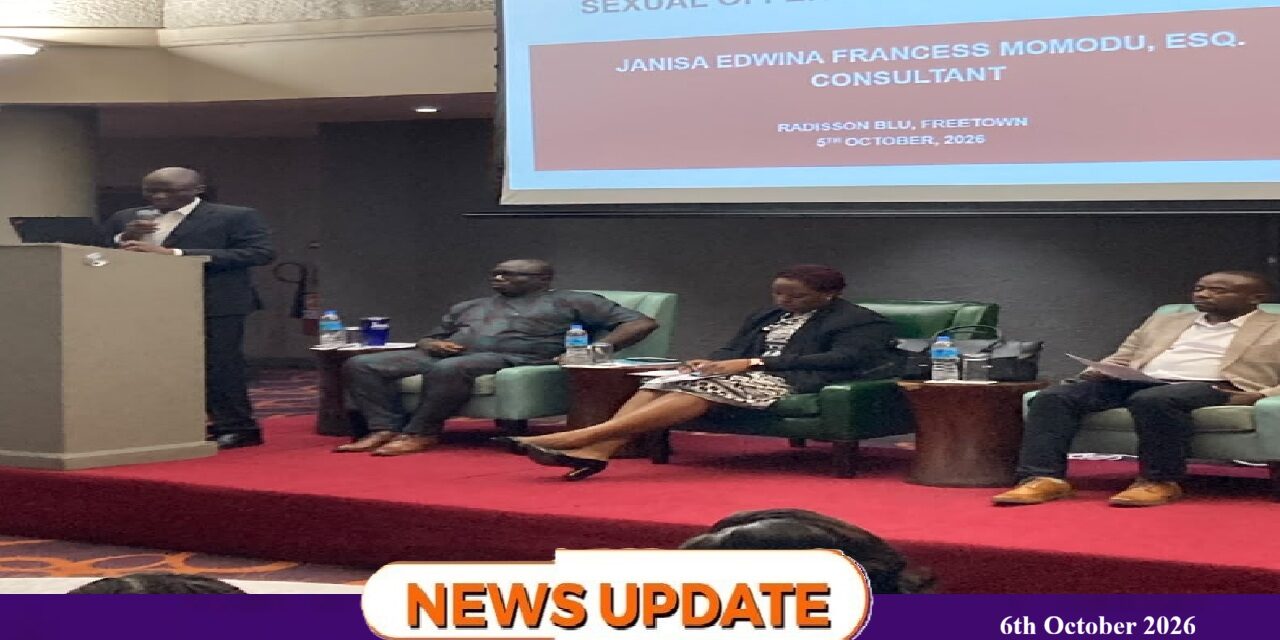
Freetown, 5th October 2026 – Concerns over the large gap between reported sexual and gender-based violence (SGBV) cases and successful prosecutions dominated discussions at a two-day stakeholders’ engagement aimed at strengthening access to justice for survivors in Sierra Leone.
The meeting, convened by Equality Now in partnership with WAVES Sierra Leone, Defence for Children International Sierra Leone (DCI-SL) and Child Welfare Society Sierra Leone (CWSL), brought together government officials, justice sector actors, civil society groups and development partners to review research findings on survivors’ experiences within the country’s justice system.
The study examines the journey of survivors through the justice chain, including reporting mechanisms, Family Support Units (FSU), investigations, evidence collection, prosecution, Sexual Offences Model Courts, referral systems and post-judgment support services.
Speaking at the engagement in Freetown, Chief Director of Protection at the Ministry of Gender and Children’s Affairs, Charles B. Vandi, acknowledged progress in Sierra Leone’s legal response to SGBV but said significant challenges remain.
According to Vandi, despite thousands of SGBV cases being reported annually, only a small number eventually make it to court.
“Out of about 2,000 reported cases, only approximately 300 reach court,” he disclosed.
He stressed that the Ministry’s priority is ensuring that survivors receive support services from the moment a report is filed, regardless of whether a case results in prosecution.
“We look at case management, and we are also monitoring what is happening in the court system,” he said.
Vandi reflected on reforms introduced since the enactment of the Sexual Offences Act in 2012, noting that weaknesses in earlier legislation allowed judges broad sentencing discretion due to the absence of minimum sentencing provisions.
He also highlighted efforts to strengthen the national referral pathway for SGBV survivors. While the framework was first developed in 2016, he said implementation stalled for several years before it was reviewed and relaunched in August 2024 in response to growing concerns, including reports of gender-based violence in schools.
The Ministry, he said, is promoting survivor-centred approaches that place survivors at the heart of decision-making throughout the justice process.
“Planning for survivors must be done with them and not just for them,” he emphasized.
Vandi further called for stronger coordination among institutions involved in responding to SGBV, warning against fragmented approaches that undermine effective service delivery.
He revealed that an electronic SGBV information management system has been rolled out to provide a unified data platform for agencies including the Family Support Unit, the Ministry of Gender and the Rainbow Initiative.
Efforts are also underway to expand safe homes for survivors and strengthen specialized justice services. Vandi disclosed that the government is working with the Judiciary and the Ministry of Justice to expand Sexual Offences Model Courts, while plans are also in progress to modernize the national 116 hotline with support from UNICEF.
Equality Now Associate Director for Ending Gender-Based Violence, Jean Paul Murunga, praised Sierra Leone for advances made in addressing SGBV but cautioned that specialized institutions alone cannot guarantee justice.
“The existence of a specialised court does not, by itself, guarantee specialised justice,” he said.
Murunga argued that survivors begin experiencing the justice system long before they enter a courtroom, starting from the moment they disclose abuse and seek support.
“Justice is a chain. If one link is weak, the entire chain can fail the survivor,” he said.
He explained that the research focuses particularly on experiences involving Family Support Units and Sexual Offences Model Courts in Bo, Kenema, Freetown and the Western Area, while also drawing lessons from other jurisdictions.
The goal, he said, is to identify practical reforms that can strengthen existing institutions rather than create parallel structures.
Also addressing participants, Senior State Counsel and SGBV Desk Officer at the Office of the Attorney General and Minister of Justice, Vivian Esther Kabia, said attention must now shift from simply enacting laws and establishing structures to examining how survivors experience justice in practice.
“We are also looking at witness management and protection, because you cannot say you have an effective justice system if victims and witnesses are unable to participate safely and confidently in that system,” she said.
Kabia called for improved data collection, integrated case management systems and stronger collaboration among the police, judiciary, Ministry of Gender, the Rainbow Initiative and the Attorney General’s Office.
She urged institutions to listen to survivors’ concerns and collectively address systemic shortcomings.
“For every victim that comes into contact with any one of our institutions, it is just one justice system. They cannot tell the difference,” she said. “Our collective responsibility is to ensure that the system responds not merely on paper, but fairly, compassionately and in practice.”
Organizers said the engagement is intended to validate research findings and translate evidence into concrete, time-bound actions that will strengthen survivor-centred access to justice. Discussions are also expected to support the operationalisation of the National Referral Protocol and improve accountability across institutions responsible for responding to sexual and gender-based violence in Sierra Leone.