By Alusine Rehme Wilson
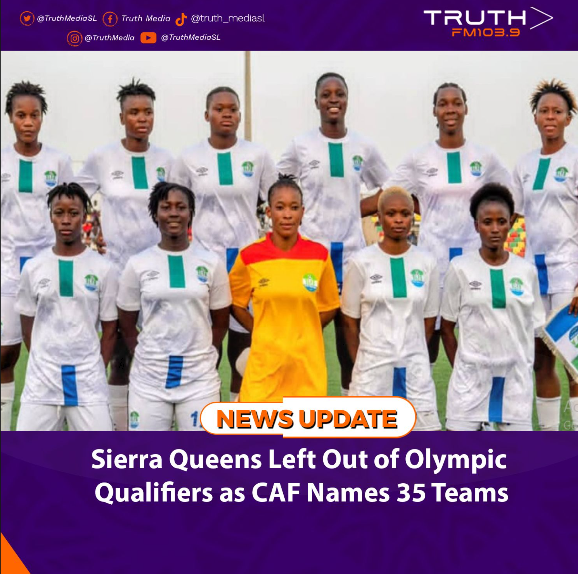
Freetown, 4th May 2026- Sierra Leone’s national women’s football team, the Sierra Queens, has been left off the list for Africa’s qualification campaign to the 2028 Olympic Games, following the release of a 35‑team lineup by the Confederation of African Football (CAF).
The qualification series, scheduled to run from June 2026 to December 2027, will unfold over five knockout rounds, producing just two African representatives for the Los Angeles Olympics. Heavyweights Nigeria, South Africa, and Ghana are expected to lead the charge, joined by rising contenders such as Zambia, Morocco, and Senegal.
CAF confirmed that the format will begin with a preliminary round featuring six lower‑ranked teams, before expanding into a 32‑team bracket. Home‑and‑away ties will steadily narrow the field until only two nations remain.
The absence of the Sierra Queens marks a significant blow at a time when women’s football is gaining pace across the continent. Participation in the qualifiers would have offered vital exposure, competitive match experience, and pathways to investment and professional opportunities, benefits now out of reach for Sierra Leone.
The draw, held on 28th April 2026 in Cairo, listed 35 participating nations, including Algeria, Cameroon, Ghana, Ivory Coast, Kenya, Morocco, Nigeria, Senegal, South Africa, Tanzania, Uganda, Zambia, and Zimbabwe. Sierra Leone’s omission underscores the rising cost of non‑participation as Africa’s limited Olympic slots intensify competition.
Women’s football in Africa is expanding rapidly, with more nations investing in infrastructure, youth development, and professional pathways. The expanded Olympic campaign reflects this growing depth, but also highlights the risks for countries left behind.
As the road to the 2028 Olympics begins, Sierra Leone remains on the outside — missing a pivotal moment in the evolution of women’s football on the continent. For a football‑loving nation, the absence is more than symbolic; it is a reminder of the urgent need to strengthen governance, investment, and commitment to the women’s game.