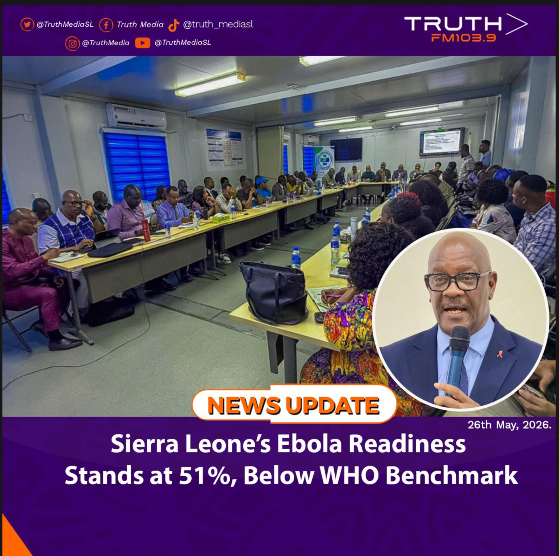
Freetown, 26th May, 2026 – Sierra Leone’s ability to respond to a potential Ebola Bundibugyo Virus Disease (BVD) outbreak has been assessed at 51 percent readiness, significantly below the World Health Organization (WHO) benchmark of 80 percent, according to findings presented at a high‑level stakeholder engagement convened by the National Public Health Agency (NPHA) and the Ministry of Health.
The meeting brought together senior government officials, epidemiologists, public health experts, and technical partners to evaluate preparedness against the ongoing outbreak in the Democratic Republic of Congo (DRC) and Uganda.
Dr. James Squire, delivering the technical update, reported that as of 22nd May 2026, the DRC had recorded 746 suspected cases, 83 confirmed cases, 176 suspected deaths, and 9 confirmed deaths, while Uganda reported five confirmed cases and one death in Kampala. He warned that projections in the DRC could rise to 3,600 suspected cases within 100 days if urgent gaps are not addressed.
“Our national readiness currently stands at 51 percent, below the WHO benchmark of 80 percent,” Dr. Squire disclosed, noting strengths in laboratory readiness (84%), surveillance systems (68%), and points of entry preparedness (63%). However, he stressed weaknesses in infection prevention and control, safe burials, logistics, and risk communication.
Despite these shortcomings, Sierra Leone has made progress: The Public Health Emergency Operations Center has been activated, surveillance protocols updated, ambulance services deployed at Freetown International Airport, isolation facilities identified, and nationwide risk communication campaigns intensified.
The meeting reaffirmed Sierra Leone’s commitment to the “4‑Ones” coordination framework, One Team, One Plan, One Budget, One Monitoring and Evaluation System, aimed at strengthening efficiency in emergency response.
Mr. Michael Kamara showcased the new Point of Entry Travel Portal, a digital innovation designed to enhance border health surveillance and streamline traveller screening.
Closing the session, Prof. Foday Sahr and Dr. Mustapha Kabbah emphasized the urgency of sustained collaboration, early preparedness, and regular simulation exercises.
“Preparedness today is the shield that protects tomorrow’s lives,” Prof. Sahr reminded stakeholders.
Sierra Leone’s 51 percent readiness score highlights both progress and vulnerability compared to regional peers: Liberia and Guinea face similar challenges, with weaker health infrastructure and porous borders. Nigeria, with a larger health system, has scaled up surveillance but continues to battle misinformation. Ghana has invested heavily in laboratory capacity, positioning itself closer to WHO standards for rapid detection.