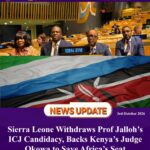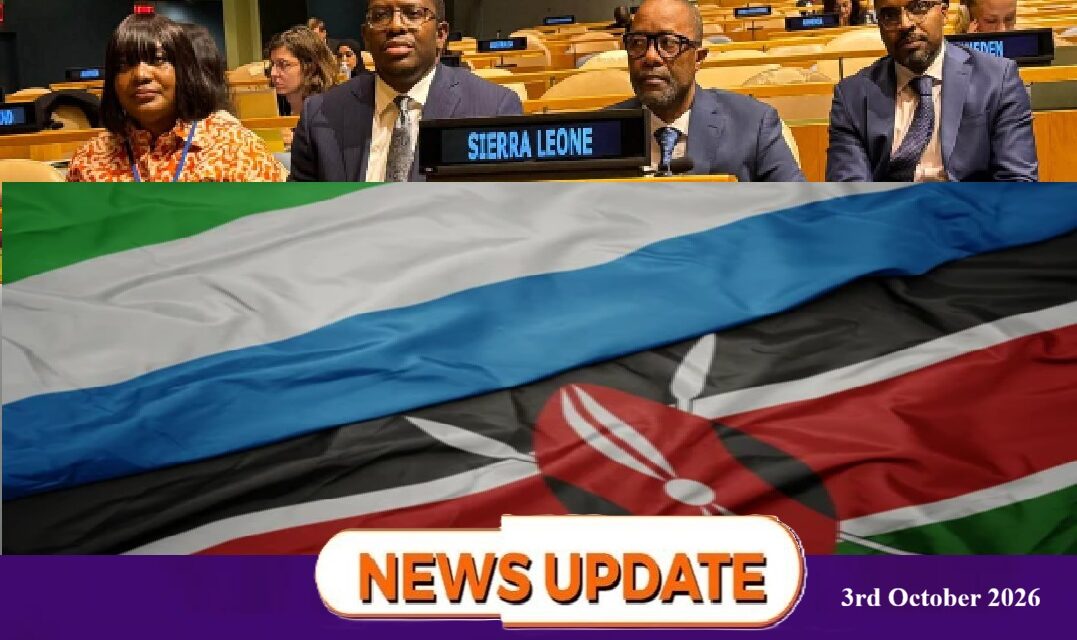
UNITED NATIONS, 3rd November, 2026 – Sierra Leone has withdrawn the candidacy of Professor Charles Chernor Jalloh for election to the International Court of Justice (ICJ), throwing its full weight behind Judge Phoebe Okowa of Kenya in a dramatic move to prevent Africa from losing its seat on the world court.
The announcement was made by Sierra Leone’s Permanent Representative to the United Nations on behalf of the Government, in a statement that framed the decision as a painful but necessary sacrifice for continental unity.
“I take the floor on behalf of the Republic of Sierra Leone to announce that my Government has decided to withdraw the candidature of Professor Charles Chernor Jalloh for election to the International Court of Justice, and to give its full support to Judge Phoebe Okowa of the Republic of Kenya,” the Permanent Representative said.
The envoy paid glowing tribute to Professor Jalloh, describing him as one of the finest international lawyers of his generation.
“We did not take this decision lightly. Professor Jalloh is one of the finest international lawyers of his generation. He was endorsed by ECOWAS, the African Union and the Organisation of Islamic Cooperation, and co-nominated by thirteen Member States from every region of the world,” he said.
“To each delegation that placed its trust in him, Sierra Leone offers its deepest gratitude. That trust was well placed. Professor Jalloh’s work for international law will continue.”
Jalloh, a respected scholar and former member of the International Law Commission, had entered the race with strong African backing. But with two African candidates in the contest, Sierra Leone warned that a split vote risked handing the seat to a non-African contender.
Sierra Leone used the withdrawal to press Africa’s broader case for fair representation on the Court.
“Sierra Leone has said many times that Africa’s two candidates were not competing for one seat. We still believe that. Africa has 54 Member States, more than a quarter of this Organization, and holds only three of the fifteen seats on the Court. That is twenty percent of the bench. No other region is as underrepresented. The status quo is unfair, and it must change,” the statement said.
“But today we face a harder reality. If Africa’s votes stay divided, the continent risks losing even the one seat now open to it, and falling further below its already inadequate share. Sierra Leone will not let that happen. Saving Africa’s seat matters more than any one national candidature. Our decision puts the continent first.”
The statement presented Judge Okowa as a unifying candidate with impeccable credentials.
“Judge Okowa needs no introduction to this Assembly. She was the first African woman elected to the International Law Commission. Since this Assembly and the Security Council elected her last year, she has served on the Court with distinction,” the envoy said.
“She brings deep scholarship, practical experience before the Court, and a commitment to the integrity of international law. Her election would also strengthen the representation of women on the bench.”
Sierra Leone also invoked Article 9 of the ICJ Statute, which requires electors to ensure the Court represents the main forms of civilization and principal legal systems of the world.
“Africa’s common law, civil law, Islamic law and customary traditions belong on that bench. So do the African States that have brought their disputes to the Court time and again,” the Permanent Representative said.
Closing the statement, Sierra Leone appealed to all UN Member States and Security Council members to rally behind Judge Okowa.
“I therefore appeal to all Member States, in Africa and in every other region, and to the members of the Security Council, to vote for Judge Phoebe Okowa. Supporting her is not a favour to Africa. It is the right thing to do for the Court, for fairness, and for the authority of international law,” he said.
“Africa will continue to press for the fair representation it is owed, here and in every principal organ of this Organization.”