Freetown, 30th March, 2026 – Sierra Leone has joined 122 other nations in voting for a landmark United Nations resolution that formally recognizes the transatlantic slave trade as the “gravest crime against humanity.”
The resolution, championed by Ghana and strongly supported by the African Union and Caribbean nations, was adopted by the UN General Assembly on Wednesday. It passed with 123 votes in favor, three against, and 52 abstentions. The United States, Israel, and Argentina opposed the motion, while the United Kingdom and all 27 members of the European Union chose to abstain.
For Sierra Leone, a country whose history is deeply scarred by the forced removal of thousands of its people during the slave trade, the vote carried profound symbolic weight. By supporting the resolution, Sierra Leone reinforced its commitment to global recognition of slavery’s enduring impact and aligned itself with Africa’s broader call for reparative justice.
Ghana’s Foreign Minister Samuel Okudzeto Ablakwa celebrated the outcome, posting a photo of the vote tally with the words: “We did it for Africa and all people of African descent.” Ghanaian President John Dramani Mahama, speaking on behalf of the African Union before the vote, described the resolution as a safeguard against forgetting, urging the world to pursue healing and justice.
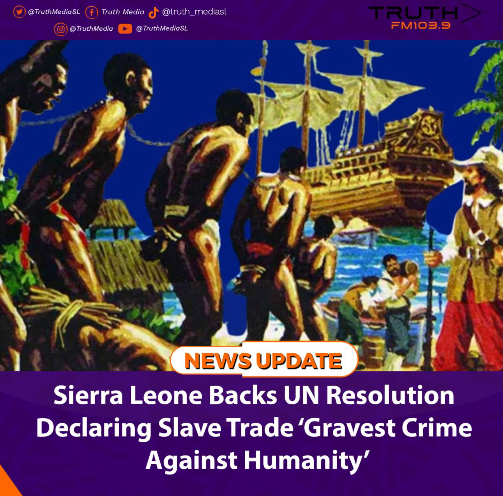
The transatlantic slave trade, which spanned from the 15th to the 19th centuries, saw at least 12.5 million Africans kidnapped, enslaved, and transported to the Americas and the Caribbean. Conditions on the journey were so horrific that only about 10.7 million survived.
Though non‑binding, the resolution carries significant moral and political influence. It opens the door for deeper discussions on reparations, education, and memorialization, while also exposing divisions in the global community. African nations and their allies argue that the legacy of slavery continues to shape racial disparities today, while many Western countries remain hesitant to endorse measures that could lead to reparations.
For Sierra Leone, the vote was more than a diplomatic gesture. It was a reaffirmation of solidarity with Africa’s collective struggle for justice and a reminder that the scars of slavery must be acknowledged as the world strives toward equity and reconciliation.