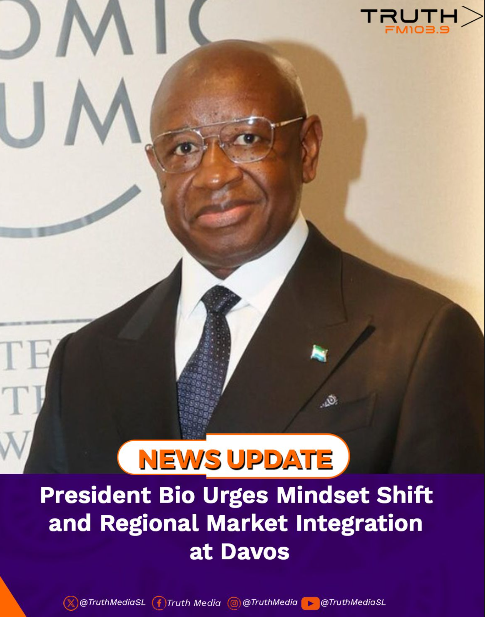
Davos, Switzerland 26th January 2026 – Speaking at the 56th Annual Meeting of the World Economic Forum (WEF), convened under the theme “A Spirit of Dialogue”, Sierra Leone’s President Julius Maada Bio has called for a fundamental shift in Africa’s economic mindset, stressing the need for collective bargaining power, regional integration, and private sector leadership to unlock the continent’s vast market potential.
Addressing fellow heads of state and global investors, President Bio acknowledged the challenges African nations face in mobilizing capital, particularly in sectors such as climate investment and infrastructure. “It is going to be difficult to mobilize capital on our side because investors remain shy of our climate investments and question profitability,” he said. “Yet, they are never shy to come for our resources.”
President Bio emphasized that Africa’s lack of unified bargaining power continues to limit its ability to negotiate favorable terms in the global economy. He pointed to institutions such as the African Export-Import Bank (Afreximbank) that are becoming increasingly aggressive in supporting African ventures, urging more collaboration along that path.
“We, at the political helm, need to change how we think about the world and how important the regional market is for us,” he stated. “We are talking about 1.4 billion people across Africa. In West Africa alone, which I chair under ECOWAS, we represent about 470 million people. These are markets ready for us to create wealth for our citizens but it requires input and bold action.”
Highlighting the need to move beyond political boundaries, President Bio announced plans for an African Economic Summit focused on private sector engagement rather than political rhetoric.
“We must stop using borders to separate us and instead use them to unite us toward economic prosperity,” he said. “I want the private sector to force us, politically, to break these boundaries so that services, money, and businesses can move freely across the continent.”
Bio explained that the summit will bring together business leaders from across the sub-region to identify practical steps for integration. “This is not going to be politics. The private sector will lead, and we will listen. We want prescriptions that can go into action not discussions that remain on paper.”
Reflecting on Africa’s current trajectory, President Bio stressed that leaders must adapt as quickly as the world is changing. “We are still stopping history in terms of mindset. The environment is changing so fast that many of us have missed the point,” he warned.
He concluded by noting the importance of dialogue and innovation in shaping Africa’s future. “It has been a lively discussion here at Davos, with many exciting points raised. Exactly a year ago, we began this conversation, and today we must move from dialogue to action.”