Freetown, 3rd November 2025- The morning after the King Jimmy Bridge collapsed, the air was thick with dust and disbelief. Wallace-Johnson Street, usually bustling, had turned into a scene of horror. Rescue workers dug through rubble as onlookers watched in silence. Six bodies, mostly young men who had been squatting beneath the bridge, were pulled from the debris.
I was there watching and wishing this was just another horror movie, but no it was real. The twisted iron rods, shattered concrete and stunned faces told a story of tragedy that could have been prevented. But King Jimmy Bridge was not an isolated case. It was a warning. And Sierra Leone is ignoring it.
The Railway-Line Bridge: A Colonial Relic on Life Support- Built in the1890s as part of the Sierra Leone Government Railway, the Old Railway-Line Bridge once symbolized progress. Today, it’s a ticking time bomb. Converted into a roadway and pedestrian crossing in the late 1970s, the bridge now groans under the weight of neglect.
Recent inspections reveal: Deep cracks in concrete pillars, advanced corrosion on iron beams, missing slabs exposing rusting steel and washed-out concrete weakening the foundation
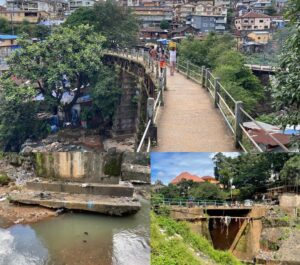
Locals report creaks and rattles whenever cars or heavy duty trucks pass. “The pillars at the centre need urgent strengthening,” said Bailoh Kante, a blacksmith who’s lived under the bridge since 1974. “One footpath pillar has already collapsed,” he added.
Despite these warnings, no repairs have been made. Authorities have placed brackets to restrict heavy trucks but that’s like a bandage on a broken bone.
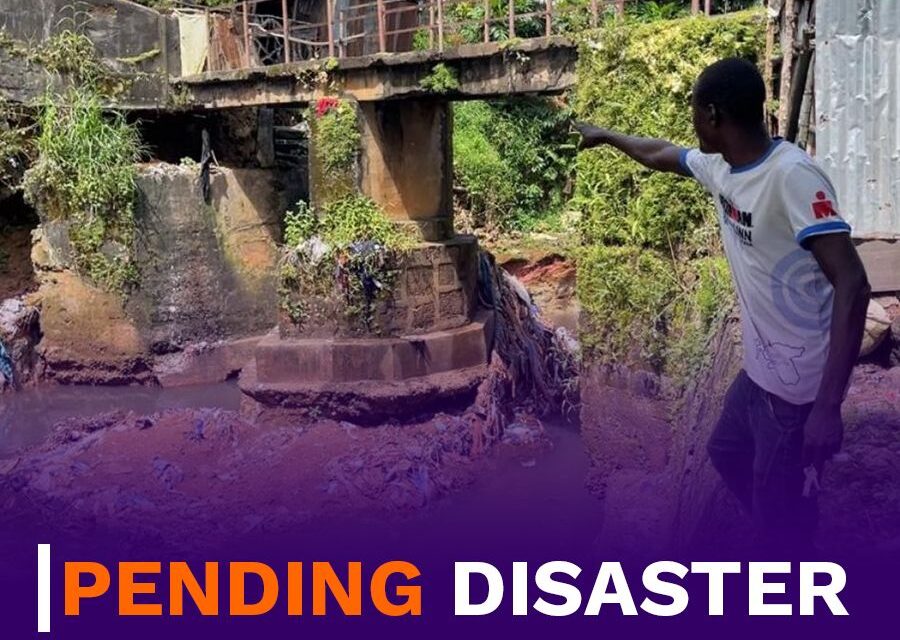
Tengbeh Town Bridge: A Community at Risk- In Tengbeh Town, the bridge connecting homes to schools and markets is eroding fast. Rainfall has washed away the soil supporting its foundation. “It’s risky, but we have no alternative route,” said Abubakarr Conteh, a resident of 15 years.
Nearby, construction worker Abu Kamara is helping a friend whose house is slowly collapsing beneath the bridge. “If something isn’t done urgently, lives will be lost,” he warned.
The Tengbeh Town footbridge, used daily by schoolchildren and traders, is also showing signs of decay. Cracks snake across its surface, and rust eats away at its joints. It’s not just a footpath, it’s a future tragedy waiting to happen.
Expert Warning: Collapse Is a Matter of Time- Civil engineer Ibrahim S. Koroma says the deterioration of Sierra Leone’s bridges stems from three key failures: Lack of routine maintenance, poor drainage systems that erode foundations and overloading beyond structural capacity.
“Bridges are designed to last decades, but only if maintained,” he explained. “Once corrosion sets in and cracks widen, the structure loses integrity. Without intervention, collapse is inevitable.”
Koroma emphasized that preventive maintenance is far cheaper than post-collapse reconstruction. “Reinforcing joints and sealing cracks costs a fraction of rebuilding. But we wait until disaster strikes.”
Rtd. Sergeant Musa Bah, chairman of the Old Railway-Line Bridge community, said engineers have surveyed the site but never returned. “We’re ready to vacate if rehabilitation begins but we need notice,” he said.
Driver Michael Sesay added, “Every time I cross that bridge, I feel it vibrate. It’s terrifying.”
The collapse of King Jimmy Bridge should have been a wake-up call. Instead, it’s become a footnote in a growing list of ignored warnings. Sierra Leone’s bridges are more than infrastructure, they are lifelines. And when lifelines snap, lives are lost.
The government must act, not with surveys and speeches, but with steel and cement. Because the next collapse won’t just be tragic, it will be unforgivable.