By: Emmanuel Mbowa
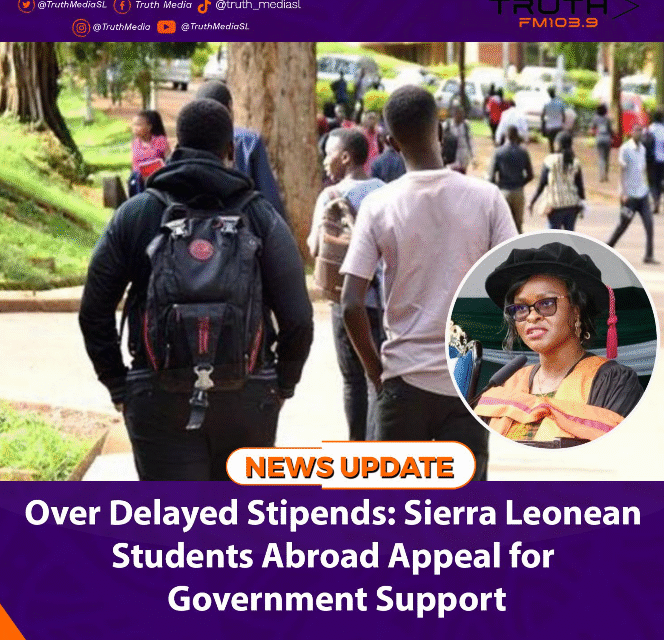
Freetown, 2nd March 2026- Sierra Leonean students studying in Russia, Algeria, and Egypt have issued urgent appeals to the government over delayed stipends, citing severe financial hardship that threatens their academic progress.
In Algeria, frustration runs deep. Students report on the Truth Education Platform that they have gone 18 months without stipends, despite completing all required procedures. “We last received our stipends during the 2023–2024 academic year. Since the start of 2024–2025, we haven’t received anything,” said Abdulai Musa Marah, Internal & External Officer for International Students in Algeria.
Marah explained that repeated appeals to the Ministry of Technical and Higher Education, the embassy, Chief Minister Dr. David Sengeh, and even the Anti-Corruption Commission have yielded no results. “It’s frustrating that we are not allowed to work and cannot perform international monetary transactions. If the government delays these stipends and our parents cannot transfer money to us, how are we supposed to survive?” he asked.
In Russia, students face similar struggles. Bawoh Swahilo Sheku, a fifth-year medical student and Secretary General of the National Union of Sierra Leone Students in the Russian Federation (NUSS-RF), said stipends for the 2024–2025 academic year were last received in August. “For this current academic year, we are now in the second semester of 2025–2026, but we haven’t received any feedback regarding disbursement,” he noted. Sheku warned that over 20 new students have arrived in Russia, where hostel cards are blocked when payments are delayed. “Things are getting out of hand daily,” he said.
For the 50 Sierra Leonean students in Egypt, the challenge is different but equally pressing. Under the Islamic Mission Scholarship, tuition, food, medical, and hostel fees are covered, but the monthly allowance of 1,000 Egyptian pounds (about $20) is far from sufficient. “That is not enough; it barely covers our transport fare,” said Idriss Dabor, a final-year student at Al-Azhar University.
Across all three countries, students stress that their success depends on consistent government support. With strict restrictions on work and monetary transfers abroad, stipends remain their lifeline. “We are here to study and return home with expertise,” Marah emphasized. “These funds play a vital role in our ambitions for our country. We are in dire need.”