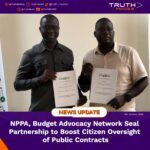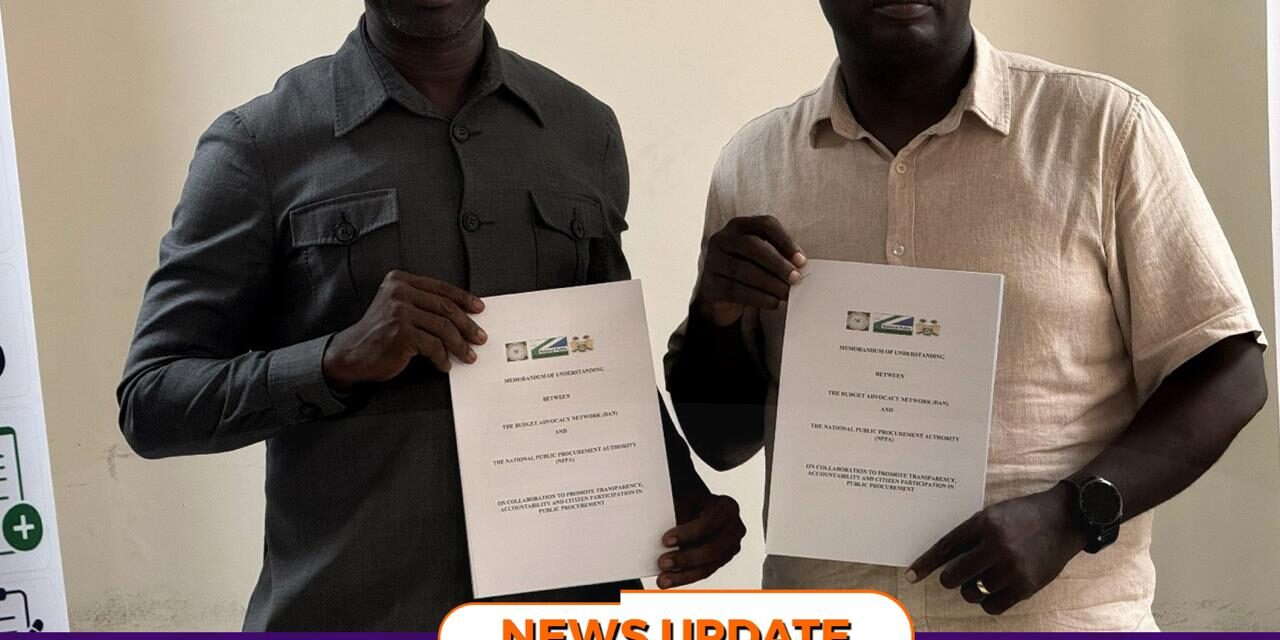
Freetown, 5th October 2026– The National Public Procurement Authority (NPPA) and the Budget Advocacy Network (BAN) have signed a landmark Memorandum of Understanding (MOU) aimed at strengthening transparency and accountability in Sierra Leone’s public procurement system by giving civil society a formal role in monitoring government contracts from award to delivery.
The agreement, signed at the NPPA headquarters, Tower Hill on September 30, comes amid growing concerns over weaknesses in contract implementation highlighted in successive audit reports and as government prepares a new public procurement law that would formally recognise citizen oversight in the sector.
Speaking at the signing ceremony, NPPA Chief Executive Officer Fodi J. Konneh said the partnership seeks to address one of the most vulnerable areas of the procurement process: contract management.
He noted that while public scrutiny has traditionally focused on how contracts are awarded, greater risks often emerge after agreements have been signed.
“Much of the attention paid to procurement has gone to how suppliers are selected. The greater risk now lies in contract management and administration, where public money can be lost after a contract is signed,” Konneh said.
According to him, the initiative is in line with recommendations from the Methodology for Assessing Procurement Systems (MAPS) diagnostic study, which called for stronger civil society involvement in procurement oversight.
Konneh disclosed that the NPPA is simultaneously working with the Ministry of Finance to digitise contract administration through the Electronic Government Procurement (e-GP) system, a move expected to strengthen monitoring and reduce the risk of ineligible expenditure, particularly on donor-funded projects.
He said the Authority’s immediate priorities include consolidating past procurement reforms, enhancing oversight of contract implementation and embedding civil society participation in the revised procurement legislation currently under development.
Under the agreement, both institutions have committed to promoting transparency, integrity and citizen participation in procurement processes, strengthening collaboration between government and civil society, identifying procurement challenges through evidence-based monitoring and improving access to procurement information.
For BAN, the partnership represents an opportunity to expand public accountability beyond budget tracking into the implementation of government contracts.
BAN Coordinator Abu Bakarr Kamara said recent audit findings revealed the need for stronger monitoring mechanisms to ensure contracts deliver value for money and intended public benefits.
He explained that the organisation would work to extend procurement oversight into communities across the country, particularly in areas where regulatory institutions have limited presence.
“Our approach is to follow the money from an evidence-based perspective, so that funds meant for hospitals, schools and other infrastructure are used for their intended purpose,” Kamara said.
He added that the initiative would help ensure government-funded projects reach intended beneficiaries while fostering greater public confidence in the management of state resources.
Kamara further stressed that BAN would maintain its principles of independence, transparency and non-partisanship while working closely with the NPPA to strengthen public engagement in procurement monitoring.
The partnership is also expected to create opportunities for the media, community organisations and traditional leaders to participate more actively in tracking public contracts and reporting on project implementation.
Meanwhile, NPPA Director of Legal Affairs and Board Secretariat, Francis Gbaya, revealed that the Authority is finalising a new procurement bill for submission to Cabinet and Parliament.
According to Gbaya, the proposed legislation contains provisions that would, for the first time, provide a legal framework for civil society organisations to monitor public procurement processes.
He noted that such provisions are absent from the current law, making the proposed reforms a significant step toward greater public accountability.
Gbaya also highlighted another key aspect of the agreement, explaining that unlike a previous arrangement with a civil society consortium, the new MOU imposes no financial obligations on the NPPA.
The absence of funding commitments, he said, removes a major obstacle that previously stalled similar collaboration efforts and allows the partnership to move directly into implementation.
As the draft procurement bill advances through the legislative process, the NPPA and BAN say they will focus on public awareness campaigns, nationwide monitoring activities and citizen engagement initiatives aimed at promoting transparency in the management of public resources.
The agreement marks a significant shift in Sierra Leone’s procurement oversight framework, opening the door for greater citizen participation in monitoring how government contracts are executed and how public funds are spent after projects leave the procurement stage and move into implementation.