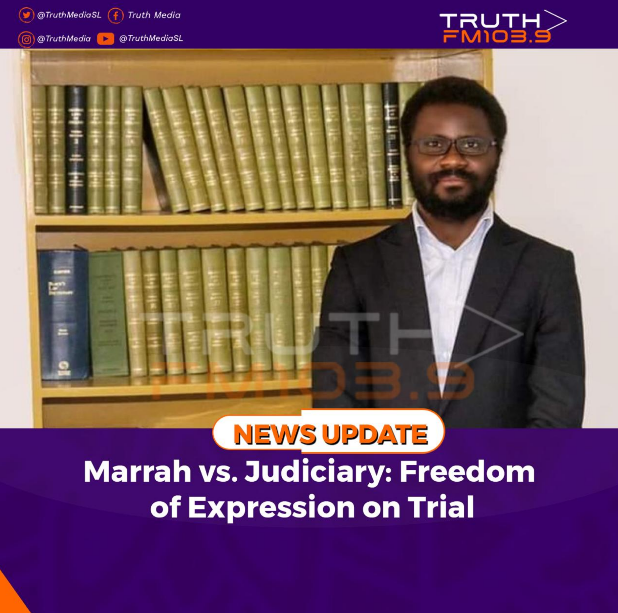
Freetown, 5th January, 2026 – Yet another high-stakes legal battle has emerged at the heart of Sierra Leone’s justice system, as prominent lawyer and President of the Lawyers’ Society, Augustine Sorie-Sengbe Marrah, takes the Deputy Master and Registrar of the High Court, Lloyd Hindolo Jusu, the Attorney General, and the Secretary of the General Legal Council before the Supreme Court.
The issue is whether disciplinary proceedings instituted against Mr. Marrah amount to an infringement of his constitutional rights to freedom of expression and conscience. The case has raised questions about the balance between professional ethics and the right of lawyers to speak openly on matters of public interest.
The complaint against Mr. Marrah stems from remarks he made during a live television appearance on AYV on December 10, International Human Rights Day. Court documents describe his comments as “insulting and disrespectful” toward judges of the superior courts. The affidavit also cites a 2020 contempt conviction and a 2022 incident at a non-judicial meeting where he allegedly stood on a table reserved for the Chief Justice and other judges.
Mr. Marrah, however, insists his remarks were part of legitimate public discourse on judicial reform, access to justice, and democratic accountability. He argues that the disciplinary process violates Sections 24 and 25 of the Constitution of Sierra Leone, which guarantee freedom of thought, expression, and opinion. He further contends that reliance on past incidents already adjudicated amounts to double jeopardy, exposing him to “unfair hearing and unconstitutional penalization.”
In his filing dated December 24, Mr. Marrah seeks a stay of the disciplinary proceedings pending the Supreme Court’s determination of the constitutional issues. His law firm, Marrah and Associates, maintains that any further sanction would be disproportionate and unlawful, given that penalties were already imposed following his 2020 conviction.
The Lawyers’ Society has thrown its full weight behind its president, warning that the use of disciplinary machinery in response to public commentary risks creating a chilling effect on professional independence. “Silence has never been the guardian of justice. Honest speech, not silence, guards justice,” the Society declared in a statement, urging the immediate withdrawal of the complaint.
The Society cautioned against using discipline to silence dissent, stressing that judicial dignity is strengthened, not diminished, by scrutiny met with openness and reform. “Public trust in the Bar and Judiciary is strained; wise leadership restores it through humility and evolution,” the statement added.
The matter stands as yet another test of how Sierra Leone’s justice system handles criticism from within its own ranks. For many lawyers, the outcome will determine whether professional independence can coexist with constitutional freedoms in a democratic society.
As the Supreme Court prepares to hear the matter, the Lawyers’ Society has called on the legal fraternity to unite in defending liberty, dignity, and truth. “Where these prevail, justice flourishes,” the Society affirmed, pledging to keep the public informed of developments.
For Mr. Marrah, the case is not only about his personal defense but about setting a precedent for how lawyers can engage in public debate without fear of reprisal. His challenge has become a rallying point for broader conversations about reform, accountability, and the evolving role of the legal profession in Sierra Leone’s democracy.