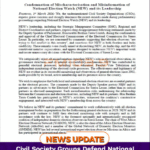
Freetown 23rd February 2016– The Sierra Leone Labour Congress (SLLC) has raised strong objections to the Constitution of Sierra Leone (Amendment) Act, 2025 Bill, warning that several of the proposed changes could trigger instability and undermine democratic accountability.
In a detailed position paper signed by Secretary General Max K. Conteh, the SLLC criticized the government’s review process, noting that unlike previous administrations, the current constitutional review under President Julius Maada Bio excluded the Labour Congress from consultations. The Bill seeks to amend 18 sections of the 1991 Constitution along with provisions in the Public Elections Act, 2022 and the Political Parties Act, 2022.
Among the most contentious proposals is the shift to proportional representation for Members of Parliament, which the SLLC firmly rejected. The Congress argued that such a system would weaken accountability, as MPs would be beholden to party leadership rather than directly answerable to their constituencies. “We firmly reject proportional representation and advocate for retaining the constituency-based, first-past-the-post system,” the statement declared.
The SLLC also opposed provisions allowing independent presidential candidates, raising concerns about regulatory oversight, and rejected proposals to hold elections in November, citing the disruption to social and economic life during end-of-year festivities. Instead, it recommended October or January as more suitable alternatives.
Other objections included: The reduction of resignation requirements for public officers from 12 months to six months before elections, ambiguities in representation for youth and women’s groups, provisions that could allow political parties to expel a sitting president, which the Congress described as “a recipe for chaos,” and amendments that could delay critical state appointments, such as the Chief Justice.
The Congress further highlighted the economic and political risks of the amendments, pointing to contradictions within the Bill and entrenched clauses that require a referendum. It warned that the piecemeal approach to reform, focused narrowly on political and electoral matters, neglected broader issues such as human rights, state policies, the judiciary, and policing.
Calling for restraint, the SLLC recommended that Parliament put the amendment process on hold and initiate a holistic, inclusive national consultation. It urged lawmakers to return the Bill to government for further review of the entire 1991 Constitution, rather than rushing through changes that could precipitate a constitutional crisis.
With over 3 million members across 32 trade unions, the Labour Congress’ intervention adds significant weight to the growing public debate over the proposed constitutional reforms.