By Emmanuel Mbowa
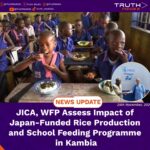
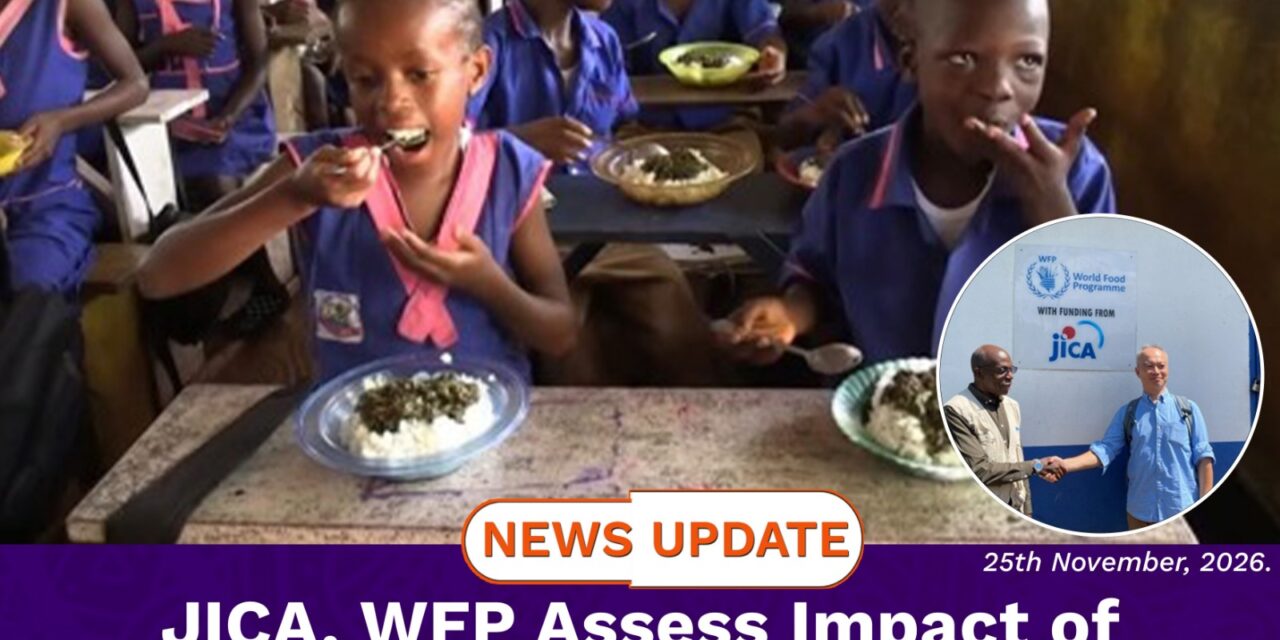
Kambia, 25th November, 2026 – The Japan International Cooperation Agency (JICA) and the World Food Programme (WFP) have undertaken a joint field tour in Kambia District to assess the impact of their support for smallholder farmers and how it is helping to strengthen local food systems and create stronger links between rice production, aggregation, markets and school meals.
The delegation visited three key sites. The Holy Cross Primary School in Rokupr, where they observed Home-Grown School Feeding (HGSF) activities and interacted with the school community. They also visited the Takoradi Agriculture Business Centre (ABC), which is managed by Takeleneh Women Farmers Association to learn about the ‘SATAKE’ rice milling process, aggregation, storage, post-harvest management and market linkages. They further engaged with farmers at Gbom Kally on the application of the Technical Package for Rice Production (TP-R) practices, and discussed their experiences, results and challenges in Inland Valley Swamp (IVS) production, including water management, irrigation and improved agronomic practices.
The Country Director of WFP in Sierra Leone, Andrew Odero, described the visit as heartwarming. “What I witnessed today is very heartwarming, especially engaging with the school children at around lunchtime when their eyes were beaming with anticipation to have their meal of the day. In the interaction, it is very clear that school feeding is enabling the school children to be in an environment where they can develop hopes and aspirations,” he said.
Odero stated that the school feeding provides a place where children can dream and learn formally. “Also, behind every plate there is a huge ecosystem, and this brings me to the point of the farmers who, in the spirit of Home-Grown School Feeding, are able to produce the complementary food that is needed to prepare the school meals, and that in itself is a big injection of additional resources into the local economy,” he said.
On the partnership with JICA and the Government of Japan, Odero stated that Japan is a strategic partner in both Home-Grown School Feeding and in developing rice value chains in Sierra Leone.
“Through the support of the Government of Japan, and specifically working with JICA, we started the process of equipping schools with the necessary facilities to run their school feeding programme. Our first activity, which we did six years ago, was with support from JICA to improve kitchen infrastructure so that children can receive safe and nutritious meals each and every day that they attend school,” he said.
Odero concluded that WFP plays an important role as enabler of Home-Grown School Feeding to happen in Sierra Leone, where they are feeding over 250,000 children in five districts. “We work with the government, through the Ministry of Agriculture and Food Security, as well as the Ministry of Basic and Secondary School Education, to procure locally produced food, which is rice, pulses of different types, and ensuring that the food is available and delivered to the schools at the right time, and the children are fed using these commodities at the right time,” he said.
The Resident Representative of JICA in Sierra Leone, Satoru Matsuyama, said he was impressed with the level of stakeholders’ involvement. “Largely, I am very much impressed that all the stakeholders are involved in the school feeding and rice cultivation and processing, and supporting each other in order to develop their future, particularly for the children who will assume leadership of the country in ten or twenty years to come,” he said.
He clarified the two different supports from the Government of Japan. “There are two different supports from the Government of Japan. The WFP school feeding programme is rather directly from the Government of Japan based on the bilateral agreement between WFP and the Japan Government, while the Improvement of Rice Production project is solely under the responsibility of the partnership between JICA and the Sierra Leonean Government,” he said.
“I can say that the Government of Japan and JICA will continue to support the Sierra Leonean Government and its people for their future,” he assured.
Head Teacher of the Holy Cross Catholic Primary School in Rokupr, Dauda Lamin Kamara, thanked WFP, JICA, the Government of Sierra Leone, and other donor partners for support the school feeding activities in their school. “Through this school feeding, we are now able to retain children in school. Initially, children used to go home before the closing period. But through the help of these donor partners and the government of Sierra Leone with the School Feeding Programme, we are now seeing a good attendance in school,” he said.
Chairperson of the Takeleneh Women Farmers Association, Isata Feika Sesay, said the new milling machine has transformed their rice processing and distribution. “Before, it was challenging for us to extract stones from the rice we milled locally, but the milling machine they have brought for us at Takorodi ABC, has improved the quality,” she said.
She commended WFP for supporting smallholder farmers across various value chains, particularly rice cultivation and production. “The rice we supply to the schools now meet international standards. We now do bulk sales to WFP,” she said.
Sesay disclosed that the centre currently has about 200 metric tons of rice in store, but needs more support with harvesting machines. “This year, I worked on 450 hectares and I couldn’t harvest all of it. Some have dried up in the bush and machines are not available. We hope that if we also receive the machines to harvest for us, we are ready to expand cultivation and production,” she said.
At the end of the visit, JICA and WFP said they had gained a shared understanding of the progress and challenges of TP-R adoption, demonstrated the practical link from production to aggregation, markets and school meals, and identified follow-up actions to strengthened technical cooperation.