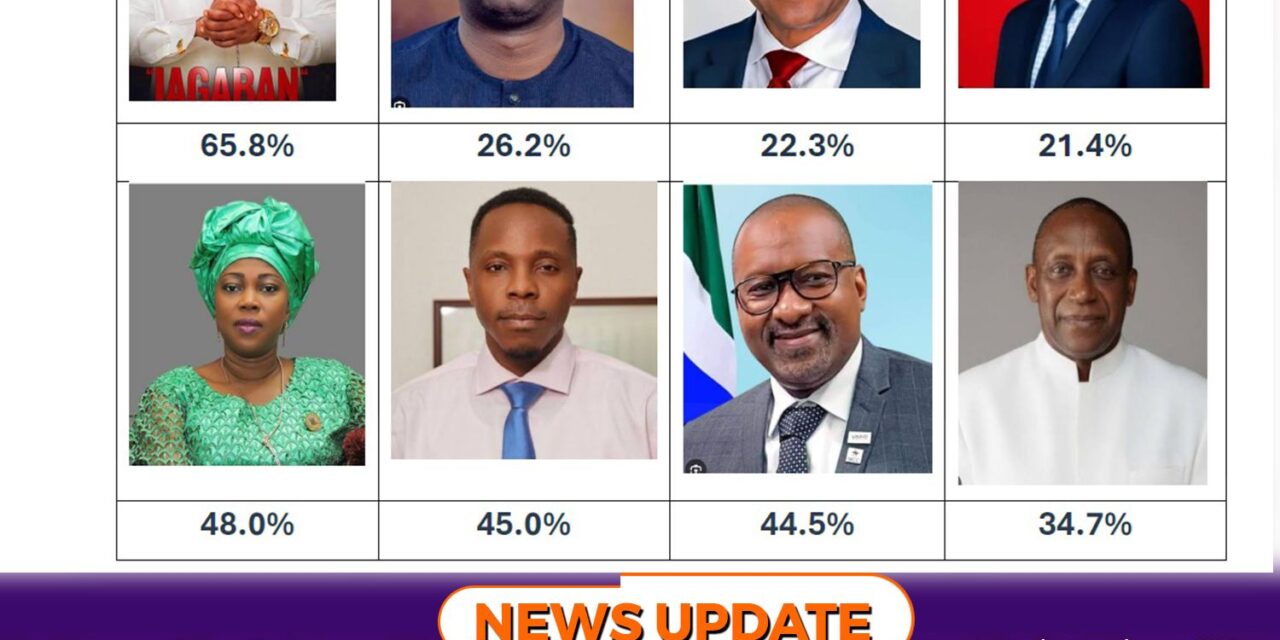
Freetown, 15th October 2026- A new survey by the Institute for Governance Reform (IGR) examining the emerging race for the 2028 presidential election has identified businessman Sheik Mohamed Kamara, popularly known as Jagaban, and First Lady Fatima Bio as the leading contenders in the opposition APC and governing SLPP flagbearer contests respectively.
The findings are contained in the second edition of Sierra Leone’s Political Marathon, a study based on interviews with 2,400 likely voters and 1,025 APC and SLPP delegates. The report provides one of the clearest snapshots yet of public and delegate preferences ahead of the parties’ forthcoming conventions, where candidates for the 2028 presidential election will be chosen.
According to the report, economic hardship, unemployment and the rising cost of living remain by far the most important issues likely to influence both party delegates and ordinary voters. More than 79 percent of likely voters identified the economy and jobs as the most critical concerns that future presidential candidates must address, while more than 72 percent of both APC and SLPP delegates expressed similar views.
The survey suggests that despite political competition between the country’s two dominant parties, there is broad agreement among voters and party insiders that bread-and-butter issues will dominate the next election cycle.
On the APC side, Jagaban emerged as the clear front-runner. The study found that 66.2 percent of APC supporters and 65.4 percent of delegates indicated a willingness to vote for him, giving him an aggregate score of 65.8 percent, far ahead of other contenders.
Trailing him were Dr. Ibrahim Bangura with an aggregate score of 26.2 percent, Dr. Samura Kamara with 22.3 percent, and Chernor Ramadan Bah with 21.4 percent.
One of the report’s most striking findings was the gap between support among ordinary party members and delegates. While Dr. Samura Kamara attracted 34.1 percent support among APC members, his support among delegates stood at just 10.4 percent. In contrast, Dr. Ibrahim Bangura recorded 14.9 percent among party supporters but surged to 37.5 percent among delegates.
In the ruling SLPP, the race appears considerably more competitive.
Among ordinary party supporters, Dr. David Moinina Sengeh led narrowly with 35.8 percent, followed closely by Dr. Kandeh Yumkella on 35.2 percent and First Lady Fatima Bio on 34.3 percent. However, the picture changed significantly among delegates.
The First Lady emerged as the strongest candidate among SLPP delegates with 61.7 percent support, followed by Vice President Mohamed Juldeh Jalloh on 59.8 percent and Dr. David Sengeh on 54.3 percent. Dr. Kandeh Yumkella, despite his strong standing among ordinary supporters, recorded 34.2 percent among delegates.
When delegate and supporter preferences were combined, Fatima Bio topped the SLPP field with an aggregate score of 48 percent, ahead of Dr. David Sengeh at 45.05 percent and Vice President Juldeh Jalloh at 44.5 percent.
The survey also examined which aspirants respondents believed were best equipped to address the country’s challenges.
Among APC supporters, Jagaban was selected by 71.9 percent as one of the candidates most capable of tackling citizens’ priority concerns. In the SLPP, Dr. David Sengeh led that category with 40.1 percent, narrowly ahead of Dr. Kandeh Yumkella at 39.6 percent.
Among delegates, however, First Lady Fatima Bio topped the SLPP rankings at 62.4 percent, while Jagaban led APC delegates with 70.9 percent.
Beyond candidate preferences, the report highlighted a significant divide between ordinary voters and delegates on what qualities matter most in selecting a presidential candidate.
Nearly half of respondents, 47.3 percent, said a candidate’s ability to finance campaigns and support party members was the most important consideration. Delegates, however, placed a much higher premium on party loyalty. Loyalty was identified as a top criterion by 45.1 percent of APC delegates and 53.7 percent of SLPP delegates.
The study concluded that while voters appear focused primarily on economic competence and material support, party insiders are more likely to reward loyalty and long-standing commitment to party structures.
Researchers noted that delegate politics remains difficult to measure because delegates may not always openly disclose their true preferences due to political pressures, influence networks and concerns about repercussions. The report therefore cautions that convention outcomes could still be influenced by endorsements, party hierarchies, campaign resources and other internal dynamics.
The survey was conducted in September and October 2026 and sampled 2,400 likely voters alongside 1,025 delegates drawn from the APC and SLPP. Researchers said the exercise was designed to capture both public opinion and the often less visible sentiments within party structures as Sierra Leone’s political parties prepare for what is expected to be a highly contested battle for the 2028 presidency.