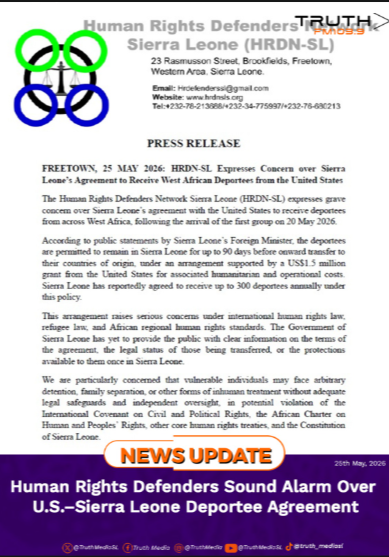
Freetown, May 25, 2026 — The Human Rights Defenders Network Sierra Leone (HRDN‑SL) has raised serious concerns over a new agreement that allows Sierra Leone to temporarily host deportees from the United States, warning that the policy could expose vulnerable individuals to grave human rights violations.
According to the Foreign Ministry, Sierra Leone received its first group of deportees on May 20, 2026, under a deal that permits them to remain in the country for up to 90 days before onward transfer to their nations of origin. The arrangement is backed by a US$1.5 million grant from Washington to cover humanitarian and operational costs, with Sierra Leone reportedly agreeing to accept up to 300 deportees annually.
HRDN‑SL argues that the government has failed to clarify the legal status of deportees, the protections available to them, or the oversight mechanisms in place. The group warns that deportees could face arbitrary detention, family separation, or inhuman treatment, in violation of the International Covenant on Civil and Political Rights, the African Charter on Human and Peoples’ Rights, and Sierra Leone’s own Constitution.
“The principle of non‑refoulement prohibits States from transferring individuals to countries where they may face persecution, torture, or other serious harm,” the statement noted, citing past cases documented by Human Rights Watch in which deportees expelled from the U.S. were later returned to dangerous conditions.
The network also highlighted the risk of statelessness, where deportees unable to return to their countries of origin could be left without nationality or legal protection.
HRDN‑SL has called on the government to:
- Publish the full terms of the agreement with the United States.
- Clarify deportees’ legal status during their stay.
- Guarantee against arbitrary detention or unsafe returns.
- Ensure access to legal aid and healthcare.
- Prevent statelessness under the new policy.
As Sierra Leone positions itself as a partner in U.S. migration enforcement, rights defenders insist that transparency and adherence to international law must be non‑negotiable. The debate now places the government under pressure to explain how it will balance diplomatic cooperation with its obligations to protect human dignity.