Andrew Chokpeleh
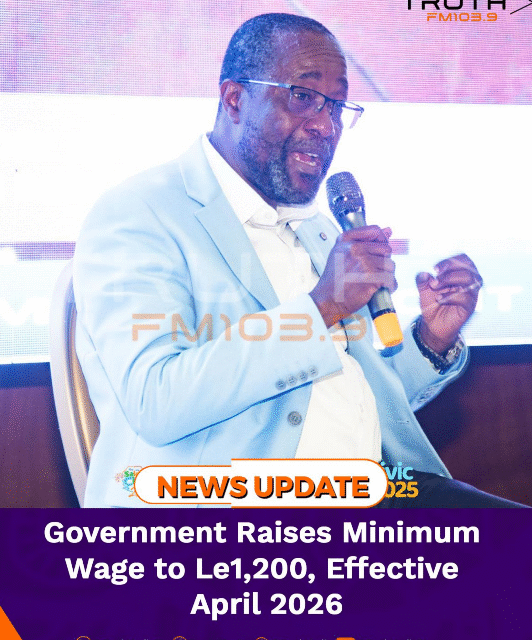
Freetown, 16th December 2025 – The Government of Sierra Leone has announced an increase in the national minimum wage, raising it from Le 800 to Le 1,200, effective April 2026, in a bid to cushion the effects of the rising cost of living.
For years, workers have complained that their salaries do not reflect the effort they put into their jobs. With the price of a bag of rice now around Le 650, the previous minimum wage left workers with just Le 150 to cover other basic needs, a figure widely seen as unsustainable.
Speaking at the Salone Civic Festival, Minister of Employment, Labour and Social Security, Hon. Mohamed Rahman Swaray, said the increase was informed by findings that the cost of living has become “very high, not only in Sierra Leone but globally.”
“Salaries must be able to at least cover basic household bills,” he stressed.
The Minister also acknowledged complaints that some employers continue to pay below the government‑approved minimum wage. He assured the public that enforcement measures will be strengthened.
“This is a serious concern being addressed, and the government will ensure the new minimum wage increase is reflected on workers’ payslips,” Swaray said.
Chief Minister Dr. David Monina Sengeh outlined the government’s broader economic strategy, noting that Sierra Leone aims to become a green economy by 2039, capable of achieving economic independence.
He revealed that the government has allocated US$24 million to the private sector to boost agriculture, which he described as a “key driver of economic growth.”
“We have trained 24 tractor operators, 40 percent of whom are women, to strengthen the sector,” Dr. Sengeh said. “Agriculture will continue to receive the support it needs as we build a thriving economy that enables citizens to live better lives and meet their financial obligations.”
The wage increase is being framed as part of a wider effort to improve livelihoods and ensure workers are fairly compensated.
“The increase in the minimum wage is another step towards improving the lives of Sierra Leoneans and ensuring that workers receive salaries that fairly reflect the effort and hard work they put into their jobs,” Dr. Sengeh concluded.