By Augustine Bamie Anthony
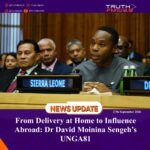
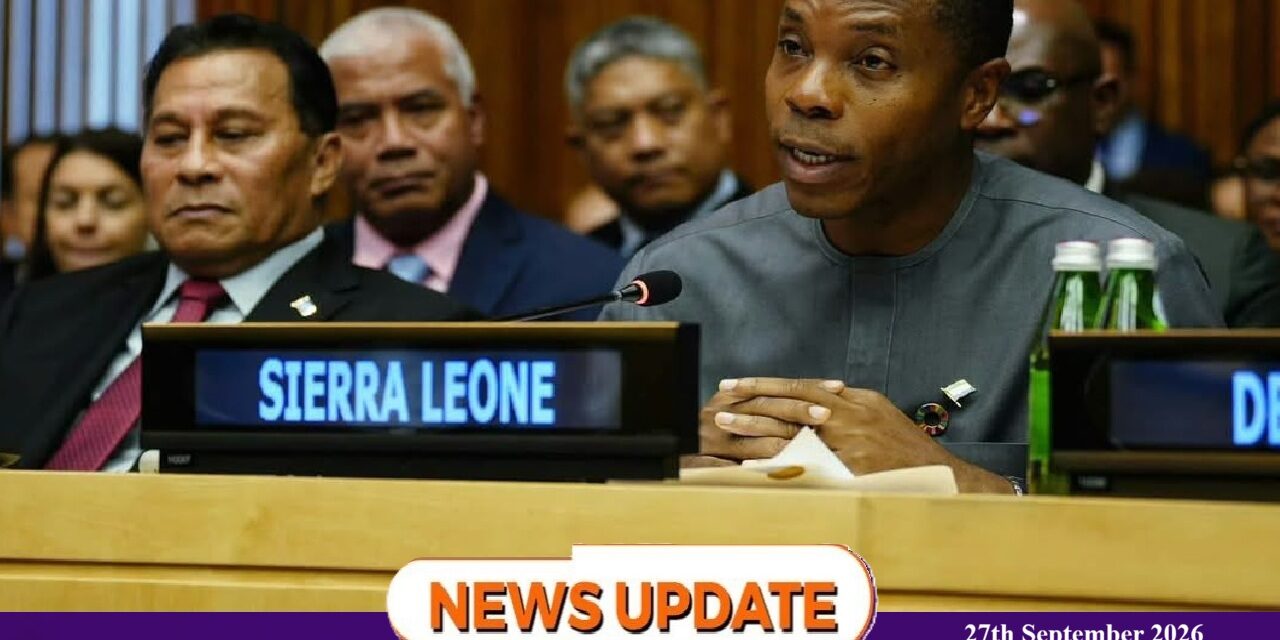
Freetown, 27th September 2026- As world leaders, investors, development partners and global institutions converged in New York for the 81st Session of the United Nations General Assembly, Sierra Leone’s Chief Minister, Dr. David Moinina Sengeh, quietly occupied an increasingly visible space at the intersection of government delivery, international partnerships and global development.
For a Chief Minister whose central responsibility is to coordinate government priorities and support the delivery of President Julius Maada Bio’s development agenda, Dr. Sengeh’s engagements at UNGA81 have reflected a consistent message: partnerships matter most when they translate into delivery for citizens.
His week opened at the 2026 Global Citizen NOW, where Dr. Sengeh joined Prime Minister Gaston Browne of Antigua and Barbuda and Zoisa North-Bond of Octopus Energy for the opening session, “Powering Progress: From Perspective to Delivery.” The theme itself captured the approach running through his engagements in New York, moving beyond ideas and commitments towards practical results.
Energy: Turning Partnerships into Investment
Dr. Sengeh subsequently engaged Octopus Energy, alongside Minister of Energy Cyril Grant, on Sierra Leone’s pioneering hybrid renewable-energy project combining wind, solar and battery storage on Bonthe Island.
The engagement was more than an energy discussion. It reflected Sierra Leone’s ambition to use partnerships, innovation and renewable energy to support industrialisation and expand access to reliable power. With energy access having increased significantly in recent years, the government has set an ambition of reaching 78 percent population access by 2030.
AI: Putting Sierra Leone at the Centre of Innovation
From energy, Dr. Sengeh moved into one of the defining conversations of the global economy: artificial intelligence. At high-level discussions on AI and Human Development, he presented Sierra Leone’s vision of a “Country-as-AI-Lab”, building on the country’s National Innovation and Digital Strategy and its ambition to use technology to improve public services and decision-making.
His message was direct: Africa should not merely consume technologies developed elsewhere. African countries should participate in shaping, testing and deploying innovations that respond to their own realities. For Sierra Leone, that means using the country as a place where promising innovations can be “seeded, tested and scaled” for wider impact.
Infrastructure: Making Investment Bankable
Dr. Sengeh also turned his attention to one of Sierra Leone’s most significant infrastructure ambitions—the Lungi Bridge. Together with Dr. Edward Sandy of the National Investment Board, Dr. Sengeh met Accrow Bridge to review progress on the project and the studies required to make it bankable.
The planned traffic-flow, environmental and social studies are intended to provide critical evidence for attracting private financing, building on existing US Government support for the project.
The message was one of measured ambition: Sierra Leone welcomes foreign direct investment, but major national projects must be approached systematically and on sound technical and financial foundations.
Africa’s New Generation of Leadership
Dr. Sengeh’s UNGA engagements also carried a strong regional dimension. Meeting Senegalese President Bassirou Diomaye Faye, Dr. Sengeh described him as a symbol of a new generation of pragmatic, visionary and results-oriented African leaders committed to delivering for their people and the continent. The interaction underscored Dr. Sengeh’s ability to operate beyond Sierra Leone’s national agenda and within the wider African leadership and development conversation.
Education: Taking Sierra Leone’s Story to the World
Perhaps one of the most significant moments came when Dr. Sengeh represented President Bio at the Global Partnership for Education event, “Multiply Possibility: A New Era for Education.”
Drawing on his previous experience as Minister of Basic and Senior Secondary Education and his longstanding involvement in global education initiatives, Dr. Sengeh placed Sierra Leone’s education financing experience within a broader international conversation.
His central message was unequivocal:
“Equitable education depends on equitable and dignified partnerships.”
He further emphasised that investment in education is an investment in economies, communities and future generations.
At the GPE event, global partners mobilised $3.5 billion for education, while Sierra Leone highlighted its domestic commitment to education financing and the importance of sustained international partnerships.
Civic Day USA: Bringing Government Closer to Citizens
Away from the formal UNGA rooms, Dr. Sengeh also featured in the Civic Day USA edition organised as part of the government’s wider civic-engagement programme.
The event provided an opportunity for Sierra Leoneans and stakeholders in the United States to engage with senior government representatives on national development and the role of the diaspora. It was a reminder that international engagement is not only about governments meeting governments. It is also about connecting national development priorities with citizens wherever they live.
From energy to AI, from infrastructure to education, and from international partnerships to citizen engagement, Dr. Sengeh’s UNGA81 engagements have placed delivery at the centre of Sierra Leone’s presence on the global stage.