By Davida Spaine-Solomon
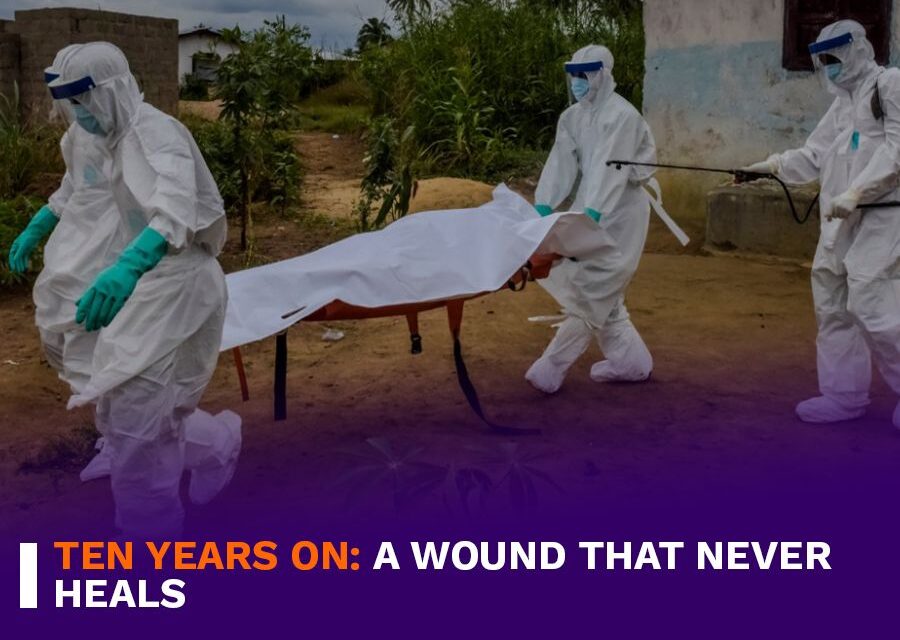
Freetown, 7th November 2025- Ten years after Sierra Leone was declared free from the deadly Ebola virus, the memories remain vividly etched in the hearts of survivors, families, and communities that bore the weight of one of the nation’s darkest chapters.
At the Kingtom Cemetery in Freetown, where hundreds of Ebola victims were laid to rest, the air was heavy with remembrance. One of the two Ebola graves was being cleaned at the early hours of my visit; members of the Freetown City Council and sanitation workers moved quietly, their gestures symbolizing respect for lives lost and the country’s continuing journey of healing.
But beyond that solemn activity lies a painful truth. What was once a sacred ground of mourning and remembrance has gradually become a dumping site for garbage and dirt. Piles of waste now surround the resting place of those who died during the outbreak a stark reminder of how quickly tragedy can fade from collective memory.
It was there that I met Brima Deen, a father still haunted by loss. His daughter was one of the many who died during the Ebola pandemic, buried without ceremony or farewell.
“I don’t even know where she was buried,” he said softly, his voice heavy with pain. “That’s the worst part. I lost her, and I never got to say goodbye.”
Brima recalls the fear that gripped communities, the sound of ambulances piercing the night, and the silence that followed when families were separated by force of circumstance. Even now, a decade later, his pain remains.
“The country is moving on, and I’m glad the disease is long gone,” he said. “But for some of us, the trauma will never fade.”
Nearby stood Aminata Kamara, whose sister a nurse lost her life serving on the frontlines. Tears welled in her eyes as she recounted the courage her sister showed.
“She died doing what she believed in, but her death left a hole that time can never fill.”
The 2014–2016 Ebola outbreak claimed 3,956 lives in Sierra Leone, leaving behind grief, trauma, and orphans but also lessons in resilience and solidarity.
In a statement marking the anniversary, Freetown Mayor Yvonne Aki-Sawyerr reflected on that painful but unifying period in the country’s history:
“Today is the 10th anniversary of the end of the Ebola outbreak in Sierra Leone. Announced by the World Health Organization in the Bintumani Conference Centre on Saturday, 7th November 2015, it was an emotional day in which we celebrated our collective triumph over a disease that took the lives of 3,956 of our compatriots. Today we remember those who lost their lives and the families they left behind. May their souls rest in peace. We also continue to remember the Ebola survivors whose lives would never be the same again, scarred by the ravages of the disease.”
She went on to reflect on her personal role in the national response:
“I am grateful for the opportunity to have served on the frontlines of one of the biggest challenges our nation has faced. From my initial advocacy in the UK to draw international attention to the outbreak, to my role as Director of Planning for the National Ebola Response Center, I am grateful that God gave me the courage to step forward and make a difference when it was most needed.”
Mayor Aki-Sawyerr also extended gratitude to former President Dr. Ernest Bai Koroma, Rtd. Captain Palo Conteh, and all those who risked their lives to end the outbreak.
“Yellow was the colour of the response, signifying hope,” she said. “I am grateful for this example of what can be achieved when we put our nation first and join hands to fight for the greater good.”
As the sun set over the Kingtom Cemetery, the contrast between decay and devotion was unmistakable. Amid the piles of dirt and neglect stood people like Brima and Aminata living witnesses of the tragedy, carrying memories that refuse to fade.
For them, remembrance is not just about marking a date it is about restoring dignity to the departed, honouring the courage of those who served, and reminding the nation that healing requires both memory and respect.
Even as Sierra Leone moves forward, one truth remains unshaken: the scars of Ebola run deep, but the spirit of the people runs deeper.