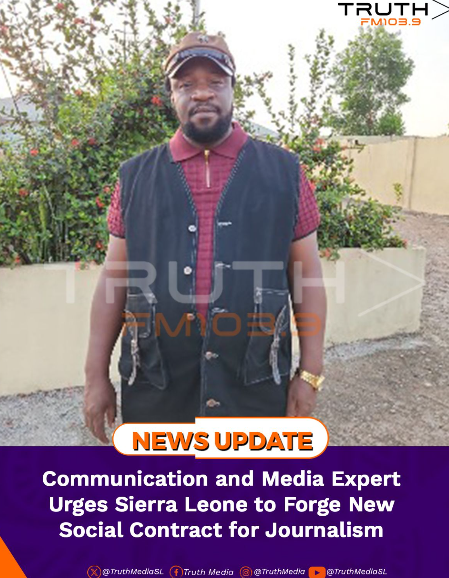
Freetown, 4th May 2026- As Sierra Leone joined the world in marking World Press Freedom Day on 3rd May 2026, media and communication expert Dr Tonya Musa has called for a “new social contract” for journalism, one that guarantees protection, sustainability, and independence for the country’s press.
The call comes amid troubling signs. Sierra Leone has slipped 23 places in the 2026 World Press Freedom Index, falling from 56th to 79th globally. Even more alarming is the plunge in the safety indicator, from 71st to 112th, reflecting rising threats and violence against journalists during politically sensitive periods.
“The most pressing concern is the country’s sharp decline on the World Press Freedom Index, dropping from 56th to 79th in just one year”.
Dr Musa further noted that legal reforms, including the repeal of the 1965 Public Order Act in 2020, were hailed as milestones. Yet concerns persist. The 2025 Counter‑Terrorism Bill and provisions in the Cyber Security Act have raised fears of misuse, with editors reportedly summoned on charges such as “cyberstalking.” Journalists warn that these developments risk eroding earlier gains.
Economic fragility, he said, adds another layer of vulnerability. With most outlets struggling to survive, financial dependence leaves them exposed to political influence. Noting that independence is compromised when survival hinges on state or advertiser support.
“Sustainable journalism cannot exist without sustainable revenue models. Financial vulnerability leaves media institutions exposed to political influence, blurring the line between independence and survival, and raising difficult ethical questions about the true autonomy of the press”.
Digital innovation, while empowering, has also unleashed disinformation and surveillance. The Sierra Leone Association of Journalists (SLAJ) has warned that political actors increasingly exploit online platforms to spread falsehoods and inflame tensions.
“The Sierra Leone Association of Journalists (SLAJ) has warned that digital platforms are increasingly exploited by political actors to spread falsehoods and inflame public tensions. Weak regulatory clarity and unchecked surveillance further complicate the ethical landscape”.
The media scholar argued that resilience requires investment in community‑based media literacy and stronger legal protections. They pose critical questions: How can Sierra Leone rank well in legal frameworks yet perform poorly overall? Can journalism remain independent when its survival depends on external funding? And how should societies balance content moderation with the risk of disguised censorship?
President Julius Maada Bio has acknowledged the stakes, noting that “The media remains a fundamental pillar of democracy… a free and empowered press is central to transparency, accountability, and informed civic engagement.” Dr Musa stressed that realizing this vision demands more than rhetoric, it requires action.
He also maintained that ethics, too, must take center stage. With laws often vague or open to manipulation, journalists need robust ethical frameworks to navigate grey areas responsibly. Without this, economic precarity risks transforming watchdogs into instruments of those who control financial resources.
He ends by indicating that Sierra Leone stands at a crossroads. And journalism’s future depends on forging a new social contract.
“The future of its journalism will depend on whether it can forge a new social contract, one that protects journalists, sustains media institutions, empowers citizens, and upholds the fundamental principles of truth and accountability.”
Note: Tonya Musa- PhD is a senior academic, communications and media expert at the University of Sierra Leone, serving as Director of Communications and International Relations and a lecturer at Fourah Bay College (FBC). He is widely recognized for his work in media, communication, and institutional advocacy.