By Nafisatu Olayinka Deen
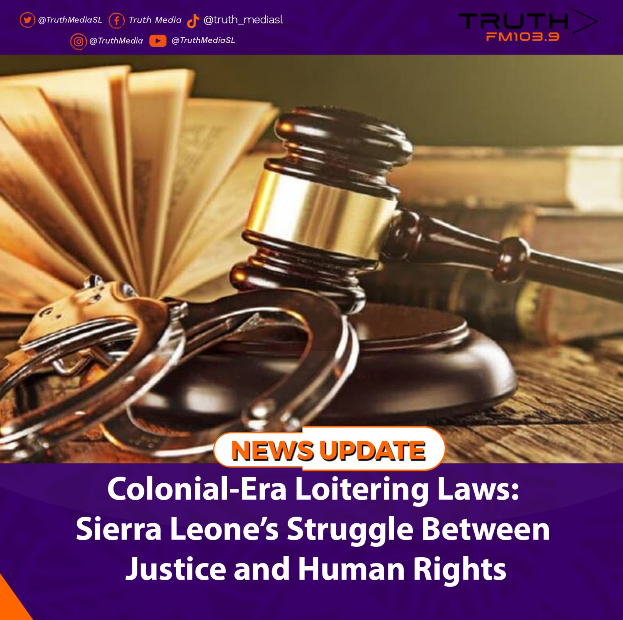
Freetown, 2nd March 2026- For decades, laws inherited from colonial rule, such as loitering statutes have lingered in Sierra Leone’s legal system. The Truth and Reconciliation Commission (TRC) report underscored the urgent need to reform these outdated provisions, recommending a thorough review to align the country’s justice framework with democratic values and human dignity.
The Law Reform Commission which is the statutory independent body established under The Law Reform Commission Act 2017, is an independent body responsible for reviewing, reforming, and proposing changes to Sierra Leone’s laws. The commission has been working diligently to ensure that our laws remain relevant, just, and in tune with the changing needs of our society.
In Sierra Leone, there’s growing recognition that laws criminalizing loitering are indeed incompatible with fundamental human rights.
In November 2024, the ECOWAS Court Ordered Sierra Leone to Repeal Loitering Laws Violating Human Rights. The Community Court of Justice of the Economic Community of West African States ruled that Sierra Leone’s loitering/vagrancy provisions (e.g., in the Public Order Act and Summary Conviction Offences Ordinance) violate fundamental human rights The Court found that these laws discriminate against economically disadvantaged and marginalised groups, violating the right to non-discrimination and equality before the law.
“Our loitering laws as currently written and applied are widely viewed as incompatible with fundamental rights, both domestically and under regional human rights standards,”
said Thomas Moore Conteh Esq, Executive Director, Citizens Advocacy Network (CAN)
In a press release by AdvocAid, dated 7 March 2024, the Economic Community of West African States (ECOWAS) Community Court of Justice ruled in favour of AdvocAid in a lawsuit against the Republic of Sierra Leone that challenged the country’s loitering laws, which AdvocAid argued unjustly targets the poor and vulnerable and violates fundamental human rights. The Court’s judgement ordered Sierra Leone to amend or repeal these laws, emphasising the need for legislation that protects all citizens from arbitrary arrests and abuse.
Speaking to Truth Media, Abdulai Sama who had been arrested a few years ago for loitering recounted his experience, citing that it was an infringement upon his right to move freely.
“I was arrested at around 1 AM after I left the club where I worked as a DJ to head home. I was stopped and questioned by a police van; I explained myself and was searched but I was still arrested and placed in the van. I could have been home sleeping but I couldn’t and I felt a lot of discomfort.
I complied and didn’t ask even though I felt that it was inhumane to restrict me even after searching me and I did not possess anything that could be linked to any criminal activity or illegal activity. I saw others get thrashed for asking questions and that is pure abuse. I even witnessed a couple being arrested that same day and joined me in the van,” he complained.
He also mentioned that he was bailed by his boss who paid for his release. Abdulai Sama acknowledges that police patrols and stop‑and‑search practices at night are important for maintaining public safety. However, he believes that anyone not carrying illegal or suspicious items should be allowed to continue freely without hindrance.
Thomas Moore Conteh Esq said that the TRC’s broad human rights agenda supports targeted reform campaigns (including against loitering laws) by anchoring them in a constitutional and moral commitment to human rights, fairness, and the rule of law. He believes that If Sierra Leone repeals or reforms its loitering laws in line with the ECOWAS Court’s judgment, alternatives should aim to balance public order with rights protections.
“In order to balance public order with rights protections, Sierra Leone should establish clear, conduct-based public order offences rather than vague terms like “idle” or “disorderly,” laws should Focus on specific harmful behaviours (e.g., obstruction, vandalism, violence) that demonstrably threaten public safety, and the laws should include clear definitions and thresholds that are predictable and enforceable without arbitrary discretion,” he said.
The persistence of colonial-era loitering laws in Sierra Leone highlights the tension between outdated legal frameworks and modern democratic values. With the ECOWAS Court and other human rights organizations all underscoring the incompatibility of these statutes with fundamental rights, the need for reform is undeniable.
As voices like Thomas Moore Conteh and organizations such as AdvocAid remind us, repealing or revising loitering laws is not merely a legal exercise; it is vital in ensuring justice, equality, and dignity for all citizens. By replacing vague, discriminatory provisions with clear, conduct-based public order offences, Sierra Leone has the opportunity to strengthen both public safety and human rights, setting an example for progressive legal reform across the region.
‘This story is brought to you with support from the Africa Transitional Justice Legacy Fund (ATJLF) through the Media Reform Coordinating Group (MRCG), under the project ‘Engaging Media and Communities to Change the Narrative on Transitional Justice Issues in Sierra Leone.’