By Nafisatu Olayinka Deen
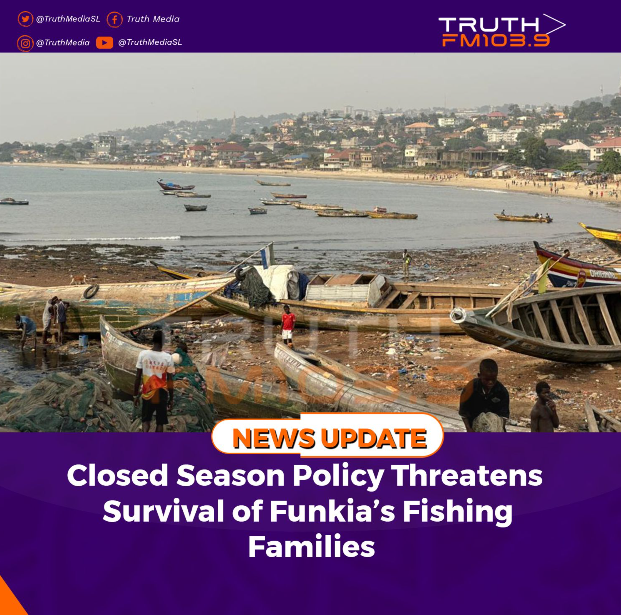
Freetown, 26th January 2026– Artisanal fishing remains the backbone of survival for thousands of families across Sierra Leone’s coastal communities. For generations, men and women have relied on the sea not only for food but also for income, education, and dignity. In Funkia, England Ville Wharf, this occupation is more than a trade; it is life itself.
According to the Feed Salone Strategy for the Fisheries and Marine Resources 2025 report developed by the World Bank, “The fisheries sector is of great economic importance and provides livelihoods for about 14 percent of Sierra Leone’s population, with women playing key roles in processing and trade.” The report further acknowledges that fisheries contribute significantly to the country’s GDP, underscoring the sector’s central role in national development.
Yet, as the government prepares to enforce another “closed season” in February 2026, a one-month suspension of artisanal fishing anxiety and frustration ripple through Funkia Wharf. For residents whose lives revolve around the sea, the looming ban feels like a prison sentence.
“I’ve lived in this community for over three decades and fishing is the only thing I know,” said Apiah Mensah, a seasoned fisherman. “It has sustained me and my family for years. I never went to school, but through fishing I have been able to educate my children. Without it, we have nothing.”
His words echo across the community. Young Fatmata Conteh, mending her father’s fishing net, explained how her parents’ work has shaped her life. “My mother is a fishmonger and my father is a fisherman. Their occupation is what feeds us, what pays for our schooling. Fishing is what brings food to the table.”
For single mother Aminata Sesay, the trade is her only lifeline. “I have been a fishmonger for over a decade. Selling fish is the only way I can provide for my children. Without it, I don’t know how we will survive.”
Similarly, Kadiatu Bangura, another fishmonger, described how her husband’s unemployment has made her the sole breadwinner. “Selling fish is what sustains my family. If the wharf closes, we are left with nothing.”
The closed season policy, introduced under the Feed Salone Strategy, aims to protect declining fish stocks and address environmental degradation. The World Bank report warns that Sierra Leone’s fisheries yield about 250,000 metric tons annually, but climate change and overexploitation have led to biomass decline, threatening food security and livelihoods.
While conservation is the stated goal, fishermen argue that the policy leaves them destitute. “The closed season makes life unbearable,” said Mensah. “We struggle to get a daily meal. If our only source of income is withheld for an entire month, how can we survive?”
Some fishermen have already migrated to neighboring Guinea during the ban, while others are considering leaving this year. Compounding the hardship is the rising cost of fishing licenses, which have jumped from 1,000 new Leones to 3,000 a blow many cannot afford.
For boat master Bangalie Sankoh, the timing of this year’s ban is particularly cruel. “The closed season lasts for a month, and this year it will collide with Ramadan. As a Muslim, I wonder how I will feed my family during such a sacred time.”
Residents also recall broken promises of government support. “We were told we would receive food supplies last year, but nothing came,” said Fatmata. “We even paid for coupons, but no help arrived. Only boat masters got a bag of rice each. How can fishmongers survive when the wharf is closed? Business becomes stiff, crime rises, and young people turn to petty theft just to eat.”
She added that January’s limited catches left families unable to save for February. “It is going to be hell for us. I plead with the government to remove this closed season. Local fishing is our only means of survival.”
The socio-economic consequences of the closed season are already visible. Residents warn of rising hardship, increased petty crime, and growing desperation. Women, who dominate fish processing and trade, say they are disproportionately affected, as their businesses collapse when supply is cut off.
Community members are calling on the government to provide sustainable alternatives during the ban, including reliable food supplies and financial support. Without such measures, they argue, the policy risks deepening poverty and eroding trust between citizens and the state.
For Funkia Wharf, the sea is not just a resource, it is the heartbeat of the community. As February approaches, the people brace for another month of silence on the water, praying that their cries will be heard before livelihoods are drowned in the tide of policy