By Samuel Hinga Norman
Freetown, 10th August, 2026 – As Sierra Leone enters a new decade of Civil Registration and Vital Statistics (CRVS), the Director General of the National Civil Registration Authority, Mohamed Mubashir Massaquoi, has noted that approximately 93 percent of the country’s population has been registered with the NCRA and emphasized that that every child must have a legal identity from birth.
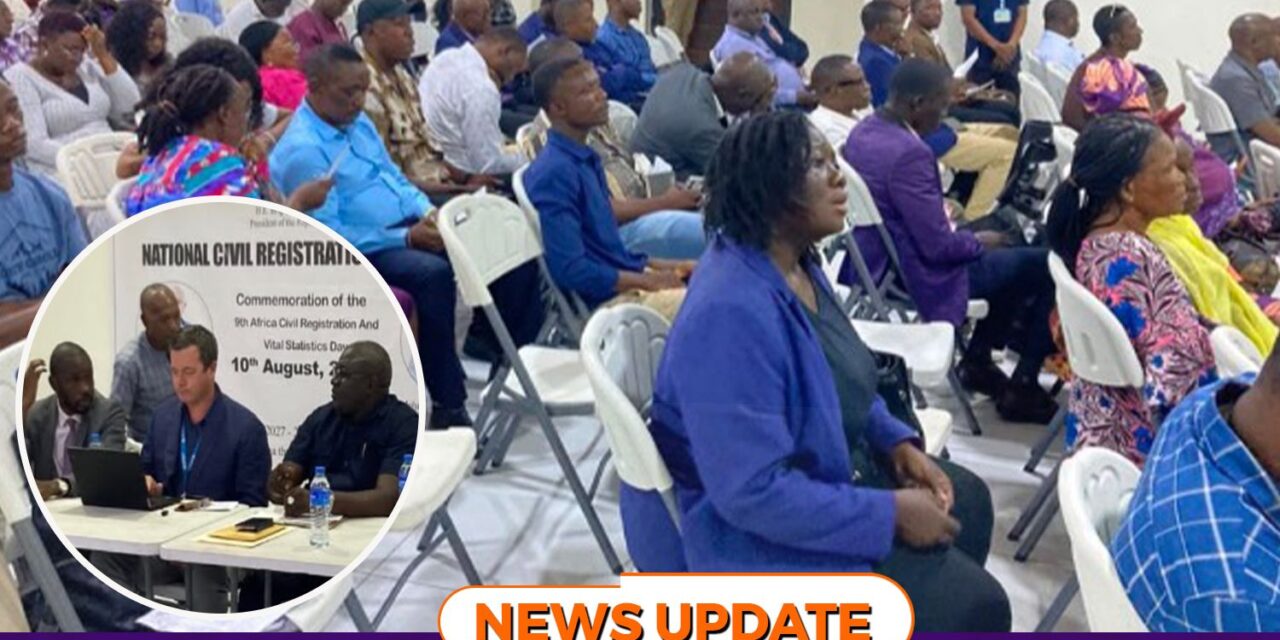
He noted that registration gives a child legal recognition and establishes the relationship between the child and the state. He made this statement on Monday, 10th August 2026, at the National Civil Registration Authority (NCRA) Conference Hall on Kingharman Road, Freetown, during a press conference commemorating Africa Civil Registration and Vital Statistics Day.
Massaquoi further reaffirmed NCRA’s commitment to ensuring that no individual is excluded from the civil registration system. “We hold firmly to the conviction that civil registration is both a right and a necessity to leave no one behind, no event unregistered, and no one unaccounted for,” he said.
For NCRA, the future of civil registration goes beyond issuing certificates. It is about creating a reliable identity system that follows an individual throughout their life.
“The future of civil registration does not merely lie in the production of a certificate; its true value lies in the creation of a trusted, continuous, and lifelong identity system that assures the recognition and rights of all, where no one is left behind,” Massaquoi said.
To illustrate this vision, he asked stakeholders to imagine a Sierra Leone where registration at birth becomes the beginning of a child’s lifelong identity journey. “Let’s imagine a Sierra Leone where a child being registered at birth sees that registration becomes the beginning of a lifelong identity journey,” he said.
The gathering brought together representatives from government, UNICEF, the Bank of Sierra Leone, the Children’s Forum Network, the Market Women Union, civil society and the media. The event marked the close of the 2017–2026 CRVS decade and the beginning of a new decade, running from 2027 to 2036, under the theme: “The New CRVS Decade (2027–2036): Consolidating the Gains of APAI-CRVS and Securing the Future of CRVS in Africa through Integration, Decentralization, and Digitization.”
Discussing the importance of child birth registration, UNICEF Chief of Child Protection, Patrick Hilton, described birth registration as far more than an administrative procedure. For children, he said, registration establishes their legal identity and opens the door to fundamental rights, including recognition of their name, nationality and protection under the law. “For children, birth registration is much more than an administrative process. It is the foundation of legal identity and a gateway to rights. It establishes a child’s existence before the law and supports their right to a name, nationality and protection,” he said.
Hilton also highlighted the protective role of a birth certificate, particularly in preventing children from becoming vulnerable to exploitation. “A birth certificate can help safeguard children from child marriage, trafficking, child labor and other forms of exploitation,” he noted.
He also called for birth registration services to be integrated into the systems families already use. “Moving forward, birth registration services must be fully integrated into the systems families use every day, including maternity services, health facilities, immunization programmes and community health platforms,” he stated.
While commending NCRA for the progress made, a civil society representative, Alphonso Manley, stressed that more must be done to achieve universal civil registration. His call was simple but fundamental. He said, “Every child should have the opportunity to obtain a legal identity from birth.”
Representing the Children’s Forum Network, Mary Julius placed the issue directly from a child’s perspective. “For us children, Civil Registration is more than just a database, certificate and administrative processes. Civil Registration is about our identity; it’s about our rights, it’s about our protection, and it’s about our future,” she said.
Julius described birth registration as a key to children’s development, stating that “it’s the first magic key that unlocks many opportunities for us as children.” She further encouraged the leadership of NCRA to make children’s registration a priority while strengthening efforts to ensure children could transition from birth registration to obtaining national identity cards.
The close of the 2017–2026 CRVS decade is, therefore, more than a celebration of what has been achieved. It is a moment to ask what remains to be done. If the first decade was about building and strengthening the system, the next decade must be about making that system work for every child, everywhere. As Sierra Leone enters the new CRVS decade, the ambition should be bigger than producing more certificates. It should be to ensure that no child is born invisible to the system.