By Davida Spaine-Solomon
Freetown, 19th December 2025- The high fences and locked doors of the Female Correctional Center in Freetown often symbolize separation between freedom and confinement, and between society and women it rarely sees. But this Christmas season, those walls could not keep hope out.
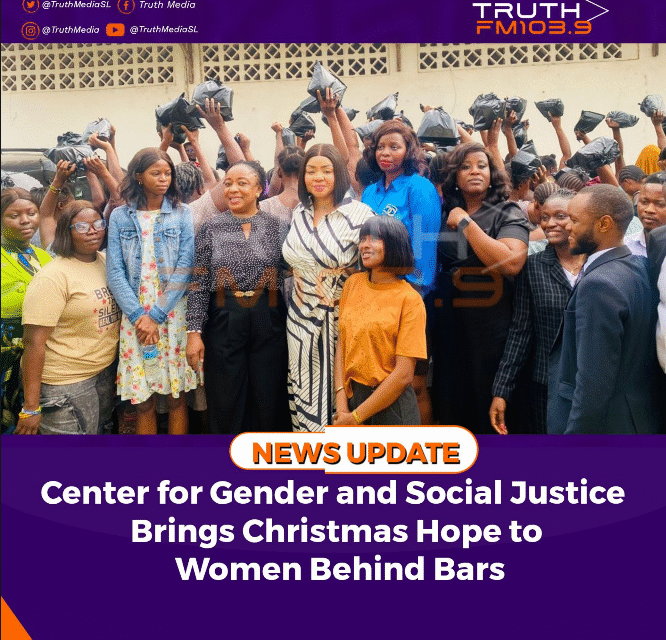
The Center for Gender and Social Justice (CGSJ), a leading organization advocating for gender equality and social justice in Sierra Leone, held a donation drive at the Female Correctional Center, bringing comfort, encouragement, and a powerful reminder of dignity to women whose freedoms are temporarily restrained.
The inmates had been informed ahead of the visit. Upon arrival, they were already seated, welcoming the visitors with bright smiles and visible excitement despite their circumstances. Dressed in uniforms of the same material but in different colours, the women young and old, some holding babies sat together in quiet unity.
The gathering opened with praise and worship. Their melodious voices, synchronized and full of emotion, filled the room as they sang, “No condition is permanent.” The words stirred deep emotions, drawing tears from both the inmates and the visitors. Christian and Muslim prayers followed, led by the inmates themselves, setting a tone of hope, faith, and togetherness.
Addressing the gathering, Janisa Francess Edwina Momodu, Executive Director of the Center for Gender and Social Justice, introduced the visiting team, noting that many were lawyers working through the organization to defend and promote the rights of women and girls.
She explained that CGSJ organizes a donation drive every December and said this year, the organization felt compelled to remember women whose freedoms are caged behind walls, fences, and cells. She expressed gratitude to the management of the Female Correctional Center for granting access to share Christmas love with the inmates, describing the visit as part of the true spirit of the season.
Momodu emphasized that even in confinement, the women remain protected by law. “There are laws that protect you,” she said, “and despite being locked up, you still have the right to human dignity and a decent life.” To reinforce that message, CGSJ donated hygiene items including sanitary pads, soap, toothbrushes, and toothpaste symbols of care meant to remind the inmates that they are loved and remembered.
Acknowledging the emotional burden many of the women carry, she spoke about feelings of separation, stigma, and isolation. “We are here to encourage you,” she said, “to remind you that your situation does not define who you are, and that your story does not end here.”
Edith Chaytoh of CGSJ also encouraged the inmates not to lose hope, reminding them that life continues beyond the prison walls. She urged them to remain prayerful and shared the biblical story of Moses, noting that hardship and confinement did not end his destiny. She appealed to the women to turn away from their former lives and embrace positive change upon their release.
Legal practitioner Ibrahim Khalil Koroma Esq., speaking on behalf of CGSJ, explained that the major difference between inmates and those outside the correctional center is freedom of movement. He stressed that inmates still retain fundamental rights, including the right to life, security, and dignity. He further noted that the law allows inmates to own property and enjoy property rights within marriage, underscoring that incarceration does not erase their legal identity.
Receiving the donation, Susan B. Joker, Deputy Director General of the Female Correctional Center, expressed appreciation to the Center for Gender and Social Justice for the kind gesture. She described the visit as the type of encouragement the inmates need, especially during the festive season, and emphasized that the institution does not judge the women but supports their rehabilitation and emotional well-being.
As the visit came to a close, it was evident that the gifts went beyond hygiene items. They carried hope, reassurance, and a reminder that even behind bars, these women are seen, valued, and not forgotten.
For a moment, Christmas crossed the fences and hope found its way home.