By Davida Spaine-Solomon
In a country where conversations around mental health and gender-based violence are still clouded by silence, the Center for Gender and Social Justice (CGSJ) is courageously rewriting the narrative. The organization an emerging force in Sierra Leone’s gender equality movement continues to empower women, advocate for justice, and dismantle barriers that hold women and girls back.
From providing legal aid and counselling to assisting women with marriage registrations, divorce documentation, inheritance rights, and national identification, CGSJ has positioned itself as a lifeline for women navigating both personal and systemic challenges. But beyond legal empowerment, the organization recognizes that true justice cannot exist without mental well-being.
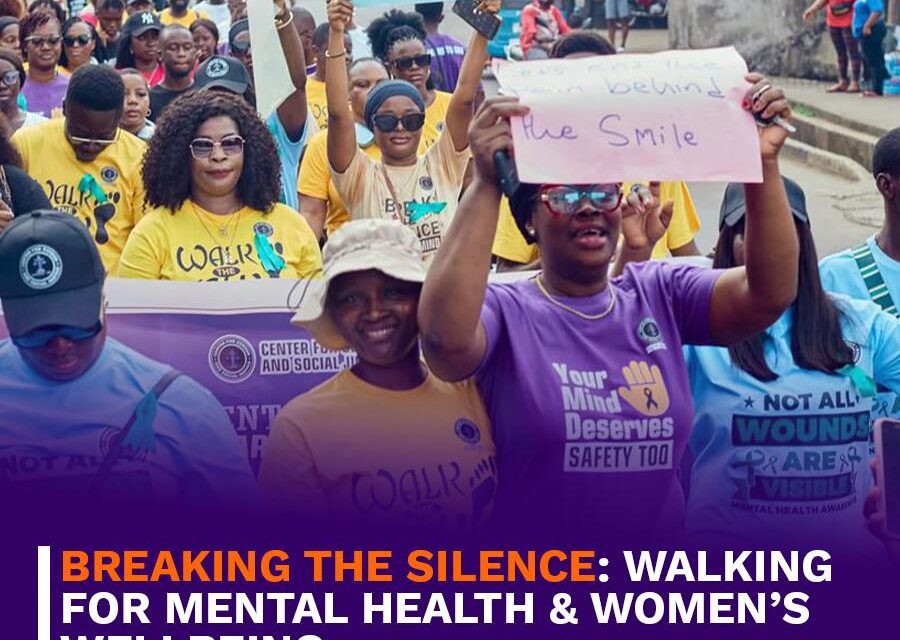
It is this holistic vision that inspired the Mental Health Awareness and Advocacy Walk held over the weekend under the theme: “Breaking the Silence: Promoting Mental Well-Being, Ending Gender-Based Violence and Drug Abuse.” The walk brought together activists, students, community members, health workers, and government officials united under one cause: to end the stigma around mental health, promote healing, and raise awareness of the invisible wounds caused by gender-based violence.
“There are different types of gender-based violence,” noted Janisa Francess Edwina Momodu, Executive Director of the Center for Gender and Social Justice. “Psychological violence comes in the form of words that make one feel less of a human being. Economic violence happens when women are deprived of financial independence when husbands stop their wives from working or earning an income. This kind of control traps women and makes them dependent, leaving them powerless to leave abusive situations.”
Francess said the walk aimed to raise awareness about these often-overlooked realities, and to remind communities that mental health issues are not a sign of weakness or madness, but part of everyday human experience. “Mental health is not something to be ashamed of,” she emphasized. “We must talk about it, support one another, and seek help. Healing begins when we break the silence.”
She further encouraged young women to seek financial independence as a form of self-protection, saying it empowers them to make safe choices and break free from dependence-driven abuse. “I’m happy with the turnout,” she added. “It shows that there’s hope that people are beginning to understand the importance of talking about mental health and breaking the stigma surrounding it.”
A Survivor’s Courage: Umu Speaks Out After a Decade of Silence
One of the most emotional moments of the event came when Umu, a survivor of rape, shared her story publicly for the first time. She revealed that she was sexually assaulted ten years ago by a politician, an experience that forced her to leave the country for fear of her safety.
With visible emotion, she told the crowd that returning home and participating in the walk was both painful and healing.
“For years, I lived in fear,” Umu said. “I left Sierra Leone because I felt unsafe and silenced. But today, standing here among strong women and allies, I feel seen. I feel heard. I’m proud to be part of this awareness campaign because it tells people like me that healing is possible, and that our stories matter.”
Her words drew tears and applause from participants, serving as a powerful reminder that breaking the silence can inspire courage in others who have endured similar pain but have remained quiet due to stigma and fear.
Also speaking at the event was Patricia Mattu K.O. Bah, Chief Nursing Officer at the Ministry of Health and Sanitation, who expressed gratitude to CGSJ for initiating the campaign. She described it as timely and necessary, especially given the rise in mental health-related challenges linked to social and gender pressures.
“According to the World Health Organization, health is not just the absence of disease it includes physical, mental, and social well-being,” she said. “Gender-based violence affects all these aspects of health. When a woman or even a man suffers violence, it takes a toll on the mind, and that can lead to depression, anxiety, and other mental health challenges.”
She emphasized that midwives and health workers play a vital role in addressing gender-based violence by educating communities, counselling victims, and creating safe spaces for open dialogue. “We continue to engage communities through health talks on prevention and reporting mechanisms,” she added. “It is everyone’s responsibility to look out for one another.”
The Honourable Minister of Gender and Children’s Affairs, Dr. Isata Mahoi, who served as the event’s keynote speaker, commended CGSJ for its consistent efforts in advancing gender justice and social inclusion. She noted that the campaign’s focus on mental health, gender-based violence, and drug abuse could not have come at a better time.
“We are seeing an alarming rise in substance abuse among our young people,” Dr. Mahoi stated. “This is not just a health concern it’s a social issue that affects mental stability, family structures, and community safety.”
Dr. Mahoi reaffirmed the Ministry’s commitment to partnering with organizations like CGSJ to strengthen awareness, prevention, and response efforts across the country. “The government remains dedicated to building an inclusive and equal society where every woman, man, and child can live free from fear, stigma, and violence,” she said. “Mental health must be prioritized in every conversation about national development.”
She concluded by urging communities to create safe and understanding environments where those struggling with mental health challenges can find help and compassion instead of judgment.
As the walk concluded, the streets of Freetown echoed with chants of “End the Silence!” and “Mental Health Is Health!” Participants carried banners painted in vibrant colors, symbolizing hope and resilience. The event served as a reminder that breaking the silence is the first step toward healing and that gender justice is inseparable from mental wellness.
Through initiatives like this, the Center for Gender and Social Justice continues to redefine what empowerment looks like: it is not just about rights on paper, but about restoring dignity, strength, and peace of mind to every woman and child in Sierra Leone.