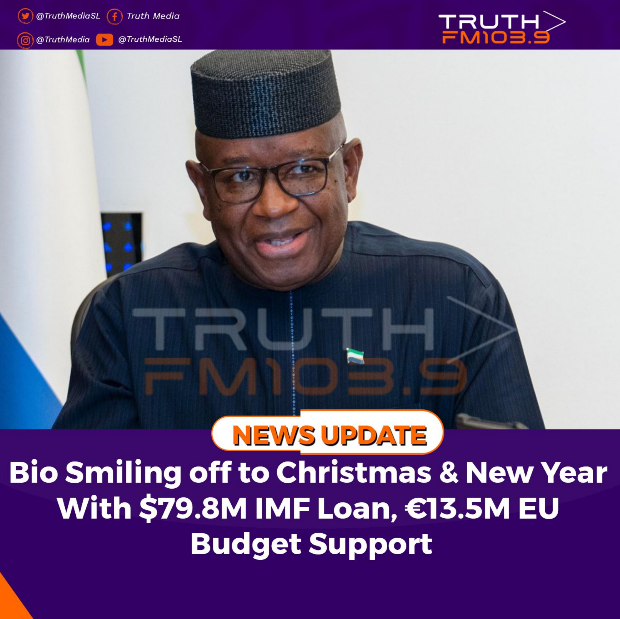
Freetown, 22nd December 2025 – Sierra Leone heads into the festive season with a significant boost to its economic outlook, following the approval of a US$79.8 million disbursement from the International Monetary Fund (IMF) and €13.5 million in budgetary support from the European Union (EU).
The IMF Executive Board this week completed the first and second reviews of Sierra Leone’s Extended Credit Facility (ECF), unlocking SDR 58.3 million (about US$79.8 million). This brings total disbursements under the program to SDR 93.3 million (about US$127.8 million). The ECF arrangement, approved in October 2024, is designed to maintain debt sustainability, reduce inflation, rebuild reserves, and strengthen governance.
Program implementation had faced setbacks in 2024 due to fiscal overruns and reserve depletion, but the IMF noted that corrective measures have since improved performance. Waivers were granted for non-observance of several performance criteria, including net credit to government and net international reserves.
At the conclusion of the Board’s discussion, IMF Deputy Managing Director and Acting Chair Bo Li praised Sierra Leone’s progress but urged continued discipline.
“The authorities have brought the ECF back on track following program slippages in 2024, and the economy is reacting favorably. Inflation declined to 4.4 percent by October 2025, the leone remains stable, growth is near potential, and the cost of borrowing has dropped to sustainable levels. However, debt remains at high risk of distress and reserves have fallen to 1.5 months of imports in September,” Mr. Li said.
He emphasized that fiscal tightening is “imperative,” calling for stronger tax compliance, improved debt management, and efforts to rebuild reserves. The IMF also welcomed Sierra Leone’s publication of the Governance and Corruption Diagnostic report, urging authorities to focus on its implementation.
Meanwhile, the European Union confirmed the disbursement of €13.5 million (approximately NLE 351 million) under its ongoing EU Budget Support – Nature Nourishes Programme. The EU Delegation in Freetown said the package reflects confidence in Sierra Leone’s commitment to reforms in public financial management, domestic resource mobilization, and macroeconomic stability.
“This support is a recognition of the progress Sierra Leone has made in strengthening fiscal discipline and driving reforms that benefit both people and nature,” the EU Delegation noted.
The programme will channel resources into priority areas, including expanding home-grown school feeding programmes, boosting rice production to reduce import dependence, decentralizing public services, and strengthening climate resilience.
“Food security is a fundamental necessity. This programme ensures that children are nourished, farmers are supported, and communities are resilient,” a government representative said.
Officials stressed that continued progress will depend on reforms to improve data quality in education and environmental measures to curb deforestation, particularly in the Western Area Peninsula National Park.
Sierra Leone’s economy is projected to grow in 2025, driven by mining and agriculture. Inflation has fallen to 4.4 percent, supported by tighter macroeconomic policies and a stable Leone, and is expected to remain in single digits over the medium term.
Yet challenges remain. Reserves are low at 1.5 months of imports, and debt is still considered at high risk of distress. Both the IMF and EU stressed that reforms must continue to avoid slippages and to ensure that external support translates into tangible improvements in fiscal stability, food security, and governance.
As Sierra Leone heads into Christmas and the New Year, the combined US$79.8 million IMF loan and €13.5 million EU support provide a timely lifeline but also a reminder that discipline, accountability, and reform will be the true tests in 2026.