Generals Opande and Agwai led the disarmament and demobilization of more than 46,000 former fighters. On January 18, 2002, fresh from Abuja, Nigeria, where the Revolutionary United Front (RUF) and the Government of Sierra Leone finally sealed a peace deal after nearly a decade of fighting, President Alhaji Ahmad Tejan Kabbah declared the war over at a ceremony at Lungi Garrison, stating in local parlance, “the war don done.” At that ceremony, over 3,000 weapons were burned, officially kickstarting the disarmament process.
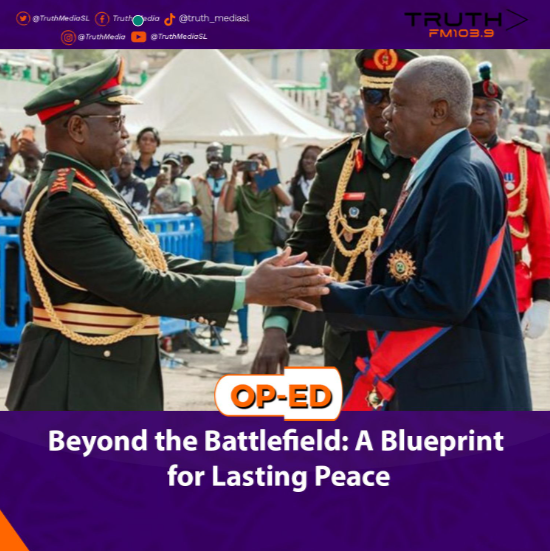
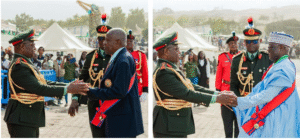
About 24 years later, in February 2026, both men returned to Sierra Leone to be bestowed with the country’s highest national honor, the Grand Commander of the Order of the Rokel. Opande’s citation read: “His leadership within UNAMSIL was instrumental in guiding peacekeeping operations, fostering trust among warring factions, and ensuring the protection of civilians.” Agwai was credited for “his innovative ‘hot spot’ strategy, which advanced DDR and strengthened peace operations.”
Apart from 1997, when the military seized power for 14 months before being removed by a UN-backed West African intervention force, Sierra Leone has experienced peaceful transitions of power from one democratically elected government to another since 1996. This stability was highlighted by the First Lady of Sierra Leone, Fatima Bio, who remarked: “Sierra Leone is sending its own troops, including our courageous women, to keep the peace in other parts of the world.”
At the official launch of the Elsie Initiative in Freetown in August last year, aimed at increasing women’s participation in UN peacekeeping, she recalled: “Not so long ago during our painful civil war, our beloved country was under the protection of a UN peacekeeping mission. Blue helmets from around the world patrolled our streets and guarded our hopes.”
From Freetown, both Opande and Agwai traveled to territories once controlled by the rebels.
Both were impressed with the current socioeconomic development of the areas they visited. Gen. Agwai praised successive administrations for improving roads connecting major towns to the capital. He noted that most towns were vibrant with young people: “I feel satisfied that the people have allowed the past to go away and are now looking forward to the future.”
His meeting with the former Donso leader was a personal victory, one he attributed to the sincerity and commitment of Sierra Leoneans, who were weary of war and ready to embrace peace. He recalled volunteering to travel to Kono, then under RUF control, to investigate complaints of ceasefire violations by the Donsos. At the time, many believed Kono would never see peaceful disarmament without renewed fighting.
There he met Gen. Issa Sesay, interim leader of the RUF: “It was that sincerity, that relationship, and commitment we built that led to the disarmament of over 5,000 combatants in Kono with ease,” he said. He credited local ownership as a cornerstone of Sierra Leone’s peace process, contrasting it with Darfur, where he also served. Agwai emphasized that in Sierra Leone, everyone was willing and ready to play their part, and that collective effort made peace possible.
For Gen. Agwai, UNAMSIL’s perseverance in persuading Sierra Leoneans to pursue negotiated peace, combined with strong international pressure and the overwhelming desire of citizens for stability, created the conditions for success. He emphasized the challenges overcome, including the use of child soldiers and the collapse of state institutions. Initially, the mission struggled with inadequate troop strength and logistical difficulties. However, reinforcement by well-trained contingents, particularly from Nigeria, and later the UK’s support helped stabilize the situation.
The mission also overcame mistrust by engaging directly with communities, supporting reconciliation, and ensuring that disarmament programs were credible and inclusive. Peacekeepers were willing to step back and allow local actors to drive the process. At the sub-regional level, Agwai highlighted the role of ECOWAS, recalling: “It was the Abuja Agreement that actually saw the disarmament of the fighters.”
From both former military leaders, local ownership and international support combined to make peace possible in Sierra Leone. They believe UNAMSIL demonstrated that peacekeeping in intra-state conflicts requires not just military presence but also political engagement, humanitarian support, and institution-building.
UNAMSIL became a reference point for later UN operations, particularly in Liberia and the Democratic Republic of Congo. In Liberia, the UN drew directly from Sierra Leone’s experience with disarmament, demobilization, and reintegration (DDR), which was comprehensive, inclusive of former child soldiers, and backed by credible security guarantees. Stronger coordination between peacekeepers and humanitarian agencies helped prevent relapses into conflict.
The experiences of Agwai and Opande, and Sierra Leone’s transition from war to sustained peace, underscore the necessity of addressing root causes, supporting governance reforms, and ensuring that peacekeepers are prepared for both security and civilian protection roles. These lessons continue to shape UN operations in other conflict zones today.
Osman Benk Sankoh is a Communications and Advocacy Officer for the UN Office in Sierra Leone.