By Temitope Egunjobi
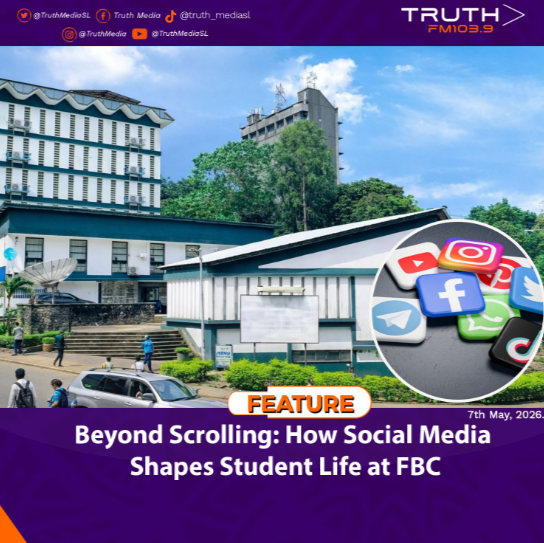
Freetown, May 7, 2026 — At Fourah Bay College (FBC), social media has evolved far beyond casual scrolling. It has become an essential part of student life, a tool for learning, work, and connection.
For 18-year-old Augusta Osmatu Bangura, a Mass Communication student, social media is both a companion and a classroom. “WhatsApp is the first app I open in the morning,” she said. “It’s because of class groups, where I check for any new information.”
Lecturers often send notes and updates through WhatsApp, making phones a constant presence in classrooms. The app also keeps Bangura connected with family members far away and serves as her main source of campus news.
But for Bangura, social media is more than communication, it’s a skill-building platform. She has taught herself to use CapCut and Canva by watching YouTube tutorials. Now, during her internship, she manages social media pages using those same tools. “Everything I put out requires me to use those apps,” she said. “I also edit for friends and for fun.”
Her reliance on connectivity is deep. “If data goes off for an hour, I get disturbed,” she admitted.
Across campus, students share similar stories. Festus Conteh, another FBC student, sees social media as “opportunities and connectivity with the rest of the world.” That connection has already shaped his career. He was hired by the Commonwealth as a researcher through LinkedIn, where the organization sought Gen Z perspectives.
“Information they needed to change lives,” he said. Though a passport delay kept him from travelling to England, the experience reinforced his belief in social media’s power.
Conteh’s digital routine starts with WhatsApp for personal messages, but Facebook is his most important platform where he runs pages for organizations and institutions. YouTube, he calls “a world university.”
“Even if you want to know what one plus one is, just type it out and it’ll pop up,” he joked. Through YouTube, he learned camera angles, editing, and filmmaking, producing a short movie for a school project where he served as both editor and camera operator using CapCut.
Conteh also earns income from YouTube content and client contracts. Losing access, he said, feels like “psychological torture.” He gets international news from X (formerly Twitter) and local updates from WhatsApp channels and Facebook. “If I had to choose, I would keep Facebook, it’s the most important,” he said.
For Mohamed Nagimu Deen, social media is the “operating system” of his life. “Seventy percent of what I do is connected to social media,” he said.
Deen uses online platforms for research, accessing articles and journals to prepare for classes and exams. “It helps me equip myself,” he said. He also relies on social media for global news and daily organization. “My schedule for the day is arranged through WhatsApp,” he explained. “Class updates and assignments from my boss come through the app.”
Through social media, Deen learned design and video editing skills he now uses to earn money creating flyers. “When I’m calm, I can create magnificent flyers and edit videos,” he said.
But when connectivity fails, the impact is immediate. “A few days ago, there was a power outage for 24 hours in my neighborhood, and my work was interrupted,” he recalled. Friends and family reached out when they noticed his absence, even his boss checked in after he missed tasks.
Across Fourah Bay College, a clear pattern emerges: social media has become infrastructure. Lecture notes arrive via WhatsApp, design jobs and research opportunities are found online, and digital skills translate directly into income.
When power cuts or data outages strike, they don’t just pause chats; they disconnect students from learning, livelihoods, and the world beyond campus.