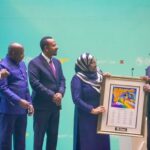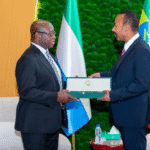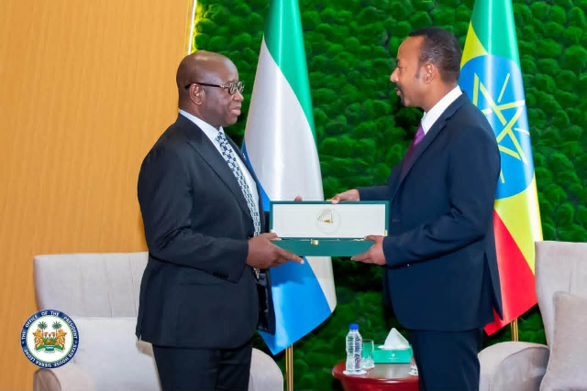
Addis Ababa, Ethiopia, 24th November, 2026 – President Julius Maada Bio has received the Africa Centres for Disease Control and Prevention (Africa CDC) Presidential Award and showcased Sierra Leone’s progress in strengthening healthcare delivery, reducing preventable maternal and child deaths, and improving childhood immunisation at the Fifth International Conference on Public Health in Africa (CPHIA 2026).
The award, presented in Addis Ababa, Ethiopia, recognizes Bio’s strong leadership and contributions to advancing Africa’s public health agenda.
Addressing Heads of State and Government, health ministers, public health experts and development partners, President Bio outlined the progress made under Sierra Leone’s national health interventions, particularly the Triple Zero Campaign, while reaffirming his government’s commitment to building a resilient, accountable and self-reliant health system.
President Bio recalled his commitment at the African Union Assembly in February this year to establish a national deadline for reducing preventable maternal deaths, take decisive action and publicly account for progress. He said his return to Addis Ababa provided an opportunity to report on the results of that commitment.
Providing an update on maternal and child health, President Bio disclosed that fewer women had died during pregnancy and childbirth in 15 of Sierra Leone’s 16 districts compared with the corresponding period last year. He, however, acknowledged the increase in maternal deaths in Freetown, noting that the situation required targeted attention and stronger coordination between referring districts and receiving hospitals.
He emphasised that the Government was determined to confront the challenges honestly, stressing that behind every statistic was a woman, a family and a life that mattered.
President Bio attributed the encouraging progress to the implementation of the 300-day national Triple Zero Campaign, launched in March 2026, with three central objectives: zero preventable maternal deaths, zero preventable child deaths and zero children left without routine vaccination.
He explained that the campaign had strengthened accountability through weekly reviews involving the Ministry of Health, hospitals and district health teams. These meetings examine reported maternal and child deaths, identify gaps in service delivery and assign corrective actions to responsible officials with clear deadlines.
President Bio also highlighted improvements in emergency obstetric care, including the training of health workers to manage complications during childbirth, more than doubling referrals through the National Emergency Medical Service and rebuilding and equipping blood banks in every regional hospital.
On childhood immunisation, he reported that the campaign had reached 10,764 children who had never received routine vaccines, surpassing its initial target of 9,006.
While commending midwives, nurses, doctors, community health workers and district health teams for their dedication, President Bio cautioned that the country was not declaring victory, noting that sustained efforts, effective monitoring and public accountability remained essential to protecting mothers and children.
Turning to the broader African health agenda, Bio called for greater commitment to health sovereignty, emphasising that African countries must take responsibility for their people’s health by setting national priorities, committing domestic resources, strengthening institutions and building sustainable partnerships.
He cited Sierra Leone’s National Health Compact, signed in December 2025, as a major framework for transforming the country’s health system over the next five years. The Compact requires an estimated investment of US$1.27 billion, with the Government intending to finance 30 per cent through domestic resources while working with development partners to mobilise the balance.
President Bio stressed that such investments must translate into tangible improvements in healthcare delivery, including operational ambulances, adequately stocked blood banks, trained health personnel and essential medicines available when needed.
He also used the international platform to reaffirm Sierra Leone’s commitment to regional health security and solidarity, recalling the devastating experience of the 2014 Ebola outbreak and the importance of African and international cooperation in responding to public health emergencies.
Against the backdrop of the Ebola outbreak in the Democratic Republic of the Congo, President Bio renewed Sierra Leone’s offer to make its experienced emergency response personnel and expertise available to countries requiring assistance through appropriate regional and international mechanisms.
“No African country should have to face a major public health emergency alone,” he declared.
As part of efforts to promote knowledge-sharing and practical cooperation, President Bio invited fellow African leaders to send their health teams to Freetown to observe the country’s weekly health-sector accountability reviews and learn from its experiences in monitoring performance, identifying service delivery gaps and following up on corrective actions.
He also extended an invitation to the Director-General of Africa CDC, Dr Jean Kaseya, and other conference participants to attend the launch of Sierra Leone’s National Health Compact in Freetown on 12th December 2026.
Concluding his address, President Bio reminded delegates that the success of public health policies must ultimately be measured by their impact on ordinary people, particularly women in labour who depend on timely emergency assistance and quality healthcare.
He emphasised that health sovereignty must go beyond policy declarations and translate into functioning health facilities, responsive emergency services and reliable access to life-saving interventions.
For President Bio, the ultimate measure of progress is simple: ensuring that mothers and children survive childbirth and return safely to their families.
He urged African leaders to leave the conference with practical lessons, stronger partnerships and a shared determination to translate commitments into action, investments into reliable services and progress into lives saved.
The Fifth International Conference on Public Health in Africa, organised by Africa CDC, runs from 23rd to 27th November 2026 in Addis Ababa, Ethiopia, bringing together African leaders, policymakers, scientists, health professionals and development partners to advance the continent’s public health priorities.
Credit: State House Media and Communications Unit