Freetown, 23rd November 2026- The National Communications Authority (NatCA) has reasserted its commitment to strengthening international cooperation, enhancing cybersecurity preparedness, building regulatory capacity, and advancing telecommunications monitoring systems as key priorities for a secure, resilient and sustainable digital transformation agenda.
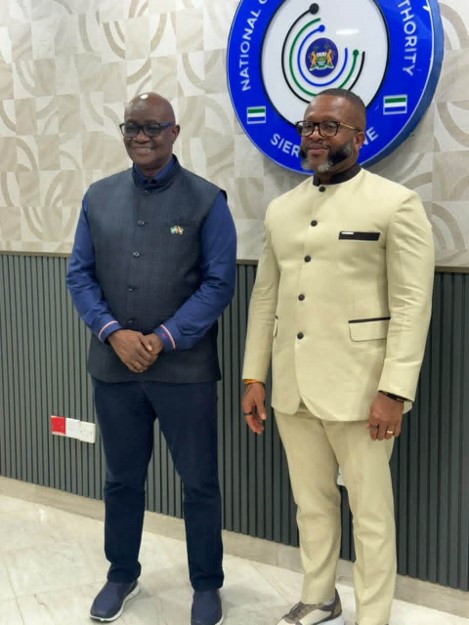
The engagement took place during a courtesy visit by Ambassador Rashid Sesay of the United Arab Emirates (UAE), who is also accredited to India, Nepal, Bangladesh and Bhutan, to the National Communications Authority. The visit provided an opportunity for discussions on emerging developments in digital technology, cybersecurity, international technical cooperation, regulatory oversight and telecommunications data management.
Welcoming the Ambassador to NatCA’s Headquarters, the Director General, Amara Brewah, highlighted the growing security implications of rapid digitalisation and increasing global network connectivity. He raised concerns about unauthorised network activities, including approximately 12 interconnected nodes reportedly linked to foreign actors, and the potential risks these activities pose to countries that could inadvertently become transit points for malicious cyber operations. He emphasised that while digital transformation presents significant opportunities for economic growth and national development, it also exposes countries to cyberattacks, external interference and potential threats to critical national infrastructure.
The Director General further drew attention to emerging technologies, including electric vehicles, whose digitally controlled systems could potentially be manipulated remotely if adequate cybersecurity safeguards are not implemented. He stressed the importance of ensuring that technological advancement is accompanied by robust cybersecurity policies, infrastructure protection measures and effective regulatory oversight to safeguard national interests.
In his remarks, Amb. Rashid Sesay highlighted the widening gap between the rapid pace of technological advancement and the capacity of regulatory institutions to respond effectively to emerging challenges. He underscored the importance of strengthening institutional capacity through international cooperation, knowledge exchange and strategic partnerships.
The Ambassador also emphasised the need to consolidate proposals for international technical assistance, particularly in areas relating to surveillance technology and telecommunications monitoring systems. Such cooperation, he noted, could provide opportunities for institutions to acquire relevant technical expertise, improve operational capabilities and respond more effectively to the evolving demands of the digital environment.
The engagement also touched on diplomatic and consular challenges involving foreign nationals whose passports may be retained during ongoing investigations, making their return to their respective countries difficult. The engagement recognised the importance of diplomatic dialogue, institutional coordination and clearly established procedures in addressing such situations.
Meanwhile, NatCA’s Director of Engineering and Infrastructure, Sahr Momodu Sewah, delivered a technical presentation on telecommunications data usage, destination analysis and voice traffic monitoring. His presentation identified TikTok as the leading data-consuming platform, followed by Facebook, YouTube and WhatsApp. Guinea was also identified as a major destination for telecommunications traffic, reflecting cross-border connectivity patterns and the geographical proximity between the two countries.
The presentation further examined billable and non-billable voice traffic, including incoming and outgoing call minutes. Africell’s reported incoming and outgoing voice rates were both recorded at 1.99. Additional discussions focused on international telecoms traffic routed through designated operator trunks, including Orange, alongside the need to strengthen trunk logging, improve data management and examine data transformation processes within QCell.
The engagement provided a platform for exchanging perspectives on the opportunities and challenges associated with digital transformation, particularly the need to ensure that technological innovation is supported by adequate security frameworks, institutional preparedness and effective regulatory systems. It also highlighted prospects for strengthening international partnerships and exploring technical assistance that could enhance NatCA’s monitoring capabilities and contribute to a more secure telecommunications ecosystem.
As part of the visit, Amb. Sesay embarked on a courtesy tour of relevant facilities at NatCA, where he was afforded the opportunity to observe the Authority’s technological and operational infrastructure. The tour provided practical insight into NatCA’s regulatory systems, technical capabilities and ongoing efforts to strengthen telecommunications monitoring and oversight.
A visit that emphasises the importance of diplomatic engagement and international collaboration in addressing emerging digital challenges, while reinforcing NatCA’s role in promoting a secure, reliable and inclusive telecommunications sector in Sierra Leone.