By Saidu Kargbo
Freetown, 10th November, 2026 – The Commonwealth War Graves Commission, in partnership with Freetown City Council and the Ministry of Tourism and Cultural Affairs, has unveiled a new memorial honouring more than 900 Sierra Leoneans who served in the Career Corps during the First World War, restoring the identities of those whose contributions and sacrifices remained largely unrecognized for more than a century. The unveiling took place at the Ministry of Finance, on George Stereet, Freetown, on 7th November, 2026.
It brought together government officials, representatives of the Commonwealth War Graves Commission, military veterans, religious leaders and members of the public.
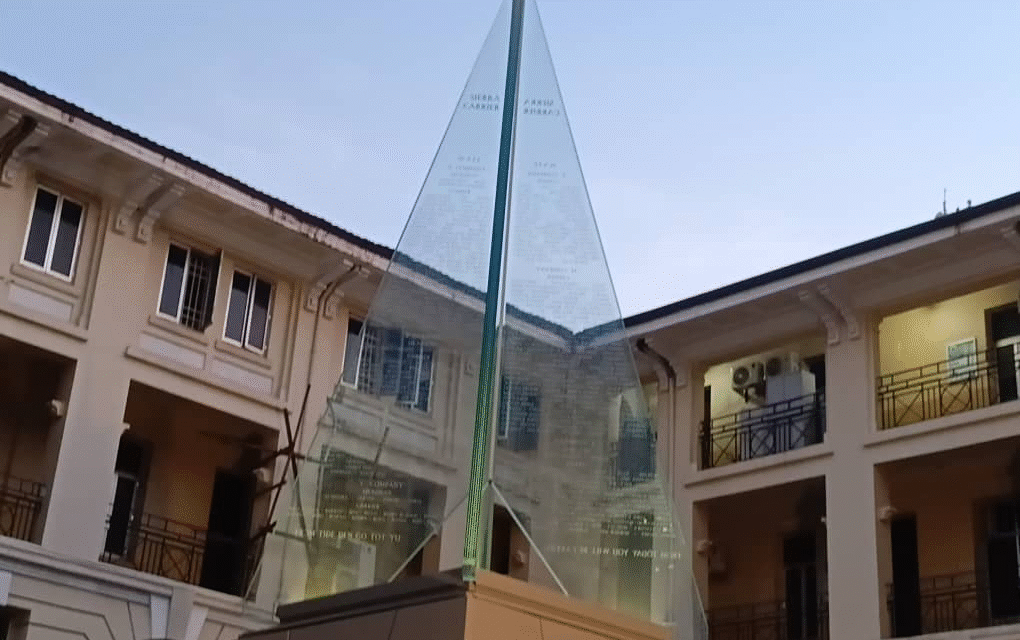
The memorial, developed through collaboration between the Commonwealth War Graves Commission and Sierra Leonean authorities, seeks to correct historical omissions by permanently inscribing the names of the fallen Carrier Corps members on a new glass structure erected alongside the original 1931 stone memorial.
Speaking during the ceremony, Vice Admiral Peter Hudson CB CBE, vice chairman of the Commonwealth War Graves Commission, said that the memorial was intended to move beyond commemorating anonymous casualties and recognise the individual identities of those who served. “The memorial is intended to move beyond anonymous sacrifice and recognise every individual by name, restoring dignity to the men whose contributions were overlooked for more than a century,” he said. He emphasized that the project was guided by the principle that every life matters. “Every life matters and should be commemorated equally, regardless of race, gender or religion,” he stated.
During the First World War, members of the Sierra Leone Carrier Corps played a critical role in transporting food, ammunition, equipment and medical supplies across challenging African terrain. Despite their indispensable contribution to the war effort, their individual identities were largely excluded from historical commemoration, leaving their sacrifices anonymous for generations.
The memorial, designed by Nigerian architect Tosin Oshinowo and her team, combines the original stone monument with a contemporary glass installation, thereby creating a symbolic dialogue between historical continuity and modern rediscovery.
The glass structure is designed to capture changing natural light during the day, while an illuminated beam projects into the Freetown sky at night and on significant commemorative occasions.
While addressing the audience, Mayor of Freetown, Her Worship Yvonne Aki-Sawyerr, described the unveiling as a significant moment in restoring the names and stories of more than 900 Sierra Leoneans whose contributions to the First World War had been missing from the country’s historical records.
She commended the Commonwealth War Graves Commission, particularly Vice Admiral Hudson, for supporting the research and commemorative initiative, noting that the project represented an important correction of historical omissions.
According to her, “The memorial restores the names and individual stories of more than 900 Sierra Leoneans whose contributions to the First World War were missing from our historical records.”
She further explained that the memorial was designed to extend beyond remembering those who served during the First World War. She said it is a symbolic space for commemorating Sierra Leoneans who lost their lives during the country’s civil war and the Ebola outbreak.
The Mayor highlighted the significance of 7th November, which marked 11 years since the end of the Ebola outbreak in Sierra Leone, saying the memorial should provide an inclusive space where the sacrifices and experiences of different generations could be remembered.
She also drew attention to the symbolic use of glass, explaining that its reflective nature allows visitors to see themselves alongside the names inscribed on the memorial. This, she noted, reinforces the message that every life matters, including those whose names may never have been formally recorded. “The beam of light represents Sierra Leoneans whose names remain unwritten, but whose stories must never be forgotten,” he said.
The Minister of Tourism, Mrs. Nabeela F. Tunis, described the unveiling as an important step towards restoring historical recognition to Sierra Leoneans whose services and sacrifices had not received the acknowledgement they deserve. She said the memorial demonstrated the importance of preserving the country’s history and strengthening national identity through culture and creativity.
She noted that although “A memorial does not resolve every question of reparations, but it represents a meaningful step towards correcting historical omissions through public recognition.”
The Minister called for stronger collaboration between international heritage institutions, government agencies, private-sector professionals and local communities to promote heritage education and historical preservation.
She further linked the initiative to preparations for 2027, identified in her remarks as the International Year of Sustainable and Resilient Tourism, emphasising the potential of heritage preservation to promote tourism, create employment opportunities, stimulate economic growth and strengthen national dignity.
The memorial, through the inscription of individual names, seeks to ensure that the sacrifices of the Carrier Corps are no longer remembered merely as part of a forgotten chapter of global conflict, but as the individual stories of Sierra Leoneans who helped shape history.
The ceremony concluded with an act of remembrance and wreath laying to honour the dignity of fallen heroes.