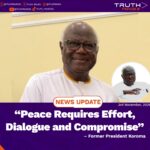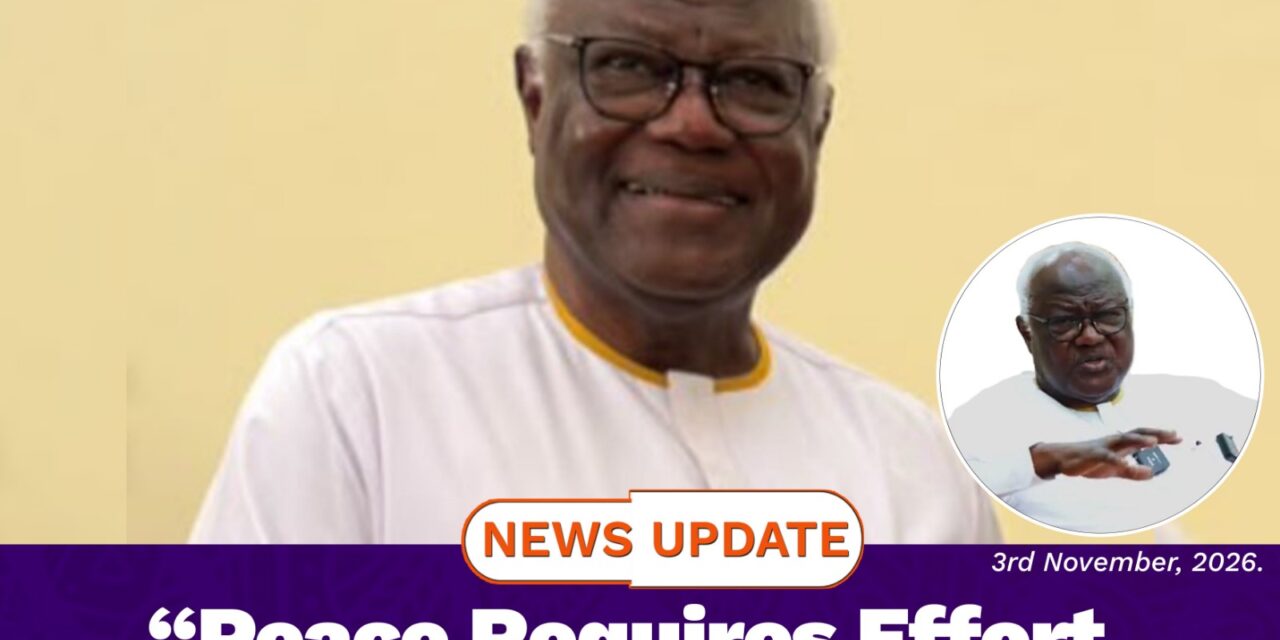
Freetown, 3rd November 2026 – Former President Ernest Bai Koroma says Sierra Leone’s peace will only hold if citizens, political parties and state institutions commit to dialogue, compromise and a willingness to accommodate one another. “Peace requires effort, dialogue, compromise and a willingness to accommodate one another,” Koroma said.
He was speaking at a press conference at his Femi Turner residence in Freetown,
where he reflected on his return to the country, his participation in the recent National Peace Conference, and the road to the next electoral cycle.
Describing his return as “good and refreshing,” the former president said Sierra Leone cannot afford to return to the starting point after every election, after investing decades in building peace since the end of the civil war in 2002.
“We do not have another country, and we do not have a choice. We must grab every opportunity to move forward,” he said.
Koroma said the central challenge is building strong, independent institutions that deliver justice and services fairly, regardless of political connections.
“Our institutions have to be independent. We must give them independence. Sometimes it’s not only politicians that have issues, but it’s also ordinary citizens who would call someone who knows someone who knows the chief executive and put a call through,” he said.
“We will modify it but even in advanced countries there are these tendencies. But we have to work on it as citizens. When we challenge issues, it must be for objective reasons, not because we benefit from it.”
He urged that the right people be given jobs and allowed to take decisions based on professionalism.
“Let us ensure the right people handle the jobs and allow them to take decisions based on their professionalism. We are all tired, so let’s come out as a new Sierra Leone that gives equal opportunities for everybody,” he said.
Koroma argued that when governments change, political appointments may change, but technical professionals should be retained to ensure continuity.
Answering questions about his own political future and a national agenda, the former president said the country must first get the foundation of peace and national cohesion right.
“We should build trust among ourselves. We may not be able to achieve the ideal, but let’s move from where we are now. Ar kin born Koinadugu en go do business na Bonthe because ar get the best offer. We need to get the foundation right first. Let’s not start from the beginning every election,” he said.
“I have done it all; it’s time to give back. I am no longer aspiring to be chairman or president, and so I look at things differently,” he added.
Beyond the peace conference, Koroma made a strong case for constructive criticism as a tool for nation-building.
“When you are criticised you will do your job better. But criticism has to be constructive,” he said.
He said criticism builds both individuals and institutions, and urged journalists, civil society and ordinary citizens to interrogate issues, hold institutions accountable and demand good governance for objective reasons, not personal gain.
He stressed that credible elections that reflect the will of the people are essential, and expressed hope that in future elections, winners would celebrate and losers would peacefully accept results – an atmosphere he said would boost democratic credentials and attract investment.
Turning to preparations for the next polls, Koroma flagged unresolved issues around the census and electoral process, warning that no group should be disadvantaged.
He reaffirmed his willingness to support President Julius Maada Bio in advancing peace, but cautioned that the actions of leaders could either strengthen or undermine progress.
“This requires all of us, irrespective of political parties. It is about Sierra Leone,” he said, adding that time is running out to fix outstanding issues before political tensions intensify.
On regional cooperation, he noted that ECOWAS is facing challenges with three member states currently outside the community, but said Sierra Leone’s stability would contribute to wider West African development.
Koroma concluded with a call for collective action: to use the current peacebuilding window to ensure the next electoral cycle strengthens, rather than threatens, the country’s democratic gains.