By Davida Spaine-Solomon
Freetown, 26th October 2026- Sierra Leone’s Feed Salone programme has mobilised more than US$1 billion in investment commitments, expanded agricultural financing facilities, reduced imports of key food commodities and supported 22,708 jobs, according to the Ministry of Agriculture and Food Security’s Year Three Report covering October 2025 to September 2026.
The report portrays an agricultural sector increasingly shaped by finance, infrastructure development and value-chain investments, with government shifting attention from production support towards large-scale processing, market integration and private-sector participation.
Agriculture’s share of the national budget has risen from two per cent to more than eight per cent, while 43 per cent of pledged Feed Salone financing has now been programmed into projects and interventions under implementation, up from 27 per cent a year earlier.
The report identifies agricultural finance, mechanisation, irrigation, local processing and commercial investment as key drivers behind the programme’s third-year performance.
Agricultural financing takes centre stage- A major feature of the year was the expansion of financing mechanisms designed to increase capital access for farmers, agribusinesses and agro-processors. At the centre of those efforts is a NLe230 million Agricultural Credit Facility established in partnership with the Bank of Sierra Leone, offering loans to agricultural businesses at a concessionary interest rate of 10 per cent.
The financing ecosystem was further strengthened through US$5.8 million in matching grants awarded to 62 enterprises, more than 40 per cent of which are women-owned. Additional financing initiatives channelled approximately US$500,000 to over 1,320 women and 3,750 young people in Bonthe and Kambia through Islamic finance products implemented in collaboration with Apex Bank.
The Empowering West African Women Small and Medium Enterprises Programme disbursed US$450,000 to 100 women-led businesses, while the ENABLE Youth Programme provided grants, mentorship and financial-access support to 61 young entrepreneurs, including 27 women.
The report notes that government has completed the Agricultural Finance Policy and validated the National Agricultural Insurance Policy, both viewed as critical frameworks for de-risking agricultural investment and expanding financial inclusion in the sector.
The Agricultural Finance Policy was awaiting Cabinet approval at the end of the reporting period, while authorities were also advancing plans for a National Agricultural Development Bank intended to provide long-term sector financing.
Rice production delivers import-substitution gains- Feed Salone’s flagship import-substitution strategy continued to centre on rice, where increased domestic production translated into measurable foreign exchange savings.
According to the report, the share of rice consumed locally that is produced within Sierra Leone increased from 62 per cent in 2022 to 73 per cent in 2025. Over the same period, the country’s rice import bill declined from US$177 million to approximately US$154 million, representing savings of more than US$23 million.
The 2025 National Crop Production Survey estimated that 661,016 hectares were cultivated under rice production, generating 1.44 million metric tonnes of paddy rice. Average yields improved from 2.13 metric tonnes per hectare to 2.37 metric tonnes per hectare.
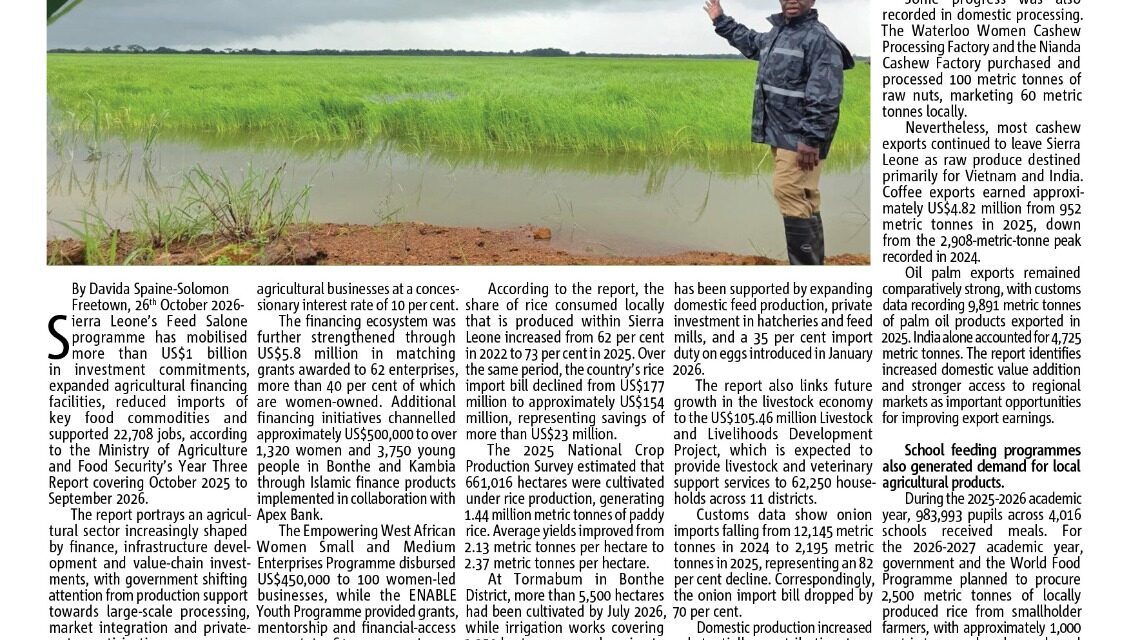
At Tormabum in Bonthe District, more than 5,500 hectares had been cultivated by July 2026, while irrigation works covering 3,250 hectares were advancing to enable multiple production cycles annually.
The Tormabum and Gbondapi agro-industrial centres, expected to be completed in early 2027, are each designed to process approximately eight metric tonnes of rice per hour and together provide storage for about 10,000 metric tonnes.
Poultry and onions cut import expenditure-The report highlights poultry and onion production as emerging success stories in reducing dependence on imported food products. Egg imports fell from approximately 56 million in 2024 to 31 million in 2025, a reduction exceeding 40 per cent.
A 2026 sector survey covering 222 farms in 12 districts reported 619,134 laying birds producing an estimated 475,000 eggs per day or roughly 173 million eggs annually.
The poultry industry’s growth has been supported by expanding domestic feed production, private investment in hatcheries and feed mills, and a 35 per cent import duty on eggs introduced in January 2026.
The report also links future growth in the livestock economy to the US$105.46 million Livestock and Livelihoods Development Project, which is expected to provide livestock and veterinary support services to 62,250 households across 11 districts.
Customs data show onion imports falling from 12,145 metric tonnes in 2024 to 2,195 metric tonnes in 2025, representing an 82 per cent decline. Correspondingly, the onion import bill dropped by 70 per cent.
Domestic production increased substantially, contributing to a reduction in market prices from more than NLe50 per kilogramme in early 2024 to approximately NLe34 per kilogramme. Pee Cee Agriculture, identified as the country’s largest commercial onion producer, expanded cultivation at Loko Masama from 85 hectares to 140 hectares between production cycles.
Export performance presents mixed picture- While Feed Salone seeks to reduce food imports, a parallel objective is to increase export earnings from major agricultural commodities. The report records mixed results across cocoa, coffee, cashew and oil palm value chains.
Cocoa exports more than doubled from 13,343 metric tonnes in 2019 to 20,272 metric tonnes in 2024. However, customs declarations for 2025 recorded 10,984 metric tonnes of cocoa bean exports valued at approximately US$79 million.
The National Crop Production Survey estimated total cocoa production at 19,642 metric tonnes, suggesting that recorded exports represented around 56 per cent of production.
Some progress was also recorded in domestic processing. The Waterloo Women Cashew Processing Factory and the Nianda Cashew Factory purchased and processed 100 metric tonnes of raw nuts, marketing 60 metric tonnes locally.
Nevertheless, most cashew exports continued to leave Sierra Leone as raw produce destined primarily for Vietnam and India. Coffee exports earned approximately US$4.82 million from 952 metric tonnes in 2025, down from the 2,908-metric-tonne peak recorded in 2024.
Oil palm exports remained comparatively strong, with customs data recording 9,891 metric tonnes of palm oil products exported in 2025. India alone accounted for 4,725 metric tonnes. The report identifies increased domestic value addition and stronger access to regional markets as important opportunities for improving export earnings.
School feeding programmes also generated demand for local agricultural products.
During the 2025-2026 academic year, 983,993 pupils across 4,016 schools received meals. For the 2026-2027 academic year, government and the World Food Programme planned to procure 2,500 metric tonnes of locally produced rice from smallholder farmers, with approximately 1,000 metric tonnes already purchased by August 2026.
The procurement programme is expected to supply meals to more than 270,000 pupils in 1,204 schools.
Employment and enterprise development- The report records 22,708 jobs created or supported across agricultural value chains, comprising 10,062 direct jobs and 12,646 indirect jobs. Women accounted for 48 per cent of all jobs while young people represented 71 per cent.
Enterprise development initiatives supplemented these employment gains. More than 3,000 beneficiaries, including 2,400 women, participated in modern vegetable production schemes, while producer groups adopting village savings and loan arrangements shared NLe304,866 following completion of their first savings cycle.
Infrastructure investments support growth- The report identifies infrastructure investment as a major pillar of agricultural transformation. Forty new tractors were deployed to priority production areas ahead of the 2026 planting season, while rehabilitation continued on more than 400 kilometres of feeder roads aimed at reducing transport costs and improving market access.
The 183-metre Manowa Bridge in Kailahun District was commissioned, improving connectivity between agricultural communities and commercial centres. Further investments were directed towards strengthening agricultural productivity through local seed systems and technology platforms.
For a third consecutive season, all rice seed requirements under government programmes were supplied domestically without imports. The National Seed Policy was approved, a seed-testing laboratory began operations at Mile 91, and a national digital soil mapping platform built from more than 10,000 soil samples was completed.
Looking ahead, Feed Salone’s fourth year will focus on converting investment commitments into operational assets and expanding financial access across agricultural value chains.
Priority projects include the US$105 million Livestock and Livelihoods Development Project, the US$75 million Sierra Leone Rice Special Agro-Industrial Processing Zone in Kambia and Port Loko, and the planned US$40 million Cassava Industrialisation Programme scheduled to begin in 2027.
Government also intends to advance the establishment and capitalisation of a National Agricultural Development Bank while mobilising resources for a national agricultural insurance programme.
The report concludes that the next phase of Feed Salone will be judged primarily on its ability to deepen domestic production, accelerate agro-processing, reduce the food import bill, increase export earnings and expand income-generating opportunities across rural economies.