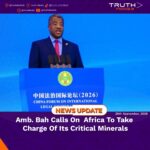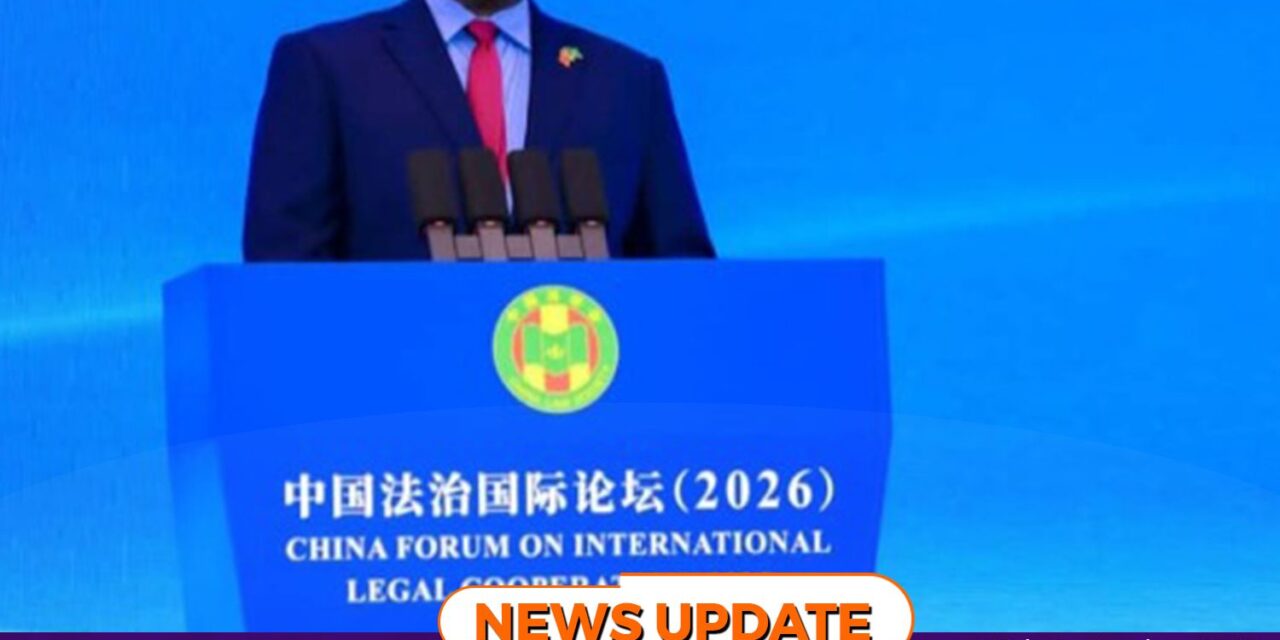
Freetown, 28th September 2026- Speaking at this year’s China Forum on International Legal Cooperation in Shenzhen, China, Amb. Alhaji Sarjoh Bah, the African Union’s top diplomat in China, boldly called for the reform of global governance, including the global architecture of resource value chains.
Amb. Bah stressed the imperative for processing and value addition of our minerals on the continent through the establishment of regional value chains. He called for amplifying Africa’s voice in determining how critical minerals are priced, how value chains are structured, and technology transfer to boost Africa’s transformative agenda.
Amb. Bah noted that Africa holds substantial deposits of lithium, cobalt, nickel, rare earth elements and platinum-group metals essential to the global energy transition, but warned that the continent risks remaining locked into its historic role as a raw-material exporter while higher-value processing happens elsewhere. “Can the world pursue a green transition while reproducing the economic structure in which Africa supplies raw materials, and others capture most of the value?” he asked. He categorically stated that “Africa’s position is unequivocally clear: that pattern must change.”
The AU envoy proposed the establishment of a China–Africa Critical Minerals Legal Cooperation Framework to, among others, include:
– A model legal and contractual provisions for critical-minerals investment that balance investor certainty with African development objectives;
– A cooperation agreement on responsible mining and supply-chain governance;
– A cooperation agreement on technology transfer, geological mapping and skills development;
– A standing mechanism for preventing and resolving China–Africa commercial disputes, including negotiation, mediation, conciliation and arbitration; and
– Greater cooperation between African and Chinese legal practitioners, regulators, judges, arbitrators and academic institutions.
The Ambassador framed the proposal within the AU’s existing continental instruments, including the African Continental Free Trade Area (AfCFTA), the Africa Mining Vision and the 2025 Africa Green Minerals Strategy, all of which call for Africa to move beyond raw-material exports toward value addition and industrialization. He also pointed to the African Minerals Development Centre as a critical locomotive for connecting extraction with processing, regional supply chains under AfCFTA, and research and development.
On the question of legal cooperation, Amb. Bah stressed that the goal was not legal uniformity between the Chinese and African systems, but “complementarity, mutual respect and legal interoperability” through a rules-based partnership combining China’s capital and technology with Africa’s resources and markets, under terms that serve the continent’s industrialization goals.